Index
1 Concept
2 Research Hypothesis
3 Narmer Palette
a) Medium and Context
b) Composition, Scale, Attributes
c) Audience and Message
4 Stele of Hammurabi
a) Medium and Context
b) Composition, Scale, Attributes
c) Audience and Message
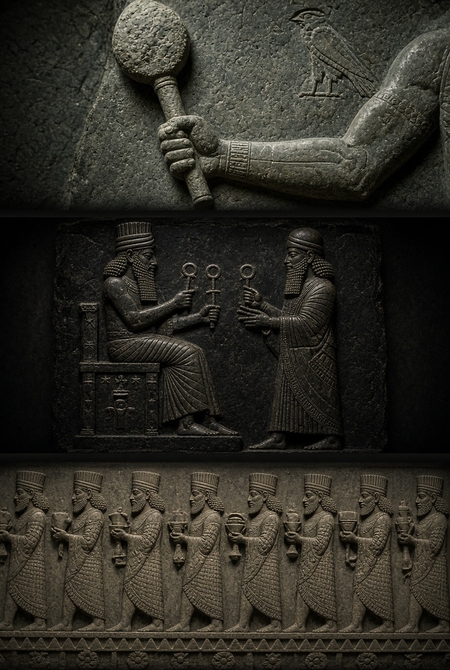
5 Apadana
a) Medium and Context
b) Composition, Scale, Attributes
c) Audience and Message
6 Comparative Analysis
7 Conclusions
Concept
This study examines how the image of power is shaped across different types of visual media in three ancient cultures: Egypt, Babylon, and Achaemenid Persia.
The focus is on three artifacts:
— The Narmer Palette (c. 3100 BCE),
— The Code of Hammurabi Stele (c. 1750 BCE),
— the reliefs of the Apadana at Persepolis (late 6th — early 5th century BCE).
These objects were selected because each represents a fundamentally different medium:
• a ritual object (palette),
• a monumental stele bearing legal text,
• an architectural space featuring reliefs.
The theoretical framework of this research is based on the communication model (sender—medium—code—recipient—message). Through this lens, I examine how the physical properties of the medium and the presumed viewer influence the manner in which power manifests itself. The principle of rubrication progresses from the object to the monument and finally to the space. Within each chapter, a consistent analytical order is maintained: medium and location $\rightarrow$ composition and scale $\rightarrow$ attributes and signs $\rightarrow$ recipient and message. The work utilizes three categories of sources: 1 Royal inscriptions (how power spoke about itself). 2 Academic research (verification of observations and contested interpretations). 3 Museum catalogs (dating, material, site of discovery). The author’s original observations and interpretations are specifically noted.
HYPOTHESIS
The hypothesis of this research is as follows:
The image of power in antiquity was neither universal nor constant. It changed depending on the type of visual medium and the intended audience.
On a ritual object (the Narmer Palette), power is depicted as a direct physical act of suppression.
On a monumental stele (Hammurabi), power appears as a law received from a god and directed toward the subjects.
In architectural space (the Apadana), power is expressed through an ordered rhythm and hierarchy that the viewer perceives with their body as they ascend the stairs.
Thus, it is not «what» is depicted, but «on what» and «for whom» that determines the nature of the representation of power.
Chapter 1. Narmer’s Palette
Chapter Entry
Namerer’s Palette is the most compact object in the study, yet its composition is built upon extremely powerful actions. The king raises his weapon, the enemy is subdued, the falcon is incorporated into the scene, and two crowns link the ruler’s image to Upper and Lower Egypt.
Here, power is not explained through lengthy text; it is perceived through an instantly recognizable situation—the ruler is in a position where the blow has not yet landed, but its result already seems inevitable.
Monument Passport
The Narmer Palette dates to approximately 3100 BCE and belongs to the period of the formation of the unified Egyptian state. The material is a dense gray-green stone (grauwacke or slate). The object was found in Hierakonpolis (ancient Nekhen). The original is housed in the Egyptian Museum in Cairo.
It is important to note separately: the existing copies in European museums (including EA35714 at the British Museum) are plaster casts. They are useful for studying details but are not the original. This distinction must be kept in mind so as not to confuse the state of preservation with the surface character.
ЕА35714 — гипсовый слепок.
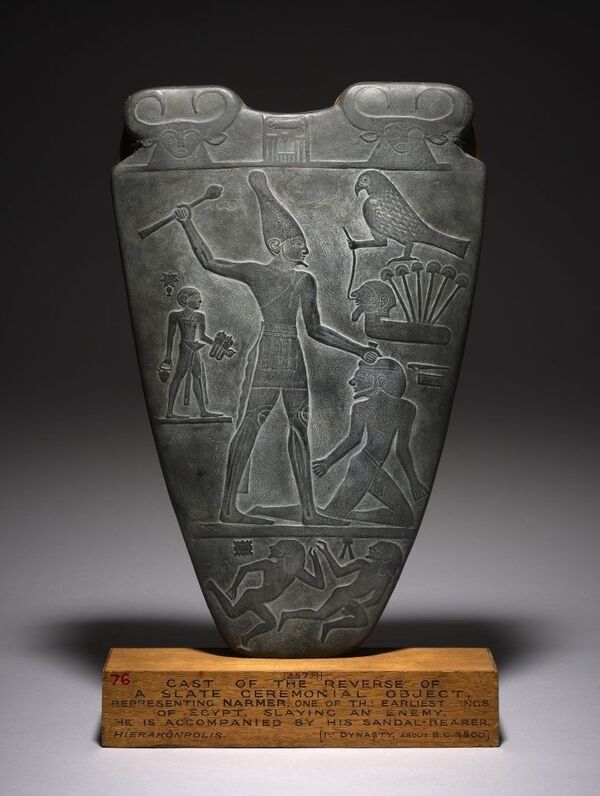
Оригинал
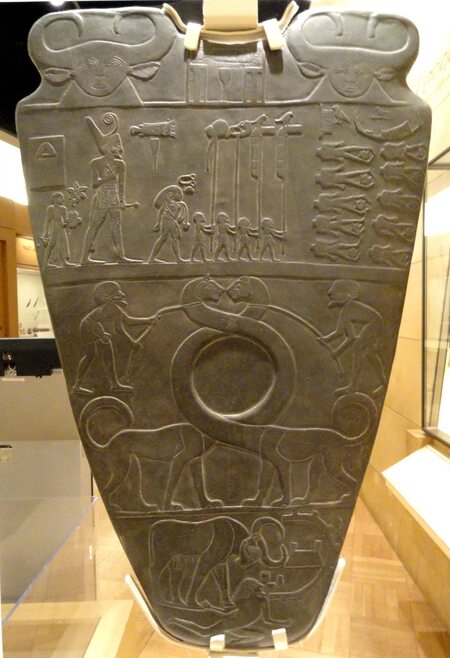
Two Faces—Two Crowns
The palette is built upon the juxtaposition of two sides. On one, Narmer wears the White Crown of Upper Egypt, and on the other, the Red Crown of Lower Egypt.
This is not a mere repetition of a single image. The change in headwear shifts the political context of the scene. The Pharaoh is presented not as an abstract warrior, but as a ruler tied to a specific territory and royal system.
Traditionally, the two crowns symbolize the unification of Upper and Lower Egypt. However, the palette is not a neutral historical account; it creates an ideological portrait of the ruler of both territories.
Moment Before the Strike
On one side, Narmer is depicted just a moment before striking. His mace is raised, and his other hand grips the prisoner by the hair. The moment of impact itself is not shown.
It is this pause that creates the tension in the scene. The movement of his arm is directed upward yet is simultaneously poised to descend. The king’s body forms a vertical line, which is contrasted by the curved figure of the enemy.
For me, what is important is that power is expressed not only by the result of victory but also by control over the moment of action. The king dictates the timing—he is capable of delivering the blow, but the image freezes him just before the action is complete.
Scale as Hierarchy
The Narmar is significantly larger than the prisoner. This is not an attempt to convey perspective or the real distance between the figures. Size functions as a hierarchical code: the important figure receives more visual space.
The exaggerated scale makes the king’s body stable and almost monumental, even within a small object. The prisoner, conversely, is reduced to an object of action. His pose and size prevent him from being perceived as an equal participant in the scene.
I read this difference as a statement about unequal status. What we see is not a duel between two comparable forces, but a visual formula of pre-assigned roles.
The Falcon and the Papyrus
In front of Narmer is a falcon, traditionally associated with Horus. Below is an image featuring papyrus plants and a captive.
In traditional readings, the papyrus is linked to Lower Egypt, and the scene is interpreted as a victory over that territory. In this context, the composition can be seen as the union of royal triumph with divine sanction and political unification.
However, this is one interpretative model, not a completely proven decipherment of every element. Therefore, I do not assert that the image literally depicts a specific historical event.
Compositionally, the falcon establishes a second level of action: the human ruler strikes down the enemy, while the divine figure connects the scene to a broader order.
King and God: Two Figures in One Formula
On the palette, the god is not depicted in a figure equal to the king. The falcon occupies a small space, but its position before Narmer’s face connects human action with divine presence.
The chorus does not replace the king nor does it perform actions on his behalf. Narmer remains the one holding the weapon and controlling the captive’s body. The divine sign confirms the meaning of the event but does not negate the king’s initiative.
Thus, power is formulated as a combination of personal strength and superhuman sanction. The ruler acts independently, yet his victory is presented as consonant with a broader order.
Palette Recipient
This palette does not resemble a public wall designed for a large crowd. Its format suggests close examination and a specific context of use. Since the precise original context cannot be fully recovered, any sacred or ritualistic purpose should be noted as a probable, rather than absolutely proven, characteristic.
This changes the nature of the message. What we have here is not mass propaganda, where one needs to quickly explain the structure of the state to all viewers. The palette functions as a concentrated sign for those capable of recognizing imperial attributes and the ritual context.
I surmise that its intended audience might have been participants or observers of sacred royal communication. This is precisely why the image may be complex and symbolically rich.
My Perspective
Narmer’s Palette conveys less of a narrative and more of a visual formula. There is almost no incidental movement within it: the mace is raised, the captive is restrained, the falcon is integrated into the scene, and the bull pushes through an obstacle. Every line is subservient to a single idea—that power exists as the capacity to bring disrupted order into submission.
Yet, I see more than aggression in the palette. The king is not depicted as a man merely consumed by fury. His body is stable, the action is ritualized, and his gestures are embedded within the structure of registers and symbols. Violence ceases to be a private emotion and becomes a legitimate procedure.
This is precisely where the power of the object as a medium lies: a small artifact transforms a royal act into a sign that can be repeatedly viewed and deciphered.
Chapter Summary
On the Narmer Palette, power is conveyed through:• hierarchical differences in figure size; • raised weaponry; • the subjugated position of the captive; • two crowns; • the connection between the king and the Chorus; • the image of the bull; • the sequence of registers.
These signs do not function in isolation. Their meaning emerges from the combination of a small ritual object, a relief composition, and an audience familiar with royal symbolism.
Power here is not something to be read as text, but something to be recognized in the formula of action.
Transition: If the palette portrays power through a concentrated gesture, the stele translates it into a system of sanction, script, and legal order.
Chapter 2. The Code of Hammurabi
Chapter Introduction
From Action to Mandate
The Code of Hammurabi shifts the scale and mode of communication. To the viewer is not a small object, but a towering stone monument covered in cuneiform script. At the top, the king stands before a god, and below is a lengthy text.
Here, power is not merely acting—it is explaining its origins and documenting the order that must be applied in earthly life.
Monument Passport
Title: Stele of Hammurabi. Date: Mid-18th century BCE, circa 1750 BCE. Culture: Babylon, First Dynasty of Babylon. Material: Basalt. Dimensions: 225 × 79 × 47 cm. Discovery Location: Susa. Current Repository: Louvre, Paris.
It is important to distinguish between Hammurabi’s reign dates and the date the stele was created. 1792–1750 BCE is the period of Hammurabi’s rule, not the precise date of the monument’s fabrication.
The surface features both bas-relief and cuneiform text. The Louvre refers to the monument as the «Code of Hammurabi, ” but in analytical writing, it is more accurate not to impose the modern conception of a unified legal code onto it. We are viewing a royal stele featuring a prologue, legal provisions, and an epilogue.
Upper Scene
At the top of the stela, two figures are depicted: seated Shamash and Hammurabi standing before him.
The composition is built on the difference in body positions. The god sits, the king stands. One character occupies a throne, while the other is positioned before it. This distinction sets not a mundane scene of a meeting, but an hierarchical situation that can be interpreted as the king receiving authority.
Shamash is turned toward the king, and Hammurabi is oriented toward him. An axis of transmission emerges between them: the god as the source, the king as the recipient.
Shamas and Hammurabi: Scale
Shamas is perceived as a more significant figure not only because of his scale. The head of the seated god and the head of the standing king are at roughly the same level, but the proportions of Shamas, his throne, and his stable posture emphasize his superhuman status.
In this instance, size works in conjunction with the pose, attributes, and the figure’s placement within the composition. The god occupies a grounded, organizing position; the king stands before him and is incorporated into his space.
Thus, the composition illustrates the source of power without needing to deify Hammurabi. He is set apart from the people, but he is not equal to Shamas.