
Ilya didn’t like starting with descriptions. But this time, he started exactly that way.
He typed a few lines about the Alley of Gratitude: about the young apple trees in Donskoy, about the path from the amphitheater, about the people in honor of whom the trees were planted here.
He reread it.
Everything seemed correct. But for some reason, the text wouldn’t move forward. The words flowed obediently one after the other, the phrases sounded smooth, but behind them—emptiness.

Ilya pushed his laptop aside and reached for his notebook. Before every new text, he would fill several pages: fragments of conversations, details, questions, sometimes a single word that could change his day. The current one was nearly finished, so Ilya reached for a spare on the top shelf. A worn notebook shifted along with it. He recognized it immediately—a scuffed blue cover, a dog-eared corner, pages yellowed by time.
On the first page, in his own large and earnest handwriting, it was written: «The Last Fisherman at the Old Pier.»
His first essay.
Ilya brushed his palm over the cover and suddenly felt the scent of an old edition return—paper, coffee, and the dust from books that hadn’t been touched from the top shelves for years. He opened the notebook.Almost none of his original text remained. A red pen had gone over it ruthlessly. Lines were crossed out, paragraphs rearranged, and arrows trailed between sentences. A bold question mark stood next to a particularly lengthy phrase.
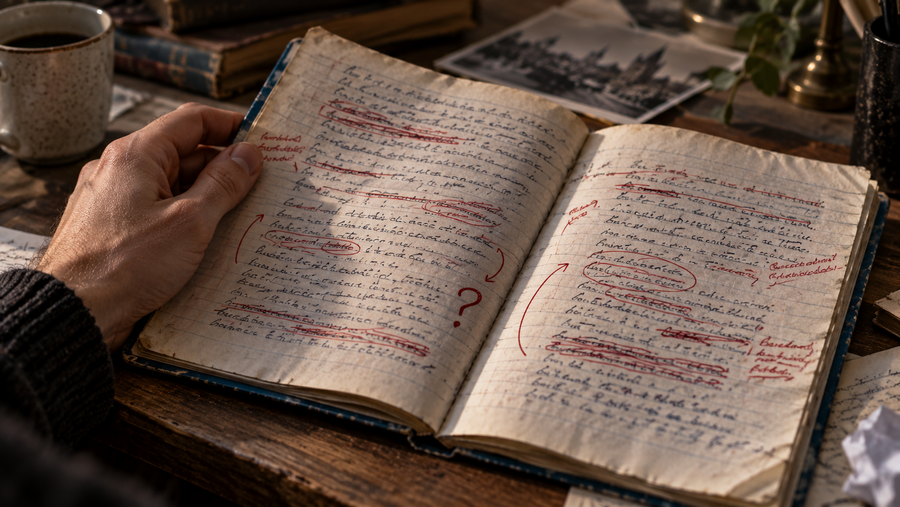
In the margins: “What’s the point?» Just below that: “You’re writing about the harbor. Where is the protagonist himself?» Ilya couldn’t help but smile. At one point, these words used to make everything boil inside him.
He was just a little over twenty then, and every completed piece of writing felt perfect to him. He could spend days and nights hunched over an essay, rearranging words, crossing out lines only to put them back, and then bring the notebook to the editor with almost childish confidence: now he will read it, take off his glasses, and say—it’s good. But the editor could extinguish that youthful enthusiasm with a single silence.He never rushed a response or showered praise. He had decades in the profession behind him, hundreds of other people’s manuscripts, and that rare habit of an experienced person noticing falsehood where the young author had already fallen in love with their own phrasing.He read slowly. Sometimes he would go back a few lines. He would bite the earpiece of his glasses. He would look at the text critically and remain silent.And Ilya sat across from him, and in that silence, he already understood: it hadn’t worked. Finally, the editor closed the notebook and slid it back across the desk.
Well… I don’t regret crossing it out just yet.
Ilya sharply snatched the notebook, slipped to a distant table, and sat down before the pages marred by red ink. For the first few minutes, he was angry, but then he would take a pen and begin rewriting. Sometimes, from the initial sketch, only the hero’s name and one successful phrase remained by night.
But Ilya couldn’t quit; his obstinacy compelled him to see things through to the end.
This continued for a long time. Over the years, the red markings decreased. Only much later did Ilya understand a simple truth: they weren’t nitpicking him. They were teaching him.
They taught him not to settle for the first good phrase. Not to hide a lack of thought behind precise epithets. And most importantly—not to write about a place until you understood whose human life was hidden behind it.
He took his notebook and went outside. The wind rustled the thin branches of the apple trees. A coolness emanated from the ground. The voices near the amphitheater grew quieter, and in that silence, the trees suddenly stopped seeming like just part of the landscape.
Someone stood behind each one. A teacher, a friend, parents. A person who offered timely support. Or, conversely, someone who didn’t praise and forced him to work on himself. Ilya ran his finger along the old red marks in his notebook. It was strange: once, he had wanted as few of these markings as possible. Now, he was grateful for every single one.
For the crossed-out paragraphs. For the notes in the margins. For the texts he had to start over. For the person who didn’t let him become accustomed to writing smoothly—and about nothing.
Returning, Ilya opened his laptop. He deleted the first paragraph. He started over.