After the night wind, the sea always returned something. That was what Nina Petrovna used to say. Sometimes it was a sun-bleached piece of driftwood, a smooth stone, or a shell with a delicate pink rim. Other times, the sea threw up on the shore things that no one noticed: a rusty tin can, a faded float, a piece of green glass.
— The ocean doesn’t just throw things out for no reason — Grandma once said. Varya laughed then: — But why are the plastic bottles there? — So people can see what slobs they are.
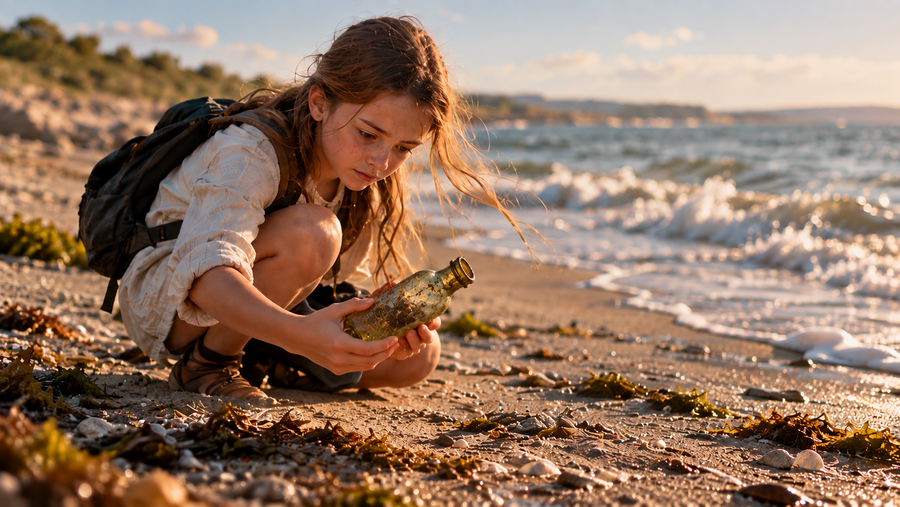
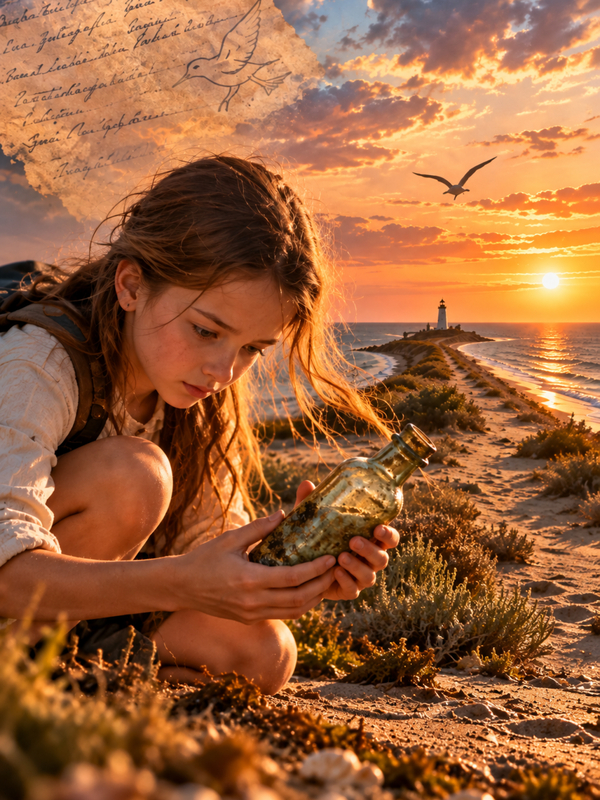
The morning after the storm, Varya headed to the water before anyone else. The sand felt cool beneath her bare feet. The night had left long streaks of seaweed, tiny shells, and clumps of grass on it. The sea hadn’t calmed down yet: gray-green waves heaved heavily over one another, breaking on the shore with a muffled rush. Varya walked along the water’s edge, turning over anything that seemed even slightly unusual with the toe of her sandal. Suddenly, her attention was drawn to a thick green glass that had nearly lost its transparency. The bottle lay on the sand so peacefully, as if someone had just carefully placed it there. There was something inside. Varya picked up the find. Through the cloudy glass, a dark strip of rolled-up paper was visible. While Varya was engrossed in examining the bottle, her friend Misha ran up to her. He looked at the bottle, then at Varya.
— No. — What do you mean, «no»? — I know you. You’re going to say there’s a treasure map. — I haven’t said anything yet. — You look like you’re hiding something. Varya shook the bottle. The paper thumped dully against the glass. — See? — I see an old bottle. And I see a person who is about to smash it and get cut. — Then take it. — Me? Why me? — Because you’re careful. — That’s called smart.
It took a long time to extract the cylinder. It crumbled, leaving a damp, brownish residue on the fingers. The paper inside swelled and adhered to itself. They sat directly on the sand, turning their backs to shield the find from the wind, and slowly unrolled the sheet.
Almost half the words had been eaten away by water. The ink had bled into bluish shadows. Some lines were gone entirely. But several could be deciphered.
My little bird…
Beyond that—a blurred stain.
…if the sea eventually brings you these words…
A few more lines have vanished.
…where the arrow of Kolaksky ends…
And almost at the very edge:
…he left what he promised.
Below, a short phrase remains:
To the end of the arrow and back.
In the corner, someone had drawn a bird. Just four quick lines: wings, beak, tail. «So?» Varya lifted her eyes. «What do you mean, ‘so’?» «Treasure.» «What treasure?» «What he left, what he promised.» Normal people don’t write about old notes like that. «Normal people don’t go looking for buried treasure based on a damp piece of paper without a date, signature, or map.» Varya carefully folded the letter.
Nina Petrovna was drying apricots on the kitchen table when Varya placed a bottle in front of her. «Look what the sea brought in.» Grandmother wiped her hands on her apron and picked up the letter. She read it quickly at first, then slowed down. Her finger paused for just a moment on the words «my little bird.» «Well?» Varya asked. Nina Petrovna carefully placed the letter on the table. «Well done for finding it.» «And that’s it?» «What’s supposed to be there?» «Someone hid something there.» «People hide all sorts of things.» «And it’s written about Kolaksey’s arrow.» Grandmother gathered the apricots into a bowl. «Varenka, don’t take anything too seriously. You never know what the sea might wash up.» Her voice was ordinary—warm. The way it was, like how she reminded you to wear a hat or not drink cold water after the heat. «Do you know what Kolaksey’s arrow is?» «I’ve heard of it once.» «And ‘my little bird’?» Nina Petrovna looked at her over her glasses. «Varya, go help me with the apricots instead.»
By evening, the letter rested in Varya’s room between the pages of a thick book, while Varya herself sat on the floor in front of the bottom drawer of an old wardrobe. She was rummaging through the wardrobe, filled with old family albums, hoping to find clues or the braid. In the photographs, people stood in front of houses, sat at long tables, and squinted in the sun on the beach. Varya flipped through them quickly. Then, a small photograph fell out of one album. A young woman stood by the water with her back to the camera. The wind billowed her light-colored dress. Beside her was a thin boy in a white shirt. Far behind them, a lighthouse rose. Varya took the picture out and read the text on the back: «To my little bird.» Below that: «To the end of the arrow and back.» And next to it—the same bird as in the letter.
«No, ” Misha said the next day. They stood by his gate. „I haven’t suggested anything yet.“ „You showed up at seven in the morning with a backpack.“ Varya handed over a photograph. Misha read the inscription, and his expression changed. „Where did you get this?“ „In an album.“ „Does Grandma know?“ Varya adjusted the strap of her backpack. — Misha. „Then she doesn’t know.“ „We just need to figure out where this was taken.“ „‘We’?“ „Okay. Me.“ He returned the photograph. „Then good luck.“ Varya turned around. — Where are you going?» «To the cape.» «Alone?» «You’re coming with me.» She walked a few steps. The gate slammed shut behind her. «I’m not going with you!» Misha shouted. Varya turned back. He followed, zipping up his backpack. — I’ll make sure you don’t drown, get lost, or decide to undermine the lighthouse.» «I wasn’t planning on undermining the lighthouse at all.» Misha was silent for a moment. «Now I’m scared.»
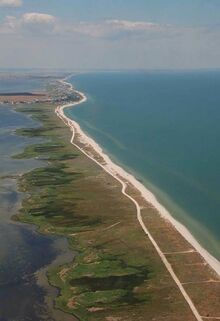
On the map, Berdyansk Spit appeared simple. The long sandy line stretched nearly twenty kilometers into the Sea of Azov, separating Berdyansk Bay from the open water. The wind pulled at clothing, slipped under collars, and blew sand onto bare legs. On the Near Spit, the city’s proximity could still be felt, but further out, the space became more expansive. — Do you even know who Kolaksay is? — Misha asked. — I do. — Of course. — Targitai’s younger son. — And Targitai? According to Scythian lore, Kolaksay received golden objects that fell from the sky, along with royal power. Beyond that, things began that were not in the ancient legends and that people might have invented later. It was as if one day Kolaksay stood facing Meotida—what the ancients called the Sea of Azov—drew his bow and shot an arrow far beyond the horizon. The arrow fell into the water. Year after year, the sea brought sand and shells to it. The wind carried them, the waves moved them along the shore, and earth gradually grew around the shaft. Thus, the long spit was formed. Misha listened and looked down at his feet. — So we’re walking on the arrow? — It turns out we are. After several kilometers, the sun climbed higher. The wind did not bring coolness—only hot, salty air. From the east, the open sea was loud and heavy. From the western side, the water of Berdyansk Bay seemed calmer. Sometimes, if you stopped and closed your eyes, you could distinguish two different sounds: one crashed against the shore short and sharply, while the other rustled softly on the sand. Varya suddenly thought that the map didn’t convey this. And she walked on.
They searched for the spot from the old photograph for over an hour. — It’s here, — Varya held the photo up. — You already said that. — The lighthouse should be to the left. — Or maybe everything has changed over the years? She angrily set the picture down. The old photograph demanded the impossible from the modern shore: to remain unchanged. — That’s it, — Misha brightened. — The spot is gone. We solved it. Home. Varya didn’t answer. She wasn’t looking at the photograph, but at the horizon. Then she took a few steps to the side. — Misha, come here. From this vantage point, the lighthouse was situated almost exactly as it was in the old picture. Only the tree that was near the people in the photo was gone. In its place, the edge of some concrete foundation stuck out of the sand. The concrete was almost entirely buried. Someone had scratched several lines onto the gray surface. Varya cleared them with her palm and saw the image of a small bird. — Well, there it is, — Varya said quietly.
They found the niche on the backside. A small, square indentation beneath the rim of the old base. Varya turned on her phone’s flashlight to examine it. But it was empty. Just sand, a few dry blades of grass, and a spiderweb. Varya ran her hand inside—nothing. «So, home now?» Misha asked. «Wait.» Varya began sifting the sand around the base. She dug with her hands; sand got under her nails. «Varya, enough.» «Just a little more.» She straightened up abruptly. «Do you always want to 'go home'?» Misha stood up too. «Because someone has to think sometimes! 'And someone has to be brave sometimes.'» He fell silent. He looked at her as if he wanted to respond. He pulled out his phone. «We have forty minutes.» «Until what?» «Until the time we were supposed to be back.» «We didn’t tell anyone the exact time.» «I told Mom.» Varya stared at him. «What are you saying?» «I’m not an idiot.» The wind suddenly blew harder. Misha looked at the sky. A heavy, bluish-gray band was gathering over the water. «Five minutes,» he said. «And that’s it.» «Ten.» «Five.» Varya dropped to her knees again. She was almost giving up. Misha was already standing with his backpack on his shoulders. «That’s it! 'Now.' 'Varya! '» A gust of wind hit her back. Sand rose in a thin cloud, brushing her cheek. Varya squeezed her eyes shut. When she opened them, something glinted near the concrete edge. Barely visible. She ran her hand over it and felt something. A few seconds later, the corner of a small box appeared in the sand. They pulled the box out together. The dark metal was covered in rust spots. The lid was stuck tight. Varya tried to pry it open with her fingernail. The first heavy drop of rain fell onto the sand. Then the second.
Misha lifted his head. — Varya. — Just a second. He grabbed her hand. — Look. The sea had already lost its former color. The wind drove short, dark streaks across the water. A few more droplets struck Varya’s shoulders. Thunder rolled somewhere far out over the ocean. — Let’s go home, — Misha said. Varya shoved the box deep into her backpack. — Let’s run.
Nina Petrovna waited by the gate. Varya saw her immediately. Gray hair had escaped from under her headscarf. Her hands were clasped across her chest. Not anger—it was worse. «Where have you been?» «Out for a walk.» The grandmother looked at the wet clothes, the sand up to her knees, and the scraped palms. «I see.» Misha said: — Goodbye, Nina Petrovna. And vanished with such speed, as if the entire trip had been practiced only for this moment. Varya walked into the room. She wanted only one thing: to close the door, take out the box, and finally open it. She set her backpack on a chair. Nina Petrovna followed in, holding a towel. — Dry your hair. Varya sharply pulled the backpack toward her, and the box tumbled out. Bouncing on the floor, it rolled toward the grandmother’s feet.
Nina Petrovna slowly sat on the edge of the bed and looked at her granddaughter. — Where did you get this from? Varya said quietly: — At the end of the arrow. Nina Petrovna closed her eyes. — There was a bird there, — Varya added. — Show me. The lid didn’t open right away. Varya pried it open with a knife until the metal finally creaked. Inside was a bundle of fabric. Nina Petrovna unfolded it herself. A small metal bird fell out of the fabric. It was very simple. Two outstretched wings, a thin tail. Grandmother took it between two fingers. She examined it for a long time and smiled. — He really made it, — she said. — Who? Nina Petrovna held the bird in her palm. — Sasha. The name sounded so quiet, as if it had been waiting for many years behind a closed door. — Is that you in the photo? — So, you found the album too. — I just… — Of course, just.
There was no anger in her voice. Nina Petrovna unrolled the second bundle. A sheet of paper lay inside. Grandmother read it and placed the letter on her lap. — He called me «Little Bird.» Rain drummed against the windowsill outside; water streamed down the glass in long, transparent tracks. — Why? — I always wanted to fly away somewhere. — And he always promised to catch up to me.
Sasha lived nearby. They were very young. They went to the sea, argued, and made plans. And they came up with a promise for themselves: to walk the Berdyansk Spit to the very end someday—to Kolaksay’s arrow. Sasha loved this story. He told it as if an ancient Kolaksay had shot an arrow toward Meotida, and the sea had begun to gather land around it. Nina laughed. Once, Sasha promised to give her a small bird, but then he left. Not for long, as it seemed at the time. First came letters, but then they became rarer. Eventually, his family left. Sasha vanished.
— What happened to him? — I don’t know. — And you didn’t look for him? Grandmother looked out the window. — I did. — Then we can find him, ” Varya said. «If we find out his last name, look…» — Not today, ” grandmother said. Varya nodded. For the first time in two days, she didn’t object.
The sea was calm again in the morning. As if no storm had taken place. Nina Petrovna placed a cup of milk in front of Varya. — Did you get very far yesterday? — Almost to the lighthouse. — Almost doesn’t count. Varya raised her head. Nina Petrovna was already getting up from the table. A small metal bird hung around her neck. — Get ready. — Where? — You’ll show me where you found it. They left together, the three of them. Misha grumbled for a long time that he had had enough adventures yesterday until next summer, but he arrived earlier than scheduled. The cape stretched ahead like a bright strip. Shells crunched underfoot again. The wind was milder than yesterday’s and smelled of warm water and salt. Varya looked ahead. Yesterday, it had been a map. Today, the same land felt like a long road that the sea had preserved between two waters. Nina Petrovna stopped by the lighthouse. She took the bird out from under her collar. The wind swayed it on the delicate chain.
— Here? — she asked. — A little further. Varya several times wanted to ask about Sasha. Is it even possible to find someone after so many years? When they reached the old concrete base, Nina Petrovna brushed her palm over the scratched bird. — Grandma. — M? — Are we still going to look for Sasha? Nina Petrovna was silent for a long time. The wind tousled her hair. The lighthouse stood behind them, and ahead, the water merged with the sky so completely that it was impossible to tell where one ended and the other began. — Maybe, Little Bird, — she said. They turned toward the house. Nina Petrovna addressed the kids. — For your efforts, I baked an apricot pie for you. Let’s go have tea. The kids joyfully jumped up from their spots and raced home, dreaming of trying the pie as soon as possible.Behind them remained the old hiding spot and the shore where the sea once washed up a green bottle. It had wandered in the sea for an unknown amount of time. And one day, it finally delivered a letter—to the place where it could finally be read.