Concept
About the project: Lume is a smart tabletop speaker that unites sound, light, and a living plant. The name derives from the Latin word «lumen"—light. The object extends the concept of smartwatches into the home environment: it synchronizes with clocks and phones, displays time, weather, and schedules, and helps users organize their day with tranquility.
Problem: Most smart speakers look like gadgets and clash with the comfort of home. Lume is conceived as an interior design object: warm light, textured concrete, and moss instead of a plastic cylinder with a speaker grille.
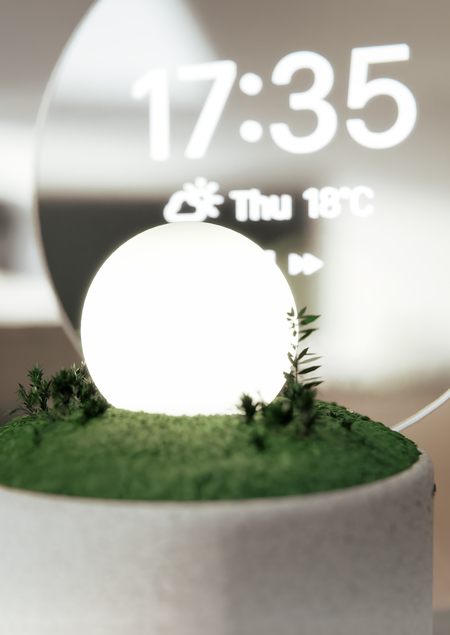
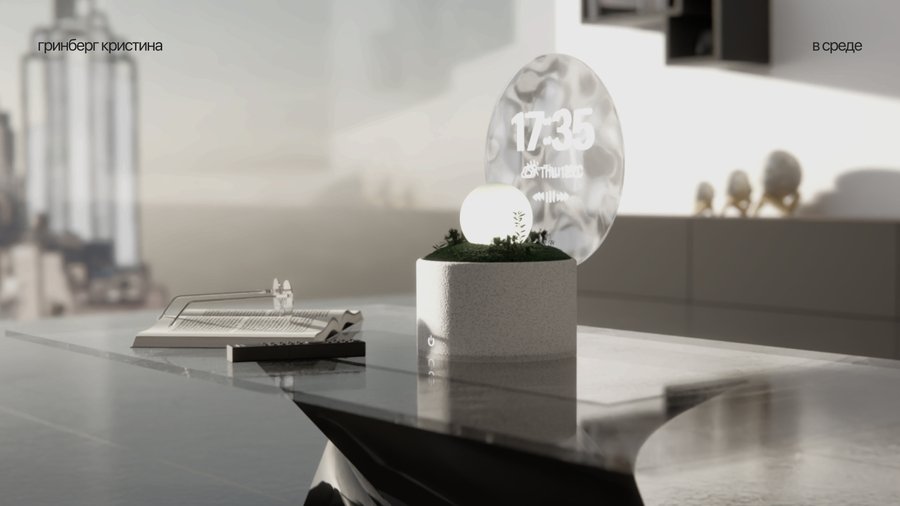
The image is composed of a concrete base with moss, a glowing spherical light fixture, and a translucent glass disk screen. The speakers are hidden, the interface is minimalist, and the light is soft, devoid of a blue spectrum. The project was developed from concept to production documentation, detailing the structure, dimensions, materials, and manufacturing technology for each component, as well as packaging and the cost for a small batch run.
Process
- Competitor Analysis: Speakers from Sony, Apple, Bang & Olufsen, and smaller studios. Conclusion: Most appear as technical devices, some are integrated with smart home technology and neural networks, but few truly become part of interior design.
- Opportunities: What if a speaker could do more—act as a lamp, incorporate a living plant, feature a blue-light-free display, connect with a user’s watch and calendar, monitor the owner’s well-being, or hide its drivers?
- Concept Board: Body segmentation, a semi-transparent display, a minimalist interface, illuminated buttons, light as an atmospheric element, and the use of concrete and moss.
- Sketching: A pot on a stand, faceted shapes, an arch with a disc, and a cylinder with a sphere and screen—the latter became the foundational design.
- AI Exploration: AI generations helped determine the proportions of the disc, sphere, and base, as well as the concrete color.
- Blender Modeling: Assembly from primitives, integrating plants and moss, followed by material application, lighting setup, and interior renders.
Features and Scenario
Lume rests on a desktop, kitchen island, or bedside table and functions as a speaker, light fixture, and information display.
- Sound: Music and voice assistant; the speaker is hidden in the base and emits sound downward, through a slot above the feet.
- Light: The sphere provides warm, diffused light ranging from 2700–4000 K; brightness adjusts via sensor and schedule, featuring a soft sunrise in the morning and dimmed light in the evening.
- Display: Time, weather, track, and calendar reminders are shown on the matte glass. The LEDs are warm and free of blue spectrum.
- Connectivity with Watch and Phone: Wi-Fi and Bluetooth; it handles calendar events, sleep-phase alarms, and prompts to take a break.
- Moss: Stabilized moss in a removable container requires no watering, making the object «alive» without risk to the electronics.
- Control: Power via a touch-sensitive button with a glowing icon on the facade, voice control, and a dedicated application.
Structure
Lume is composed of 14 parts: a concrete shell on the exterior, a printed chassis on the interior, and the electronics, disc, and sphere are mounted on the chassis. Since the disc and sphere can be removed without tools, the speaker fits into a low-profile box.
Components and part numbers match the annotations on the explosion diagram and cross-section:
- Dome light Ø70 mm with a neck Ø30 mm.
- LED module on a stand, Ø28 × 45 mm.
- Screen disc: glass Ø180 × 5 mm with a transparent LED film.
- Moss container Ø128 × 22 mm.
- Stabilized moss.
- Outer housing Ø150 × 100 mm, 8 mm wall thickness.
- Chassis Ø132 × 88 mm—internal framework for all components.
- Control board 70 × 50 × 15 mm.
- USB-C power module 30 × 20 × 8 mm.
- Speaker and passive radiator, both Ø52 mm.
- Touch button: light guide Ø12 mm and a sensor behind it.
- Bottom cover Ø140 × 6 mm.
- Four silicone feet Ø12 × 6 mm.
- Fasteners: eight M3 × 10 screws and eight M3 brass bushings.
How the parts are held together. The chassis is inserted into the body from the bottom and secured with four M3 screws to brass bushings cast into the upper concrete rim. The bottom cover is attached to the chassis with another four screws. The disc slides into a slot on the chassis by 20 mm and is secured with a silicone U-profile; power to the LED strip runs through four spring-loaded contacts in the slot. The sphere is placed on the stand and fixed with a bayonet mount.
Assembly Procedure
- Cast the body with set-in bushings, sand, and seal.
- Print the chassis and bowl, and inlay the thermal inserts.
- Install the speaker, transducer, circuit board, power module, button sensor, and LED stand onto the chassis.
- Connect the wiring, test the sound, light, and disc contacts.
- Insert the chassis into the body and secure it with screws, then install the button light guide.
- Screw on the bottom cover and apply the feet.
- Place moss in the bowl and set the bowl on top.
- Insert the disc into the groove and install the sphere.
Dimensions
Lume dimensions are 180 × 150 × 266 mm (width across the disc × depth × height), with a weight of approximately 1.6 kg. The speaker fits on a nightstand or a shelf with a depth of at least 200 mm. The base is a cylinder measuring Ø150 mm and 100 mm in height. There is a 6 mm gap beneath it, supported by silicone feet, through which the sound emanates. The glass disc, Ø180 mm and 5 mm thick, is positioned 30 mm behind the center of the base and recessed by 20 mm into a groove. The Ø70 mm sphere is raised above the moss, and its center is at a height of 146 mm. The total height of the speaker is 266 mm.
Materials and Technology
All details, excluding glass and electronics, are fabricated in the School’s workshops; the glass is cut and tempered by the glass workshop, and the electronics are pre-made modules.
Outer Shell: Light gray fine-grained fiberglass-reinforced concrete. The master model is 3D-printed, a silicone mold is made from it, and the mold is poured with concrete along with brass bushings for the screws. After curing, the shell is sanded and treated with a water-repellent coating. Chassis and Moss Pot: White PETG, FDM-printed in the workshop. M3 threaded inserts are embedded in the chassis, and the pot is printed to be waterproof so the moss does not wet the electronics. Bottom Cover and Button Light Guide: The 6 mm birch plywood cover is laser-cut along with perforations for sound and is coated with oil. The light guide is a 12 mm circle of matte acrylic engraved with the power symbol. Display Disc: 5 mm tempered glass is cut by a glass workshop: circular cutting, edge polishing, frosting the front side with sandblasting, and tempering. A transparent, warm-glowing LED film is glued to the back side. Purchased Components: Opal diffuser Ø70 mm, 3W LED module with 2700–4000 K adjustment, 5W speaker with passive radiator, ESP32-S3 board with a Class D amplifier and two microphones, USB-C PD 20W power module, stabilized moss, silicone feet, and mounting hardware.
Cost and Edition Size
One unit of Lume costs approximately 9,200 ₽; a series of 10 pieces is around 95,000 ₽, including the mold. These prices are estimates based on retail costs for materials and modules; no quotes were requested from contractors. The screen is the most expensive component: the transparent LED film is about 3,000 ₽, and the tempered matte glass for it adds another 900 ₽. Electronics cost 1,400 ₽ (board, amplifier, microphones, power module), sound is 600 ₽ (speaker and passive radiator), and light and the button cost 650 ₽ (shade, LED module, light guide, sensor). The fiberglass concrete casing with impregnation and bushings costs around 350 ₽, and printing the chassis and basin along with plywood, fasteners, and feet is 550 ₽. The moss costs 300 ₽. Packaging with instructions is 450 ₽, and assembly and testing of one unit is approximately 1,000 ₽. The total is about 9,200 ₽ per unit. One-time costs: the master model and the silicone mold for the casing cost about 3,500 ₽. One mold can yield 30–50 castings. The minimum run is 1 unit, and the standard series is 10–20 units. The most expensive item is the LED film; in a more budget-friendly version, it can be replaced with a circular display behind glass.
Packaging
Lume ships disassembled in a 200 × 200 × 170 mm, three-tiered box; the molded pulp inserts continue the theme of natural materials and eliminate the need for plastic.
- Bottom tier, 120 mm. Base with bowl and moss in a molded pulp insert.
- Middle tier, 35 mm. Insert with sphere cradle, USB-C cable, 20W adapter, and instruction manual.
- Top tier, 10 mm. Disc in a corrugated envelope with a soft liner. The box: three-ply corrugated cardboard, kraft finish on the exterior; the lid features blind embossing of «Lume» and the sphere icon, and the side displays single-color printing with contents and labeling. The instruction manual is an A5 folded sheet: contents, two-step assembly (insert the disc, install the sphere), application connection, care instructions for the concrete and moss, and safety information.
Visual example of what the packaging could look like
Instructions