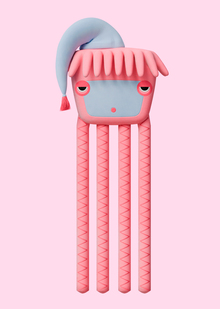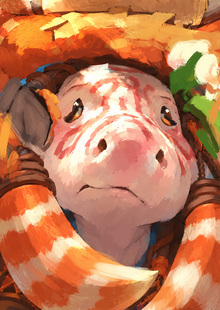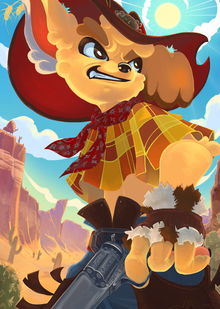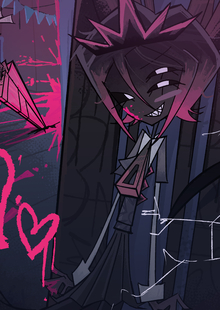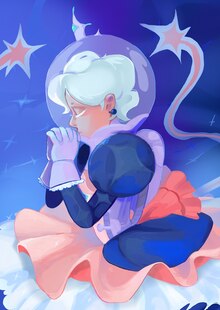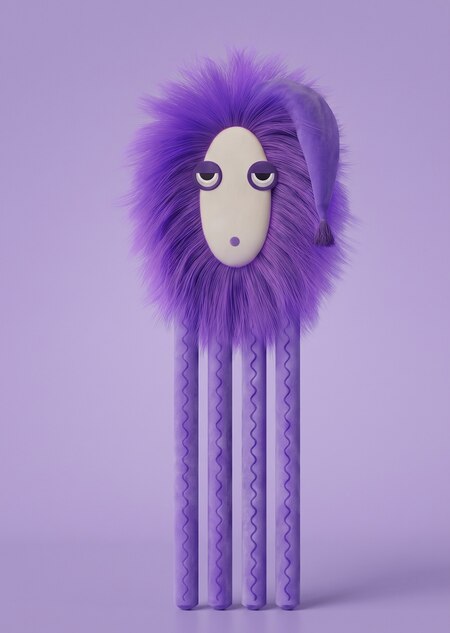
Kufi — a soft textile plush toy from the Kosssmariki series.
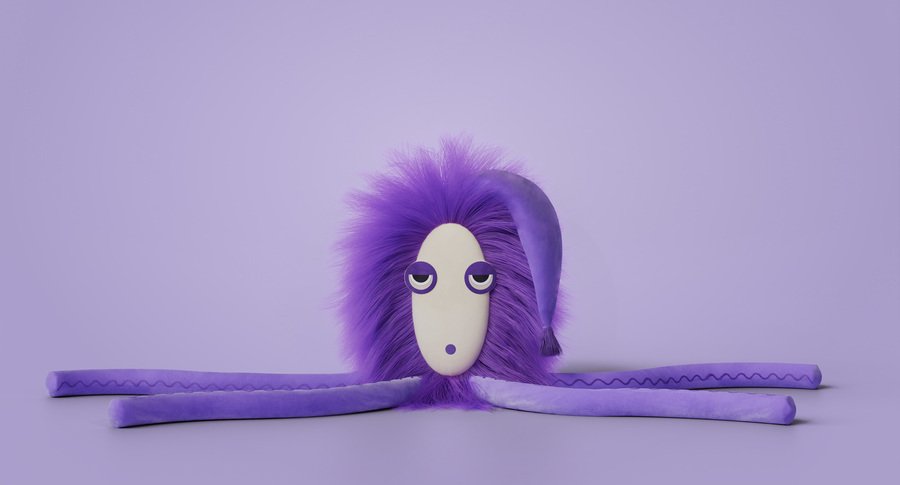
The toy is designed for kids aged 6–12 and teens aged 14–22 to serve as a «faithful companion nearby, ” helping to reduce pre-sleep anxiety. Long, flexible paws (50 cm) with embedded magnets allow it to wrap around an arm, the headboard, or a pillow—the tactile contact creates a sense of security. It features a detachable sleep cap, an embroidered face without plastic eyes, and hypoallergenic plush and felt. The toy comes in a fabric pouch with a branded patch. Collecting is possible—the series includes several characters.
Course Concept and Usage Scenario
Problem: 1) Younger generations are increasingly experiencing loneliness, anxiety, and sleep disruption.2) Children experience fears related to falling asleep alone and fear of the dark.
Solution: Tactile interaction (flexible paws) → a sense of security. Establishing a bedtime ritual → reduction of anxiety. Replacement for physical contact for those living alone. Interior object → a feeling of warmth and presence.
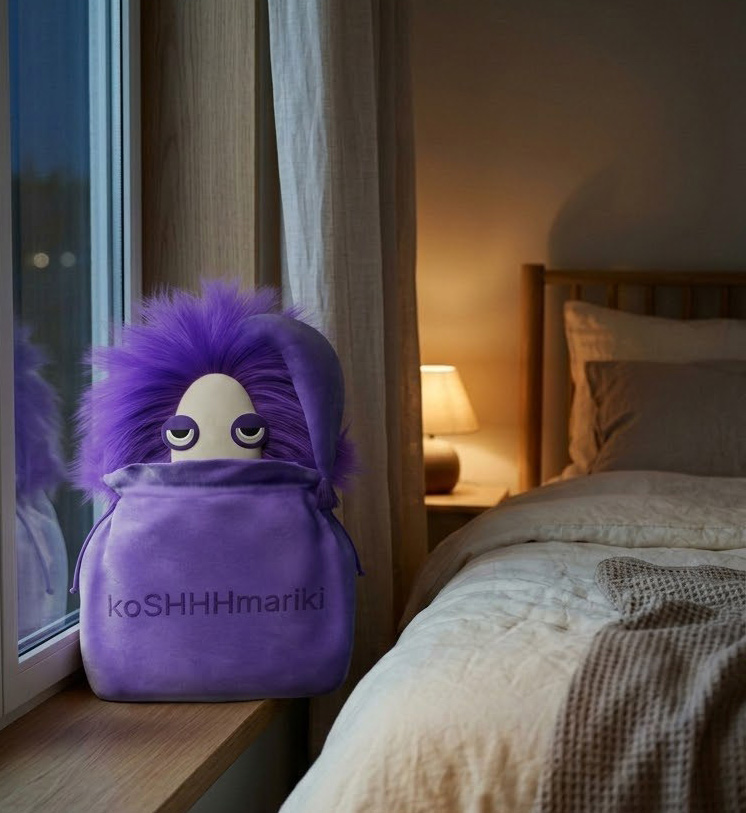
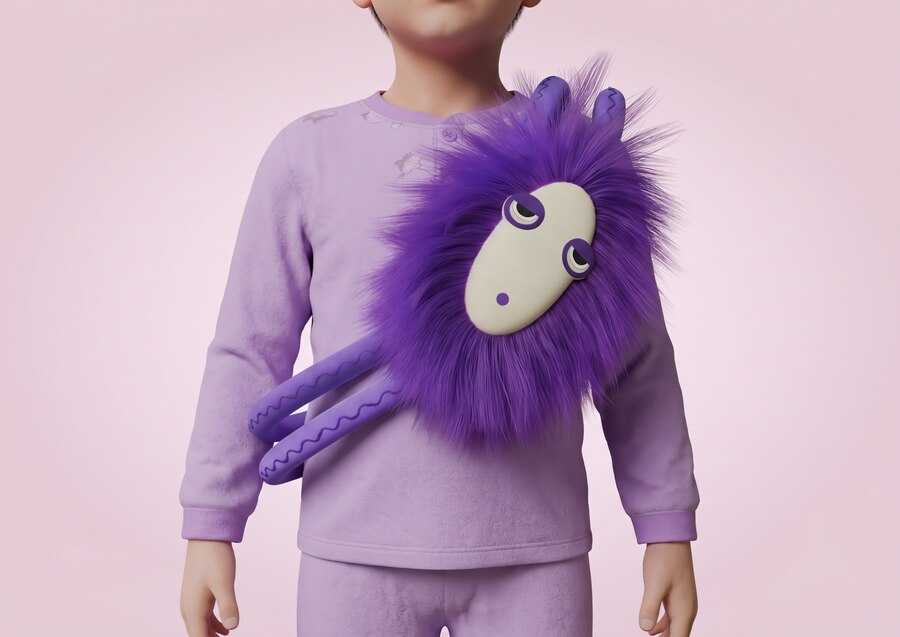
Use Case:
Sleep — The child/teenager wraps Kufi’s paws around an arm or a pillow; magnets secure the position.
Ritual — Putting the detachable cap on Kufi before bed serves as the «time to sleep» signal.
Play — Rearranging the paws, changing poses, and collecting other characters.
Decor — Kufi sitting on the bed, wrapping paws around the headboard.
Anti-stress — Manipulating the paws, tactile contact with the long fur.
Gift — Packaged in a bag featuring the Kosssmariki patch.
Sketches
Visualizations
Precise dimensions
Overall toy size — 790 mm Pattern on toy paws — 15 mm width Mane: Length — 300 mm Width — 200 mm Face: Length — 160 mm Width — 110 cm Mouth diameter — 15 mm Eye socket diameter — 42 mm main circle The eye itself — 30 mm Pupil — 23 mm Hat: Height — 276 mm Radius — 55 mm Yarn — 41 mm length of the bundle Paws: Length — 500 mm Paw circumference — 100 mm Distance between paws — 18 mm Bag: Depth — 130 mm Width — 327 mm Height — 333 mm Cord diameter — 20 mm Letter width — 15 mm
Materials Description
Design Overview and Assembly Instructions
Structure
Head—round, made of long-pile fur, with an embroidered face.Face—oval inlay of beige velboa, eyes made of felt (42 mm main circle, 30 mm eye, 23 mm pupil), mouth Ø16 mm.Cap—removable, height 276 mm, radius 55 mm, with a 41 mm pom-pom. Fastening—via Velcro or hidden snap buttons.Paws—4 pcs., length 50 cm, Ø10 cm, with embedded neodymium magnets (spacing ~10 cm). Interior—synthetic down.Body—compact, concealed under the fur.
Assembly Instructions:
Open along the pattern (7 mm seam allowance).
Shaping the head parts, tucking/stuffing.
Embroidery of the face before stuffing.
Stuffing with synthetic down.
Sewing the paws, sewing in magnets (pockets + fixing).
Stuffing the paws.
Attaching the paws to the body using a hidden seam.
Sewing the bonnet, installing the fastener.
Sewing the pouch, applying the logo.
Finishing, Quality Control (QC).
Care instructions: the bonnet can be removed, and the body can be washed at 30°C. Magnets can be removed through the hidden seam if necessary.
Hardware and prefabricated components
Position Quantity Note Neodymium Magnets Ø10 mm 8–12 2–3 per leg Buttons/Velcro for Cap 2–4 safety compliant, EN 71-3 Bag Cord Ø16 mm 2×50 cm — Cutting Mat 15 mm 1 m for processing Kosssmariki Patch 1 woven, embroidered Wings Thread № 184 1 spool — Monofilament 0903 1 skein — ⚠️ Magnets—must be sewn in and inaccessible to children (safety).
Manufacturing Technology Description
Production was entirely executed by an independent seamstress (outside of the School’s workshops).
Sewing Operations:
Pattern Cutting — manual, rotary cutter, using 1:1 PDF templates.
Sewing — domestic/semi-industrial sewing machine (e.g., Janome, Brother, Juki).
Overlocking — 4-thread for edge finishing.
Facial Embroidery — hand satin stitch or domestic embroidery machine.
Magnet Insertion — pockets made from the main fabric + fixed with double stitching.
Stuffing — manual, synthetic down/hollofill.
Final Assembly — hand blind stitching.
Finishing — steam ironing.
Quality Control — stitch testing, magnet check, absence of small loose parts.
Seamstress Equipment:
Sewing machine (straight stitch).
4-thread overlocker.
Steam iron / steamer.
Cutting table, rotary cutter, scissors.
(Optional) domestic embroidery machine.
Production Workflow: Author (patterns, tech pack, sample) → Individual Seamstress (cutting, sewing, embroidery, magnet insertion, stuffing, assembly) → Author (Quality Control, bagging, labeling).
Why the School does not use workshops: the project is realized manually, and all operations can be performed using standard/semi-industrial sewing equipment; CNC, laser, and 3D printing are not required. This simplifies series scaling and lowers the barrier to reproduction.
Production Partner Contacts
Individual Seamstress (Yulia) @mrsMikky