Alphabet of Rhythm
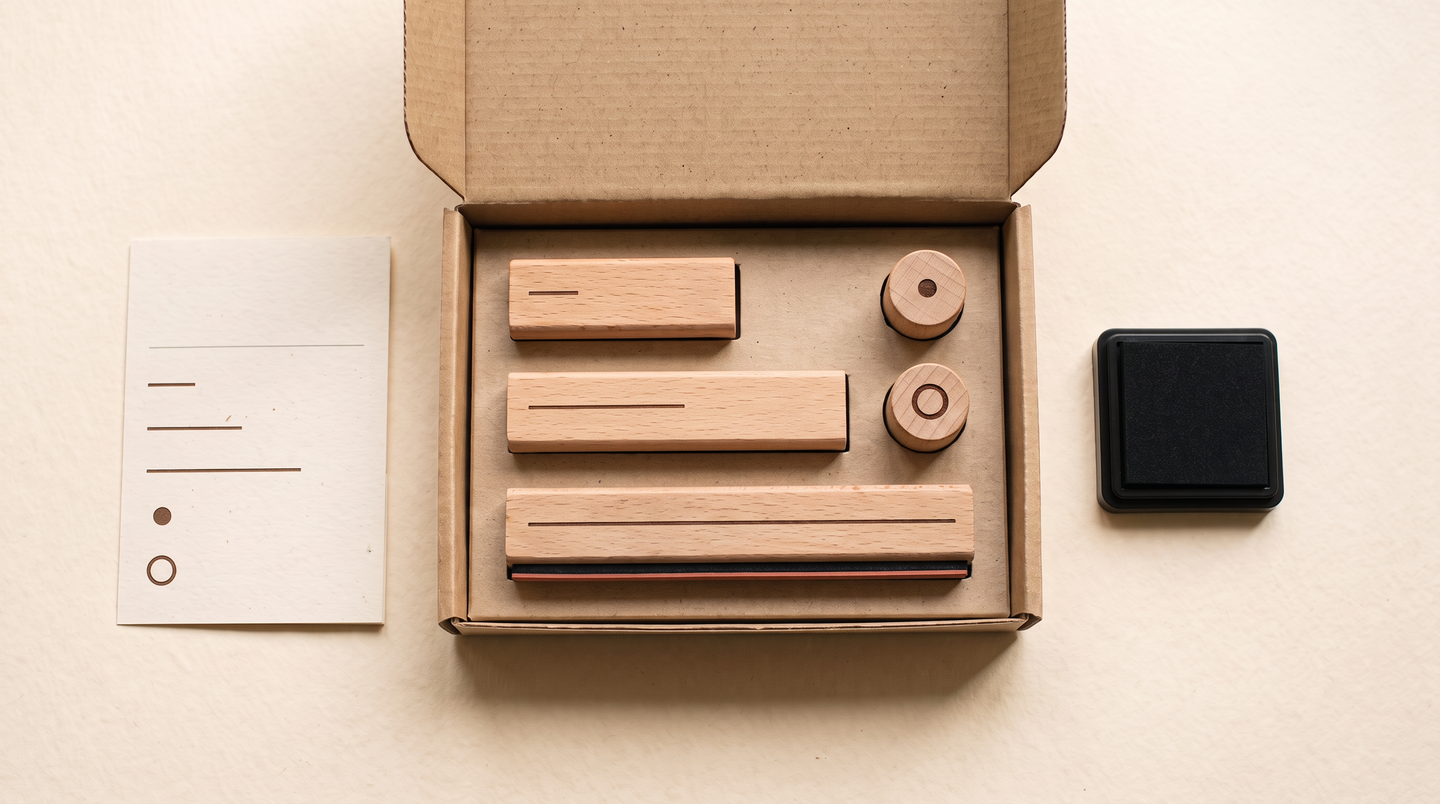
A stamp set that visualizes the rhythm of text. Five characters, a sheet of paper, and any line.
Concept Five stamps to print the rhythmic portrait of any text. No computer, on paper, by hand. You move down the line word by word, stamp for each one, and a pattern emerges on the page—a pattern that was always within the text. It is different for Pushkin and Mayakovsky, and you can see it immediately.Background The method evolved from stylometry—the study of texts through word length, rhythm, and repetition—which my father researched. The stamps do the same thing without computation: each mark is a word, each dot is a pause. This project extends a thesis on the «Golden Intersection» festival, which asks: can we visualize the patterns that constitute style?Niche Stamp sets exist as decorative or children’s items; there is no instrument that translates text structure into an image. The closest analogs are the data visualizations by Stefani Posavets and Georgia Lupi, but those require digital processing. Here, the translation is done with a single hand movement.
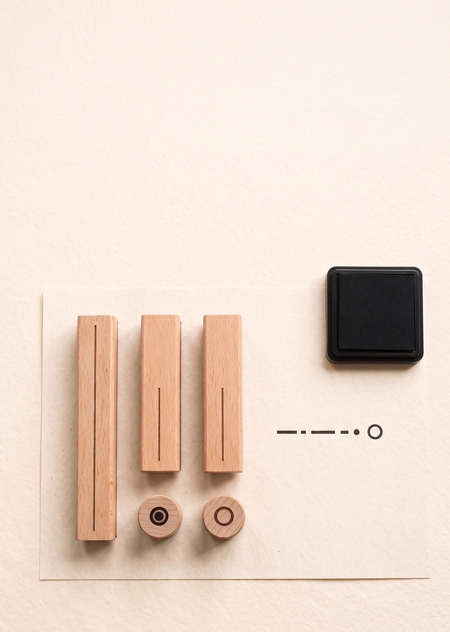
A tool that translates text into a pattern. The length of the stick equals the word length, a dot signifies a pause, and a circle represents a repetition. The pattern is not invented; it already existed within the text—the stamps merely reveal it.
User Scenario
Take any line of text: a poem, a letter, a message.
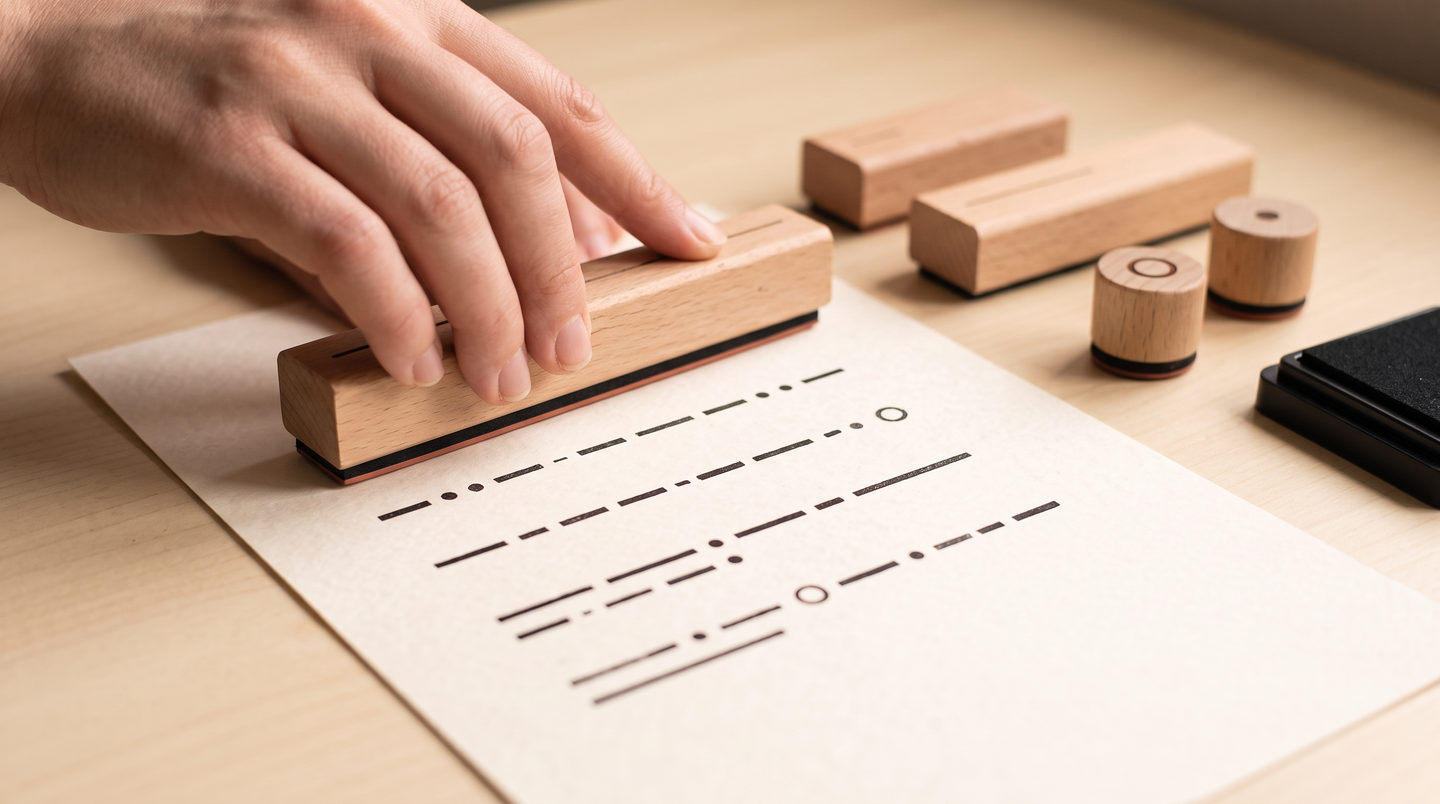
Read word by word and mark it with a stamp: a short line for words of 1–3 letters, a medium line for 4–6 letters, and a long line for 7 or more.
Place a dot at punctuation marks. If the word has already appeared, use a circle instead of a line.
Move to the next line. After several lines, a pattern appears on the page. Compare it with another text.
On the left is Pushkin’s «I remember a wondrous moment, ” the first four lines. On the right is Mayakovsky’s „Could you?“ Each mark is a word: the length of the stick is the length of the word, a dot is punctuation, and a ring is a repeated word.
How It Works
Five marks describe three characteristics: the length of the stroke, the pause, and the repetition. This is enough to distinguish the authors: one has dense lines made of short strokes; the other has long marks alternating with dots.
The blocks lie flat, and the rubber pad is on the bottom wide side, running the full length. You press by applying pressure to the block from the top: a long block produces a long stroke, and a short one produces a short one. The dot and the ring are round stamps, and they print using the end of the block.
Detail | Parameter
(1) Short Stamp — 30 × 15 × 15 mm block, 30 × 3 mm impression (2) Medium Stamp — 45 × 15 × 15 mm block, 45 × 3 mm impression (3) Long Stamp — 60 × 15 × 15 mm block, 60 × 3 mm impression (4) Dot Stamp — Ø 18 × 15 mm, Ø 3 mm impression (5) Repeat Stamp — Ø 18 × 15 mm, Ø 6 mm ring impression (6) Ink Pad — 60 × 40 mm, single color (7) Box — 170 × 110 × 30 mm, 1.5 mm cardboard, kraft insert (8) Instruction Card — 150 × 100 mm (9) Set Weight — ≈ 180 gDesign specifications.Detail | Material
(1) Blocks — beechwood, sanding, oil finish (2) Inserts — photopolymer or rubber, laser cutting, full length of the block (3) Marking Sign — laser engraving on the top face (4) Pad — finished hardware, water-based ink (5) Box — binder cardboard, kraft paper wrapping; insert tray — kraft card, die-cutting (6) Card — 300 g designer paper, screen printing or digital printingAssembly Procedure
1. Cut and sand the blocks
2. Engrave the designation on the top surface
3. Cut the inserts according to the template
4. Glue the inserts to the bottom surface of the blocks
5. Assemble the box and insert the cushioning
6. Place the stamps, cushion, and card
Production Technology Prototype: manual assembly, laser cutting of inserts, one day. Small series: carpentry workshop for lumber, batch laser cutting of inserts, manual assembly. Jigs are not required; the run can be repeated without retooling.Hardware and Finished Components Stamping pad 60 × 40 mm, water-based ink, cardboard for the box and casing, paper for the card.
Where it lives
At the festival, there will be a table with stamps: guests print their favorite lines, and by evening, a wall of different people’s rhythms comes together. After the festival, there will be merchandise and standalone items for bookshops and concept stores.
Development A series could be released with variations in symbols: for music (rhythm and rest), for movement (repetition and synchronization), as well as sets with extra pillow colors to print two artists on one sheet.Connection to the Thesis The visual investigation shows how designers translate the rhythm of music, text, and movement into an image. The stamps provide this translation for everyone. The subject is a miniature version of the entire festival—the encounter between the artwork and a careful observation of its structure.
«Alphabet of Rhythm» connects three things that usually exist separately: a method of inquiry, a hands-on tool, and play. Its purpose is not to measure text, but to see it.
«Factory» Project / Diploma Project «Golden Intersection»