Navigator
- Introduction
- Concept
- Main Body: — Otto Dix’s Perspective — Georg Grosz’s Perspective — Max Beckmann’s Perspective
- Conclusion
- Bibliography
- Image Sources
Introduction
During the period of national-socialist rule in Germany, art was subjected to strict governmental oversight. Classical works of art became the model and the sole authentic art, and, according to Adolf Hitler, the embodiment of the racial ideal.
Modernist movements were declared «degenerate» because it was easier and safer to influence the masses through classical, «simple» art. About 16,000 works by German artists whose pieces were labeled as «degenerate» were removed from galleries and destroyed.
In 1937, the «Great German Art Exhibition» opened in Munich—a prime example of art approved by Hitler. Idealized, realistic works celebrated Germanic myths, the Aryan race, peasant labor, and military valor. This art, which was easily understood by the common populace, promoted racial theory and Nazi notions of the «ideal.»
At the same time, the «Degenerate Art» exhibition was opened specifically to ridicule modern movements—Expressionism, Dadaism, Surrealism, and other trends. It displayed works that the government deemed «sick, ” „anti-German, ” and „Jewish-Bolshevik.“ The exhibits were placed alongside insulting commentary to destroy the aesthetic value of such art and incite popular hatred toward it.
Concept
The central idea of this visual research is to examine why art was prohibited from being a «truthful reporter, ” expressing genuine feelings and the author’s perspective on specific events, yet simultaneously being compelled to serve as a weapon of mass propaganda for others' values.
In this research, I aim to examine how the visual language and perspectives of artists—using Dix, Gross, and Beckmann as examples—clashed with the Nazi «ideal.» Their works expressed the most overt protest and refusal to accept a singular «correct art.»
In my opinion, the relevance of this research lies in the fact that people are still unwilling to see the truth, especially concerning traumatic events in their lives. Artistic techniques such as formal distortion and disharmony compel the brain to recall past pain or future anxiety. Consequently, even in the contemporary world, it remains easier for people to engage with «comprehensible» art—art that offers fleeting emotions and distraction without delving into anything deeply personal or unsettling, thereby bypassing consideration of more profound aspects and experiences.
Otto Dix’s Perspective
Otto Dix, who survived two world wars, became one of the first artists to depict the true face of war, eschewing the customary heroic and poetic motifs.
«War is something brutal: hunger, lice, mud, those insane sounds… Looking at my early work, I felt that I had completely missed one side of reality up until then—its ugly side.»
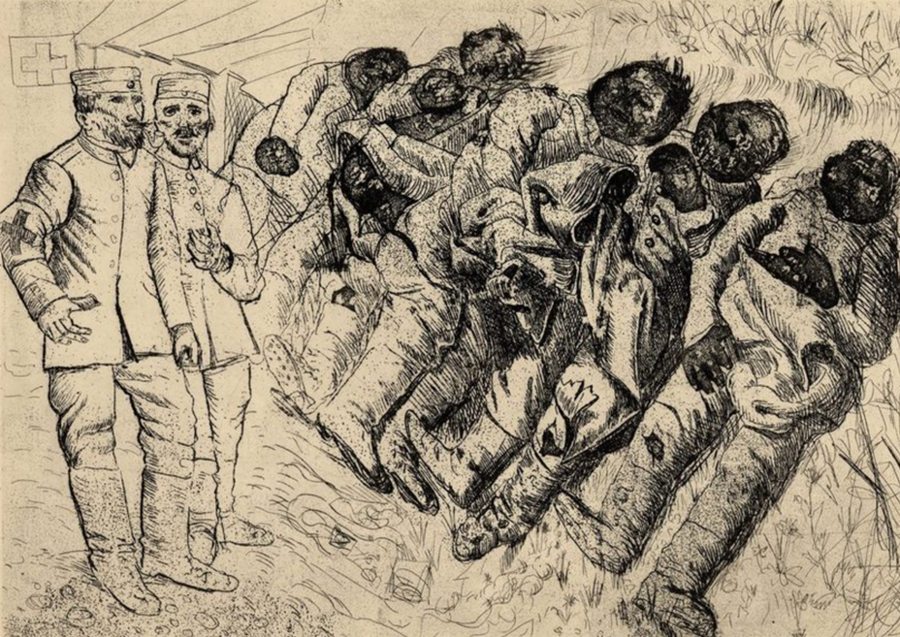
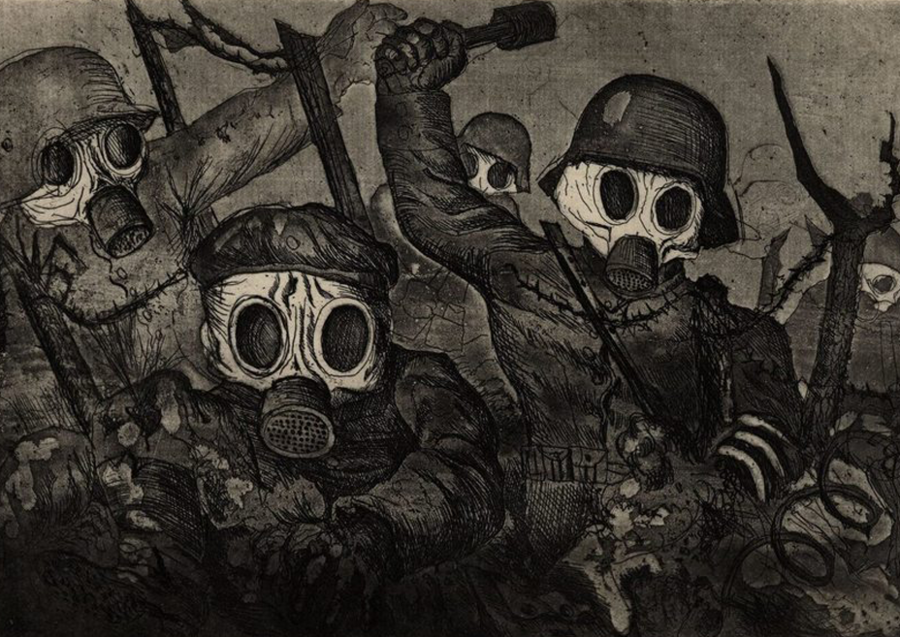
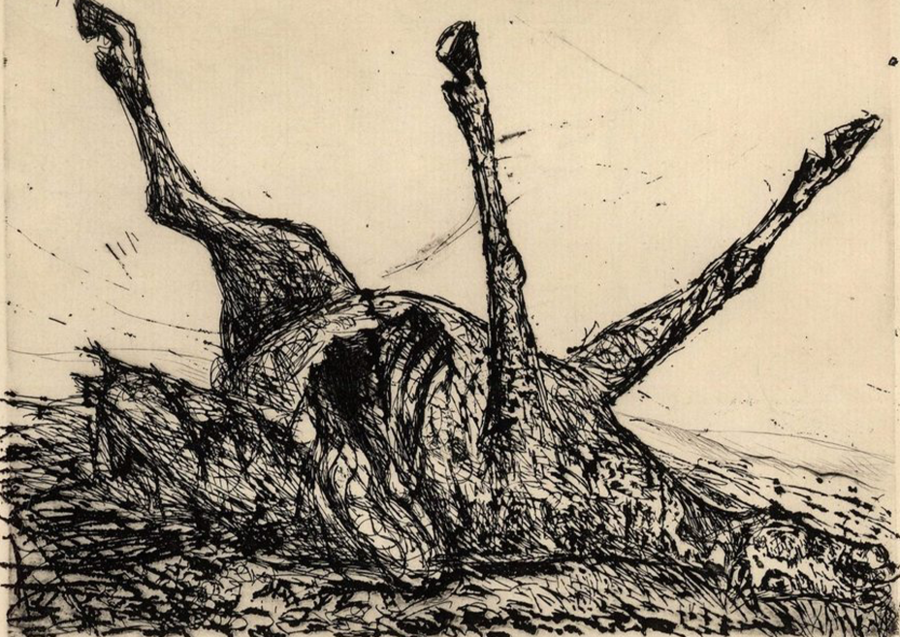
Otto Dix, «War» Etching Series, 1916
Otto Dix recorded the horror and his personal sensations from the events he witnessed on the front lines, which resulted in an entire cycle of engravings. These very sketches formed the basis of his famous «War» cycle, published in Berlin in 1924. Executed in an Expressionist style, they convey the artist’s existential comprehension of the catastrophe that unfolded. For Dix, war appears as an all-consuming element—a terrifying natural cataclysm, disease, madness, chaos, and horror.
Otto Dix, «Self-Portrait as Mars,» 1915
World War I profoundly impacted the artist’s creativity and life. Most often, he depicted its aftermath, and after experiencing the war and all its horrors, the patriotic, brave soldier transformed into an anti-war artist. Otto Dix’s personality seemed to become distorted, much like the figures in his work. In this self-portrait, Dix sees himself as the embodiment of the God of War. He places himself back into the chaos he experienced—sharp features, distorted structures, and skulls—bright flashes that express the destructive power of war. In his work, the artist seems to equate this with divine retribution, which shattered, destroyed, and mingled his identity with eternal memories of the war.
Otto Dix, «Woundworkers,» 1920
The engraving, «War Cripples,» was created based on a painting of the same name that participated in the «Degenerate Art» exhibition due to its criticism of German heroes of the First World War; the original painting was subsequently lost or destroyed. Dix depicted mangled, legless veterans with horrific faces, ironically passing by a shoe repair shop where they were no longer needed. It is noteworthy that their faces and bodies resemble robots in some ways—one soldier’s jaw appears bolted on with a nut. This detail could directly signify the loss of several body parts during the war and their replacement with prosthetics, or it could be interpreted as the moral and personal decay of veterans who served in the «killing machines» of war and continued to sow chaos after its conclusion, like robots set to a destructive programming, because the traumatic experience of war can never be forgotten by them.
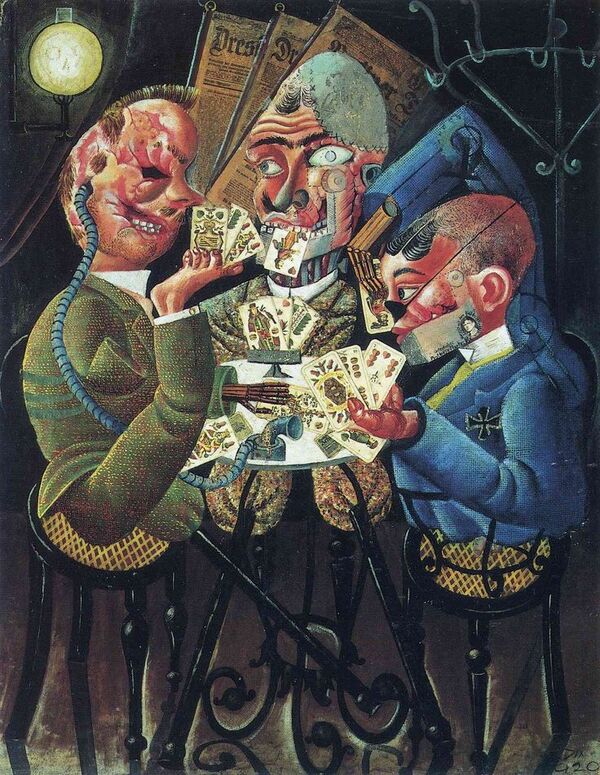
Otto Dix, «Skat Players, ” 1920
Similar to the previous one, but a preserved work by Otto Dix, this piece also depicts soldiers disfigured by war. The painting features three former German officers playing Skat—a popular card game in Germany, widespread among conservative circles and soldiers in the trenches. All three characters are severely wounded veterans of the First World War who sustained multiple injuries.
The work serves as a sharp social satire on the plight of veterans in Germany. Thousands of soldiers who returned from the front as disabled men found themselves unwanted in the new social reality, where they were viewed not as heroes but as a reminder of Germany’s defeat. Consequently, they often gathered in their small circles, detached, spending the remainder of their lives on unproductive pursuits.
Otto Dix, Triptych «War,» 1932
Otto Dix’s «War» is a monumental triptych, rendered in tempera and oil on wood. The artist spent three years on the work and completed it exactly one year before the Nazis seized power and began the hunt for «degenerate art.»
When Dix was officially placed on the list of «anti-German» artists, he refused to wait for his main statement on war to be confiscated and destroyed. Instead, he dismantled the triptych, keeping only one panel while secretly distributing the remaining fragments among his friends. Each friend hid their portion from Nazi searches until the end of World War II. Dix had foreseen the reaction of the German authorities—when their powerful propaganda manufactured the image of the heroic soldier bravely fighting for the homeland in World War I to cultivate future heroes willing to fight in the next war—nothing is more dangerous than the cruel and horrifying truth of what war is, in reality.
Dix’s choice of a triptych form is not accidental; the composition mirrors the structure of a traditional altarpiece, and for a German viewer in 1932, inevitable associations were drawn to Grunewald’s «Isenheim Altarpiece.» Dix depicts a world where people destroy each other with senseless cruelty, repeating the most tragic narrative of Christianity in every war.
In the lower, horizontally elongated section of the triptych, a row of corpses is shown in a tight, compressed space—within coffins. The central panel depicts a bloody battlefield strewn with disfigured bodies. Dominating the entire scene is the figure of a flying phantom or Death itself, which turns out to be a corpse hung on a metal beam—a remnant reduced only to bones and scraps of fabric over time—yet this figure is the embodiment of death that the viewer perceives at first glance when encountering the triptych.
Otto Dix, Triptych «War,» central panel, 1932
I see four stages of war in this triptych: the right panel shows soldiers walking into the fog—an ominous and bleak unknown regarding their fate; the central panel expresses the bloody carnage on the battlefield—the very heart, the climax of the war, the most horrifying event; and the left panel features the artist’s own involvement, and perhaps a narrative he experienced firsthand, depicted as a ghostly memory.
Otto Dix, triptych «War,» lower panel, 1932
The fourth, smallest, and lowest-placed section reveals the true outcome of the war—not the triumphant heroes returning home, but the dead, mutilated soldiers in narrow underground coffins—the genuine end of the war.
Otto Dix «The Seven Deadly Sins,» 1933
Otto Dix painted the «Seven Deadly Sins» in 1933, immediately after being dismissed from a teaching position at the Dresden Academy of Fine Arts because his paintings were considered a threat to the nation’s moral revival.
The work depicts a «procession» of grotesque figures, each personifying one of the seven deadly sins. The dwarf with wild eyes and black mustache—which the artist completed much later—resembles a Führer, as the author saw him as the primary embodiment of a terrible sin like envy. The dwarf sits astride a horribly hunched old woman with glazed, desirous eyes, who symbolizes greed. The dancing figure in a skeleton costume represents sloth, whose bones are positioned in a manner reminiscent of a swastika, suggesting that people themselves brought death upon themselves through their laziness. Anger is symbolized by a bestial creature, complete with horns and fangs, denoting the loss of humanity by the Nazis, while lust is the most obvious and simple figure in Dix’s work, and vanity is depicted in its most humiliating form; gluttony is rendered as an infant inside a costume. These images seem to expose the entire depravity of the Nazi regime—through this biblical motif, the artist demonstrates the destructive force they brought to their people.
George Gross’s Perspective
George Grosz, much like Dix, was a witness and participant in World War I, which is reflected in his works depicting the horrors of the postwar period unfolding in the city streets. He satirized the social and moral decay of society, Nazism, and exposed the vast gulf between the rich and the poor. The artist was a leader of Berlin Dadaism and one of the harshest critics of the Nazi regime. His art mocked power, corruption, and militarism, which made his life in Germany increasingly difficult and eventually led to his loss of citizenship, after which he moved to the United States.
Georg Gross, «Solar Eclipse,» 1933