Concept
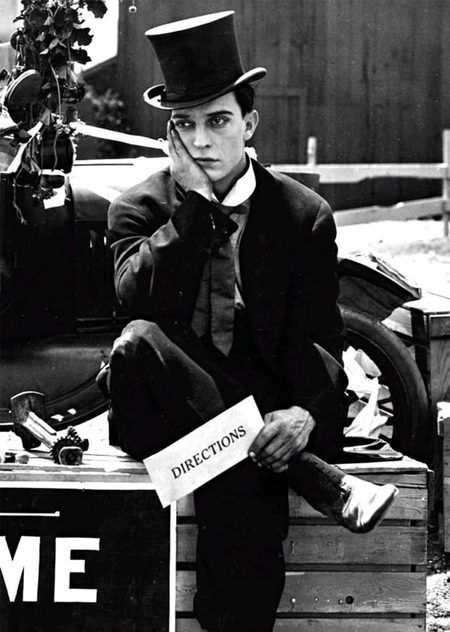
Buster Keaton—one of those silent film auteurs whose distinctive method is inseparable from the construction of the frame itself. The director worked during a period when cinema was actively developing its own expressive means, and the absence of synchronized dialogue forced directors to find ways to convey character, action, and dramaturgy exclusively through imagery, movement, editing, and spatial organization. Under these conditions, Keaton developed a unique visual method.
In his films, Keaton merged the roles of director, screenwriter, actor, gag writer, and stunt coordinator; therefore, his films can be viewed as cohesive artistic constructions where individual elements adhere to an overarching logic. Space in his work is rarely a neutral backdrop for action. The street, the railroad, the ship, the house, the machine, or the cinematographic apparatus become active participants in the events and impose specific behavioral rules upon the protagonist.
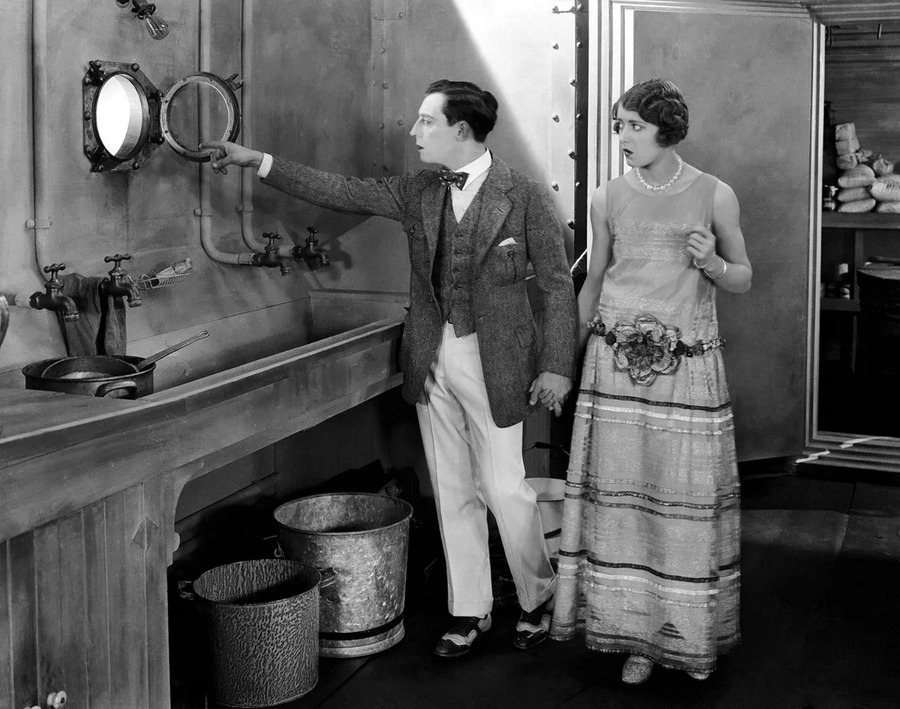
«The Navigator» (directed by Buster Keaton and Donald Crisp, 1924)
The selection of this topic for my visual research is driven by a desire to understand how Kiton’s recurring visual motifs coalesce into a cohesive cinematic narrative that can be perceived without a single word.
How does Buster Keaton form a distinct visual poetry in silent film through the organization of space, scale, movement, and frame depth? This question became central to the creation of the visual study.
My hypothesis is that the scale, mechanism, trajectory of movement, and depth of frame form a clearly integrated system in Keaton’s work, allowing him to generate comedic effect almost without verbal explanation. Through these techniques, one can trace Keaton’s characteristic view of the world as a complex machine—a system in which the human being exists independent of his will. The comedy arises from the clash between his actions and the laws of that space, meaning that randomness and improvisation become part of a precisely calculated visual structure.The principle of categorization is based on visual devices found across several films that gradually form a unified system: scale, mechanism and object, trajectory and movement, frame depth. These elements are interconnected: scale indicates the human’s position in the world, the mechanism establishes the rules, movement defines the character’s behavior, and frame depth allows the viewer to see how various events coexist within a single visual space.When selecting material for this visual study, I drew upon film scholarship concerning silent cinema, comedy, and the visual language of cinematography, as well as research on Buster Keaton’s oeuvre and interviews. These sources enabled me to examine Keaton’s films not merely as a collection of comedic scenes, but as the result of a consistent engagement with space, movement, and screen time. For the visual component of this study, I presented still frames and excerpts from five films: «Sherlock Jr.» (1924), «The General» (1926), «The Navigator» (1924), «Our Hospitality» (1923), and «Seven Chances» (1925), in which each of the analyzed techniques is most clearly expressed.
Scale: a small figure in a large space
One of Buster Keaton’s characteristic techniques is juxtaposing the human figure with its surrounding environment. The protagonist is most often a small figure within a vast space, against which their movements appear insignificant. Furthermore, Keaton does not aim to isolate the hero in close-up shots; the entire space usually remains visible in the frame, allowing the image to convey not only the character themselves but also their smallness in relation to the world around them.
«The General» locomotive (directed by B. Keaton, 1926)
In the film «General Steam Engine, ” Johnny Grey finds himself against the backdrop of a vast military landscape. A telling scene shows him chopping wood on the locomotive tender while soldiers march in the background. In one shot, two events of incomparable scale converge: the hero’s mundane labor and military action, yet one barely affects the other. Johnny continues his work, while the war rages nearby, making the hero seem even smaller—he is inside a massive event, but he does not become its focal point.
This attitude toward space is linked to Keaton’s general conception of cinema. In interviews, he repeatedly emphasized the need to portray action as plausibly as possible, utilizing real spaces and objects whenever they could be filmed directly in front of the camera [1]. In such cases, the scale of events is not obscured by editing: the protagonist remains in the frame alongside their surrounding environment, and their relationship is determined by the image construction itself.
«The Navigator» (directed by Buster Keaton and Donald Crisp, 1924)
A similar technique is used in the film «Navigator.» The enormous ship takes up almost all the space around the characters, and Rollo and Betsy remain almost alone inside this structure, making their figures appear exceptionally small. The ship functions not merely as a backdrop, but as an independent part of the action: the characters must navigate its decks, search for necessary objects, and adapt to the space’s scale.
«Seven Chances» (Seven Chances, dir. B. Keaton, 1925)
In «Seven Chances, ” the scale shifts within a single action. Initially, the protagonist encounters small stones that begin to follow him, but then their number grows and the stones themselves become larger. A minor accident gradually transforms into a massive danger, and Kiton explains what is happening with no words—the size and quantity of the objects themselves demonstrate that the situation is spiraling out of control.
Thus, using a wide framing, Keaton depicts the individual as a small part of a vast, autonomous world. The frame shows that space does not adapt to the protagonist; instead, it dictates its scale and laws, which is precisely why even a simple action by Keaton can gradually evolve into a massive spectacle.
Mechanism and subject: the structure as a field of action
Another significant characteristic of Buster Keaton’s films is the role of objects and mechanisms. Things in his films rarely remain mere background details; instead, they influence the protagonist’s behavior, impede them, assist them, or completely alter the outcome of their actions. In this sense, the object functions as an active participant in the unfolding events, rather than just a decorative element. Keaton himself speaks to this when discussing the creation of his comedies. He noted that ideas for gags could arise from the set dressing, props, and even ordinary objects—if one considered what could go wrong in a simple situation [1]. Thus, an ordinary object unexpectedly becomes a source of action.
«The General» (directed by B. Keaton, 1926)
This characteristic can be seen in «The General Engine, ” where the locomotive itself is a constant participant in the action. Johnny doesn’t just operate it; he continuously interacts with its mechanics: climbing onto the tender, working with levers, loading fuel, and moving across the locomotive’s parts. Because the locomotive has its own size, speed, and mechanism, the protagonist must account for its capabilities. Siegfried Krakaauer notes that in Kiton’s version, the „General“ is perceived almost as a living being—he details specific parts—the edges, the platforms, the buffer—and shows how intimately the hero is connected to this machine [5]. The locomotive thus becomes practically a second character in the film.
«The General Locomotive» (The General, dir. B. Keaton, 1926)
The mechanism’s role becomes even more vivid in the scene with the cannon. The outcome here depends not only on Johnny’s actions but also on the cannon’s position, the locomotive’s movement, the tracks, and other details. The protagonist tries to control the situation, but the mechanism continues to operate according to its own logic: one action leads to another, and what ultimately happens is unexpected even to the hero himself.
«Sherlock Jr.» (Directed by B. Keaton, 1924)
Similarly, the objects function in «Sherlock Jr.» The projector and screen become part of the action: Keaton doesn’t just watch the image; he becomes connected to it and is literally thrust inside the screen space at a certain moment. An ordinary cinema object transforms into an adventure setting, and through this simple action, the director demonstrates the possibilities of cinema itself—the screen can become a door to another world.
Thus, Buster Keaton, by imbuing mechanisms and objects with his own logic, makes them not merely aids in storytelling, but active participants who create parts of the narrative themselves. A hero might plan something, but the outcome depends on how the surrounding objects behave—and this is precisely why the comedy often arises not from a single joke, but from the collision between the human and the properties of an object.
Route: movement along a line
In the films of Buster Keaton, the hero’s movement most often follows a specific line—a railway, a river, a street, or a slope—which can serve as his trajectory. The hero is not simply moving from one place to another; rather, he becomes enveloped within a predetermined path that gradually dictates his actions.
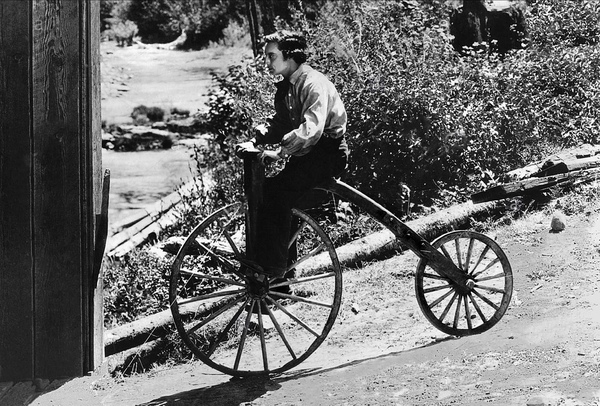
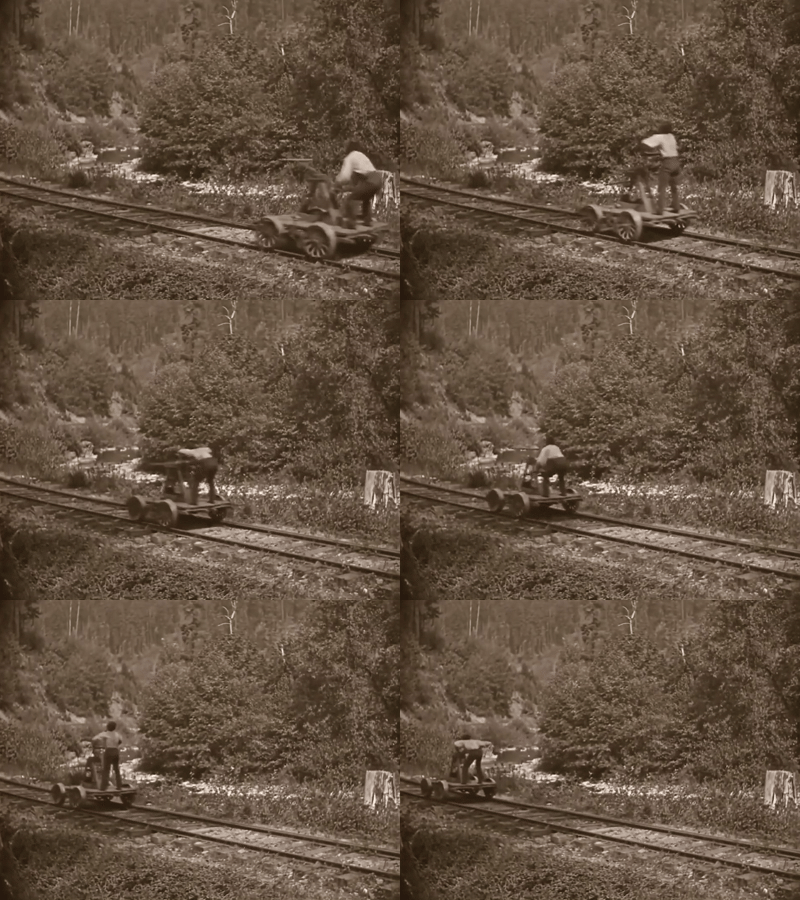
«The General» (Directed by B. Keaton, 1926)
In «General’s Locomotive, ” this theme is evident right from the title: nearly all of the film’s action revolves around the railroad. Johnny pursues the stolen locomotive, utilizing various modes of transport—a handcar, a bicycle, and his own engine. The transport changes, but the direction of travel remains the same, and the railroad connects individual episodes into one long chase.
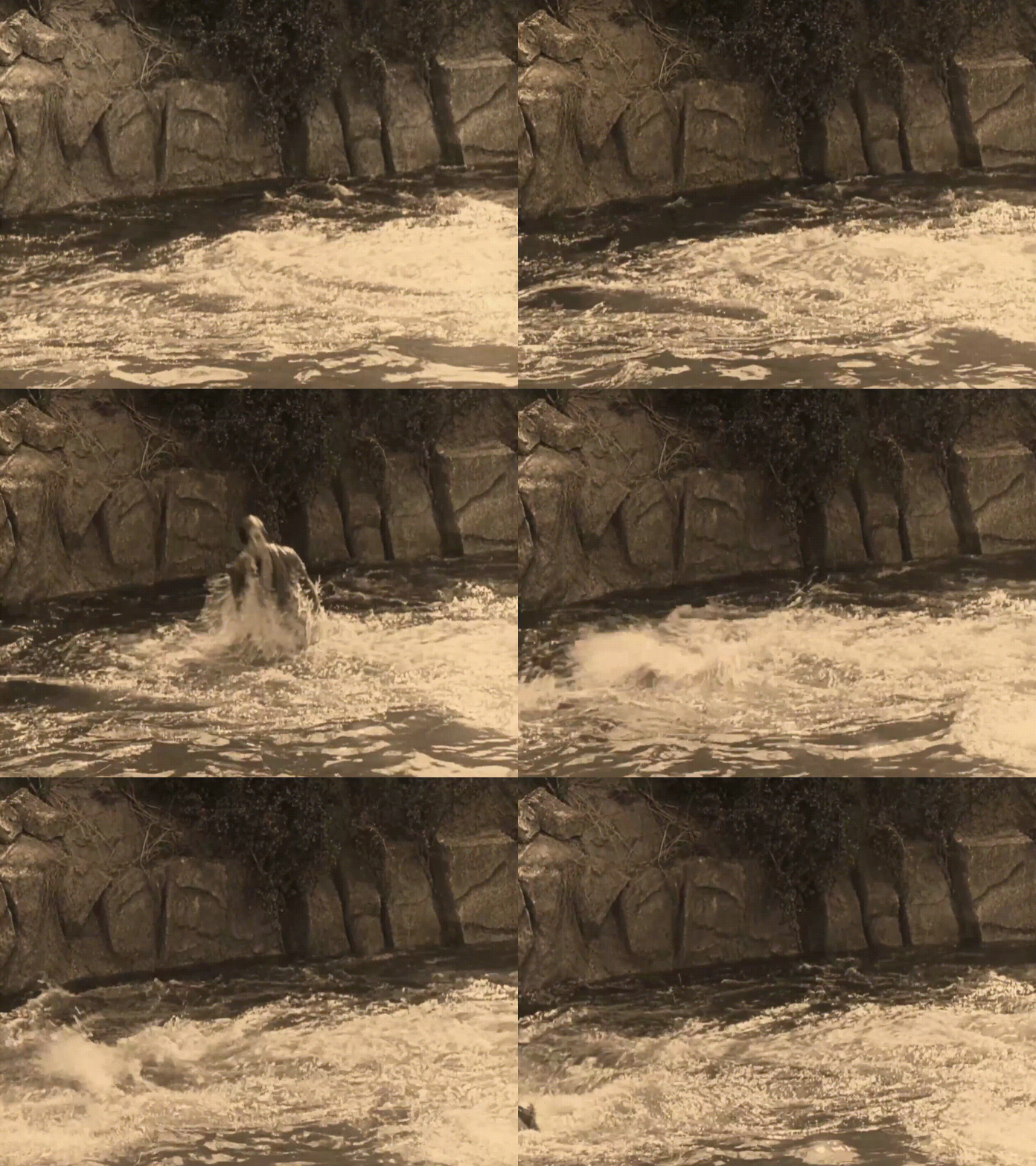
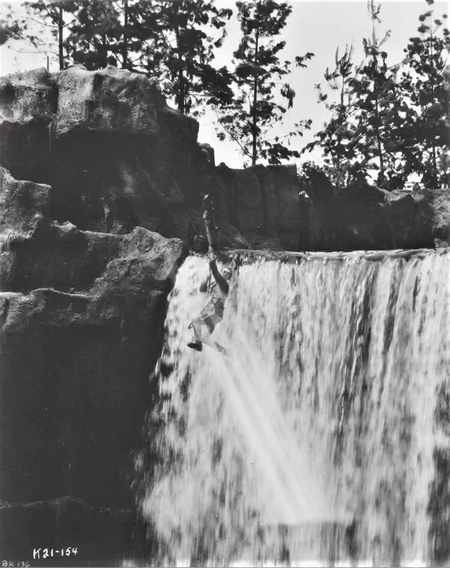
«Our Hospitality» (directed by Buster Keaton and John J. Blaystone, 1923)



















