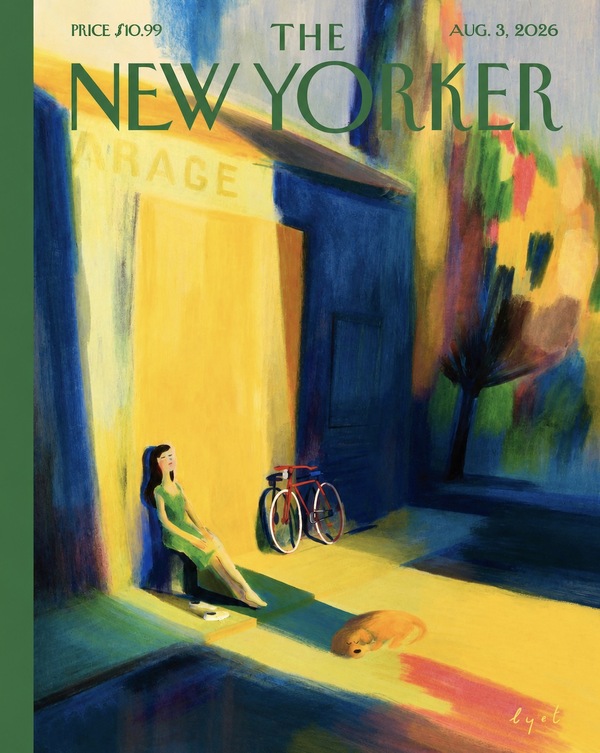
We have known the rainbow since childhood—artists work with a palette, and designers work with RGB and Pantone. But an article in the August issue of The New Yorker forces us to question even that.
The catalyst was an experiment conducted by scientists from the University of California, Berkeley. They learned to use lasers to affect not the entire retina, but specific light-sensitive cells. One of the experiment participants reported seeing a color that had never before existed in human experience. The researchers gave it the working name «olo.»
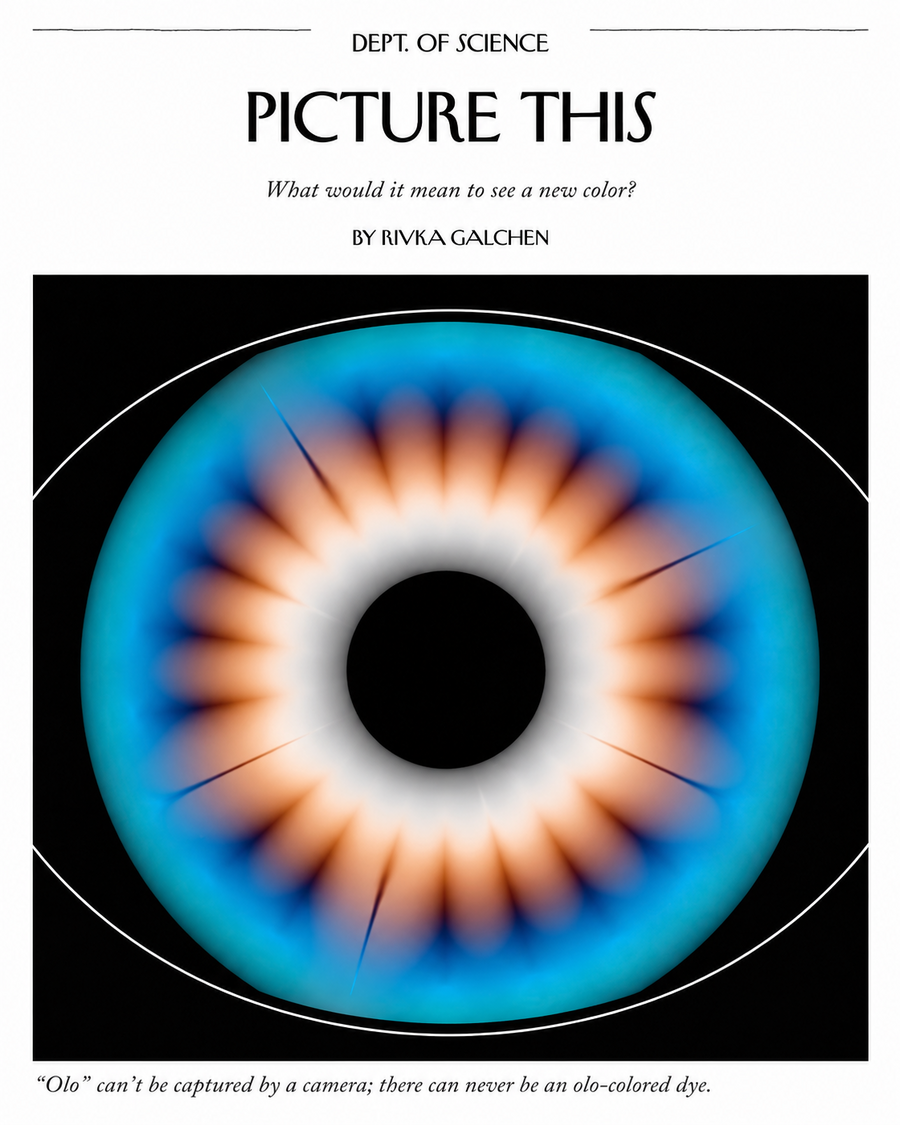
Rivka Galchen’s «Picture This» article in The New Yorker.
The paradox is that this color cannot be shown. It cannot be photographed, printed, mixed from pigments, or displayed on a screen. It arises only in the human brain, whose cones have been stimulated in a particular way. At first glance, it seems as if scientists have discovered a new color. However, the article’s author, Rivka Galchen, suggests viewing the experiment differently. Perhaps it doesn’t so much expand the palette of the world as it does alter our perception of what qualifies as color in the first place.
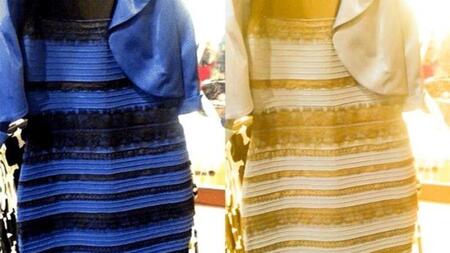
We are accustomed to thinking that color is a property of an object. An apple is red, grass is green, the sky is blue. In reality, only electromagnetic waves of different wavelengths reach the brain; color emerges later when the brain interprets signals from three types of retinal cones. This is precisely why some people saw the famous internet dress as white and gold, while others saw it as blue and black. The object was the same, but the color was different.
It is interesting that artists arrived at this idea long before neurobiologists. Isaac Newton had already demonstrated that white light is composed of numerous hues. Goethe disagreed with him, believing that color is born not only in light but also in the observer’s perception. Bauhaus instructor Johannes Itten noted that colors with the same saturation can appear to us with completely different brightness. The purest yellow looks almost luminous, while the purest blue appears unexpectedly dark. In other words, our eye has never been an objective camera.
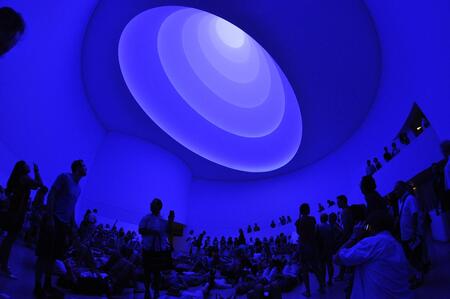
Contemporary artists continue to explore this imperfection of sight. James Turrell builds spaces where color cannot be separated from light, Olafur Eliasson manipulates lighting so that viewers begin to question their own perception, and Anish Kapoor made Vantablack—a material that absorbs almost all light and transforms volume into visual void—the subject of long-standing debate. While scientists strive to create new colors, artists have long been creating new ways to experience them.Photo: James Turrell. Aten Reign, 2013.
Therefore, the story of «olo» is interesting not so much as a scientific sensation. Even if it is later determined that it is not a new color but an extremely saturated shade of green, the main question has already been posed. Are we truly seeing the world as it is? Or only as our brain allows us to see it? Perhaps, right now, there is someone near us who distinguishes shades we don’t even suspect exist.