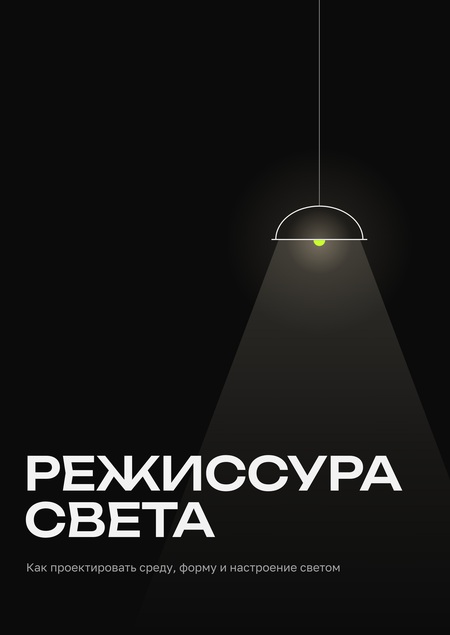
The course will teach you to design light as consciously as form and color.
Abstract
Light dictates how a person perceives form, color, and material, and how they feel within a space. The same interior reads as entirely different projects under varying light conditions.However, in design, light is often relegated to a final layer added after the entire concept has been developed. This course teaches students to approach light from the very beginning: understanding its mechanisms, building lighting scenarios, and managing mood.Every idea undergoes three evaluations: calculation in DIALux, visualization in Blender, and a physical mock-up using LEDs.This course will allow students to complete the full cycle and develop their first lighting concept—a finished case study ready for a portfolio.
Who is this course for
This course is suitable for interior and environmental designers (students in their 2nd–4th Year and practitioners with up to 3 years of experience), 3D visualizers, exhibition and window display designers, as well as product and graphic designers who work with lighting and product photography.
To begin the course, you will need basic 3D modeling skills (such as assembling a simple room with furniture in Blender, SketchUp, or 3ds Max) and the ability to read a floor plan. All course software is free, and the model kit will require a set of LEDs costing approximately 3,000 ₽.
The course runs for 8 weeks and is divided into 4 modules, moving from understanding light to its design, verification, and defense.
You will learn
▸ Quantify light and explain lux, Kelvin, and color rendering to the client. ▸ Manage the perception of form and material through light direction and hardness. ▸ Establish a lighting hierarchy: ambient, accent, decorative, and navigational light. ▸ Design lighting scenarios for different times of day. ▸ Validate the solution using calculations based on standards and credible renders in Blender. ▸ Assemble a lighting mockup and present the concept.
Practical Assignments
Lighting Audit of your room with a map derived from 10 measurements.Photo series of a single object under six lighting schemes.Comparison of one material at 2,700, 4,000, and 6,500 K.Scenario Plan for a space with three different scenarios.Space calculation in DIALux with a deviation from standard not exceeding ±10%.Three renders from a single camera and a lighting fixture specification.Lighting model 1:20 with two switchable scenarios.
Learning Format
The course runs for 8 weeks. This amounts to 64 academic hours, or approximately 8 hours per week: 2 hours of class time and 6 hours of independent study.
The learning format is blended. The main portion takes place online, but weeks 7 and 8 feature two in-person labs: one for participants to assemble a light model and the other for the final project defense. For those unable to attend in person, there is an online track: the model is assembled at home following video instructions, and the defense is conducted via video conference.
Asynchronously, students read long-form articles with illustrations, renders, and diagrams, watch 30–40 minute video lectures, and complete assignments at their convenience. Each module includes a glossary of terms.
Synchronously, a weekly webinar review session is held for 2 hours on a weekday evening. During this session, the curator reviews student work and answers questions.
Each week includes one hands-on assignment with a verifiable deliverable. The curator provides written feedback within 72 hours. These assignments progressively build up to the final project.
The cohort size is limited to 20 people. Necessary software includes Blender and DIALux evo (both free), Figma or Miro, a smartphone with manual camera controls, and a model kit, which costs approximately 3,000 ₽.
The course concludes with the final project defense. Those who submit all assignments and score at least 12 out of 20 on the defense receive a certificate of professional development.
Thematic Plan
We begin by examining the nature of light and how the human eye perceives it. This module provides the fundamental vocabulary and quantitative knowledge necessary for everything that follows.Physics and the perception of light—lumens, lux, and how the eye adapts to varying light conditions.Light and form—direction, hardness, and contrast: how light sculpts volume.Light color and material—color temperature, color rendition, and the influence of light on biological rhythms.
Moving from observation to design: dissecting light into layers and verifying solutions with data.Light hierarchy and scenarios—four layers of light and scenarios based on time of day.Standards and calculation—what SP 52.13330 requires and how to calculate space in DIALux evo.
We test the concept in two ways: in a render using actual luminaires and on a physical model.
Lighting in 3D—an honest render in Blender featuring IES profiles and HDRI.
The lighting mock-up—a 1:20 scale model with LEDs, a dimmer, and switchable scenes.
In this block—an example of a completed project.