Navigator
- Concept
- Genre History
- The Protagonist as a Guide to Another World
- Classic Tropes
- Food in Isekai
- Integration of Moe Culture
- Conclusion
Concept
In our time, one of the most popular genres in film and literature can rightfully be called fantasy. A specific subgenre—so-called «isekai» stories, where a character ends up in another world due to circumstance—is also sought after and widely distributed across works from various countries. However, in Japan, a distinct genre has emerged from this trope, complete with its own rules and characteristics: isekai (яп. 異世界), which literally translates to «another world.»
Why have isekai gained such strong footing in Japan and why are they relevant to viewers and readers today?
My hypothesis is that the reason Isekai has established itself as an independent genre is tied to a unique Japanese perspective and content that proves appealing and captivating to both creators and the target audience. Isekai is not merely a story about heroes transported to another world; it is a cross-section of contemporary Japanese culture. They «function as collective archives of modern Japanese imagination» [3]—and largely, it is the integration of this cultural context that has made these stories what they are. This is not only what distinguishes Isekai from similar non-Japanese narratives but also what keeps them relevant to their target audience today.
This topic was chosen due to the discrepancy between the ambiguity of public reception of the Western genre and its continued high popularity within Japan. Therefore, the objective of this visual research is to identify the element that makes Isekai appealing specifically to the Japanese audience—and according to my hypothesis, this lies in the incorporation of Japanese cultural context.
From this, I would like to divide the research into five chapters: «Genre History,» «The Protagonist as Guide to Another World,» «Classic Tropes,» «Food in Isekai,» and «Integration of Moe Culture.» Beginning with the genre’s history to trace the trajectory of interest in the trope, I will then focus on the core components of any work: the main character, key themes, and character representation (female archetypes are particularly interesting in Isekai). The research will conclude with a conclusion and summary of findings.
The research will analyze the most popular works whose narrative techniques have become firmly established within the genre to examine the elements that have proven most significant to the audience. The visual material will consist of frames from anime, as well as illustrations from manga and light novels (Japanese: ラノベ, derived from English «light novel»). It is important to note that for the Isekai genre, the light novel is usually the original source material; manga and anime are adaptations released later, while remaining quite faithful to the original.
Several academic articles, verified for their relevance and reliability, were selected as textual sources using Google Scholar.
Genre History
As mentioned previously, the very concept of a protagonist entering an unknown, unfamiliar world is not new—it can be found in many ancient works and even in Japanese classical tales, such as «Urasima Taro,» where the main character finds himself in an underwater kingdom.
Utagawa Kuniyoshi, «Urashima Tarō and the Turtle,» 1852.
Isekai are first characterized as adaptations of Western works set in other worlds, such as Frank Baum’s «The Wonderful Wizard of Oz» and Lewis Carroll’s «Alice in Wonderland.» However, despite the Japanese approach to animation and thematic similarities, it is difficult to fully categorize them within the isekai genre.
«The Wonderful Wizard of Oz, ” directed by Fumihiko Takayama and John Denilkiewicz, 1982.
«Alice in Wonderland, ” dir. Sigeyo Koshi, 1983
Stories about «isekai» protagonists became more distinctive toward the end of the 20th century with the release of the manga and anime «The Twelve Kingdoms» by Fuyumi Ono, which also significantly increased the audience’s interest in similar types of stories.
«Twelve Kingdoms, ” by Fuyumi Ono, illustrated by Akihiro Yamada, 1992, manga cover
The term «isekai,» as well as the recognition of it as a distinct genre, began to gradually form in the 2000s. The genre’s peak popularity is generally linked to the website «Sosetsuka ni Naro,» where many authors of popular works began their careers. The development of the genre received an additional boost from the light novel «Master Sword Online» (2009) and its anime adaptation, which significantly shaped the modern look of isekai and solidified RPG logic and gaming mechanics within the genre. [5]
«Sword Master Online,» directed by Tomohiko Ito, 2012, game mechanics
«Swordmasters Online» became a turning point and significantly popularized the genre. Moreover, the game’s logic became ingrained on a deep level—not just through the presence of interfaces and level systems. The medieval setting itself, as well as the necessity of fighting monster mobs to progress, directly stem from computer role-playing games.
«This Wonderful World!», directed by Takaoami Kanasaki, 2016, a typical medieval town from the isekai genre
The main character as a guide to another world
The main character acts as a mediator between Japan and the fantasy world: by introducing the audience or reader to its rules and characteristics, they simultaneously infuse the narrative with Japanese experience, knowledge, and values.
«This wonderful world!», directed by Takaoami Kanasaki, 2016. The main character goes outside in search of a new game.
«Re: ZERO — Starting Life in Another World, ” directed by Masaharu Watanabe, 2016, first appearance of the protagonist
«War Chronicle of a Little Girl,» directed by Yutaka Uemura, 2017. Scene introducing the main character before he is transported to another world.
The protagonist and their setting are connected by deeper cultural contexts. The most common archetypes for Isekai protagonists are the hermit-gamer, the student, or the office worker. Often, they share a dissatisfaction with their lives in Japan—a feeling familiar to the genre’s audience. [5] Entering another world becomes a form of liberation and escapism for these characters. Viewers and readers, identifying with the hero who gets a «second chance, ” also experience a sense of freedom and the possibility of starting life over.
Classic Tropes
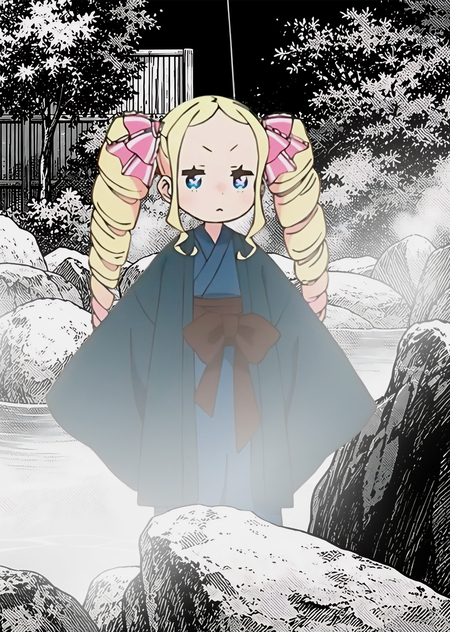
Japan is a country rich in culture, one that deeply respects its traditions—elements which authors in Isekai often translate into fantasy worlds. This process creates a set of recurring tropes in the genre’s works, many of which function as a form of fan service for the Japanese audience. For example, in other worlds, characters wear traditional Japanese attire, bathe in hot springs, and eat familiar Japanese food.
«Lord», 2019, official greeting card for the «Mass for the Dead» gaming community
«Re: ZERO — Life in Another World with Zero Status, ” directed by Masahiro Sinohara, 2024, characters in yukatas