Central Question: Does the sublime exist in trends, fashion, and popular culture? Hypothesis: Yes, provided the artifact has no single creator or singular purpose. In this case, it behaves like nature, but the sublime within it is hidden beneath the surface and must be unveiled. Knowledge of scale becomes sublime only when it transforms back into an image that the imagination cannot fully grasp. The chapters build upon one another—moving from nature and cities through mass cinema, trends, and memes to AI brain rot—with each addressing its own specific inquiry. Simultaneously, the spectator’s sense of safety is examined: in cinema, it is freely given; in memes, they build it themselves; but in the conclusion, it is revealed to be an illusion.
Navigation
1 Introduction
2 The Sublime in Nature
3 Handcrafted Work
4 Mass Media Cinema
5 Trends and Memes
6 AI Brainrot
7 Conclusion
8 Sources
Introduction
The Sublime—one of the key concepts of 18th-century aesthetics. Burke and Kant associated it with mountains, storms, the ocean, and the starry sky: a person confronts something that surpasses them in size or power and experiences both fear and awe simultaneously. Kant found the sublime exclusively in raw nature. He excluded human-made objects: an object has a purpose, and a purpose gives the imagination a measure, preventing it from becoming lost. Pop culture seems to be the complete antithesis of the sublime: short videos, trends, memes, blockbusters, and AI-generated images are made by humans and designed for easy consumption.
But behind every such surface lies a scale that defies imagination: thousands of people in credits, millions of repetitions of a single meme, an algorithm that no one can fully explain. This collective lacks a single author or a single concept, and the scale itself is not immediately apparent—it must first be discovered and then perceived as a whole. This work tests where Kant’s boundary lies if it were to be transposed from nature into culture, where nearly everything is made by human hands, yet almost nothing is conceived in its entirety.
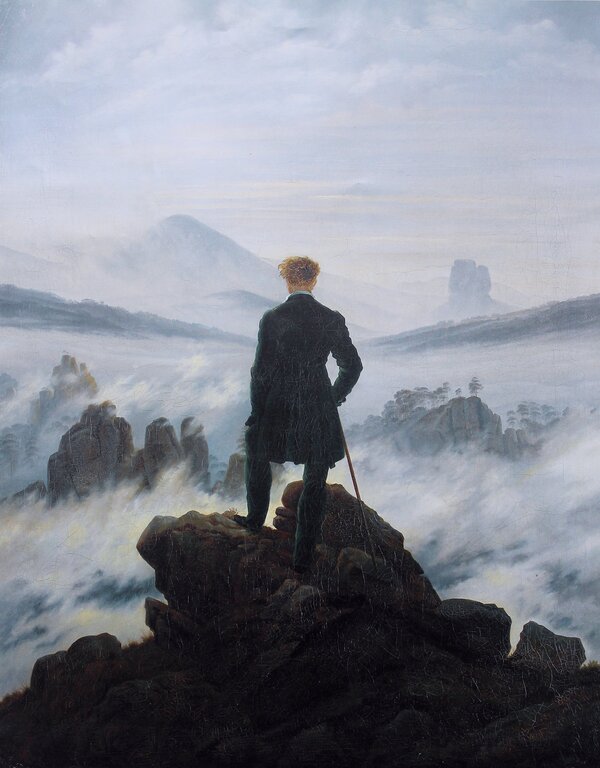
Caspar David Friedrich, «Wanderer Above the Sea of Fog, ” 1817
Central Question: Is there the sublime in trends, fashion, and pop culture? Hypothesis: Yes, if the artifact lacks a single creator and a singular purpose. In that case, it behaves like nature, but the sublime is concealed beneath the surface and must be revealed. Awareness of scale only becomes sublime when it transforms back into an image that the imagination cannot encompass. The chapters progress incrementally—from nature and cities through mainstream cinema, trends, and memes to AI brainrot—and each addresses its specific question. Simultaneously, the viewer’s sense of safety is examined: in film, it is given freely; in memes, they construct it themselves; and in the end, it proves to be an illusion.
The Sublime in Nature
In 1757, even before Kant, Edmund Burke described the sublime as immense, dark, and powerful—a horror that is safe and therefore pleasurable. In the «Critique of Judgment» (1790), Kant divides the sublime into two types, the first of which is the mathematically sublime: that which is vast beyond comparison. The imagination attempts to encompass the whole and fails, yet reason is still capable of conceiving infinity. From this gap is born a feeling: dissatisfaction with powerlessness and pleasure from the power of reason.
Steve Urwetson, «Milky Way over Black Rock Desert, Nevada, ” 2007
Thomas Furman, «Erg Shebbi in Evening Light,» 2021
Megaurab09, «Two Mountaineers in the Khumbu Icefall, ” 2026
MikelleBandin, «Sea of Clouds on the Summit of Mount Pulag, ” 2026
The second type is dynamically sublime: a power before which humans are insignificant—a thunderstorm, a volcano, a hurricane, a waterfall. Yet, it is only sublime when we observe it from a safe distance. According to Kant, the person who truly fears cannot judge the sublime (§ 28); they simply seek refuge. The power must be terrifying, but not to us in the immediate moment—we imagine the danger without being in it. At that point, fear transforms into a feeling that there is something within us that is beyond nature’s control.
NOAA, «Vessel NOAAS Miller Freeman in a Storm, ” 1975
Giuseppe Amenta, «Eruption of Mount Etna, ” 2021
Pyotr Goralek, «Lightning Over the ESO Headquarters, ” 2017
NASA, «Hurricane Isabel and the ISS, ” 2003
Falk2, «Devil’s Throat Viewpoint, Iguazú, ” 2018
Kant distinguishes between the beautiful and the sublime. The beautiful is a harmonious, bounded form: a snowflake, a leaf, a seashell. We admire it, but our imagination can handle it. The sublime, however, is formless and limitless, and judgment of it must not rely on an end goal: the starry sky is sublime not because we think about populated worlds and orbits assigned for some purpose, but because we see the vast expanse. Kant demands that we look at the object as it appears to the eye—without knowledge that is absent from mere contemplation: about purpose, utility, or even precise dimensions. Yet, knowledge can become an image again: the leaf is beautiful in itself, but if we imagine the millions of years of evolution behind it, that itself becomes a cause for the sublime. It follows that the sublime arises when the imagination fails to grasp the magnitude or power, and the judgment does not rely on the object’s purpose; in the case of power, the viewer must also feel safe.
Wilson Bentley, «Snowflakes, ” 1902
Julian Herzog, «Ficus Leaf in Sunlight,» 2014
Chris 73, «Nautilus Shell in Cross-Section, ” 2009
Handcrafted
Kant’s handmade sublime excludes: the goal of the object provides a measure for the imagination, and it is not lost. Every great structure also had a singular purpose: a tomb, a temple, a dam, a rocket. Kant retells the traveler Savary, who advised viewing the pyramids neither too closely nor too distantly, and describes the bewilderment of a person entering St. Peter’s Basilica for the first time. For such structures, he introduces two boundary cases. The colossal—an object that is almost too large to be comprehended: the goal still provides a measure, but with difficulty. The monstrous—an object whose sheer size destroys the purpose for which it was conceived. Neither of these, for Kant, constitutes a pure sublime.
Ludovic Delot, «Giza Pyramids and Camels, ” 2026
Giovanni Paolo Panini, «Interior of St. Peter’s Basilica in Rome, ” 1735
Mario Roberto Duran Ortiz, «Guvera Dam from the Air,» 2017
The relationship with a city is different. Old European cities were not planned as we see them today: each house had an owner and its own purpose, but none of those purposes encompassed the entire city. It grew over centuries, house by house, from thousands of individual decisions, lacking any overarching design. This is why the alleys, which are overly narrow today, were not laid out for the city it ultimately became. Therefore, when you look at such a city from above, your imagination has nothing to anchor onto—it’s like trying to measure a mountain range without a standard.