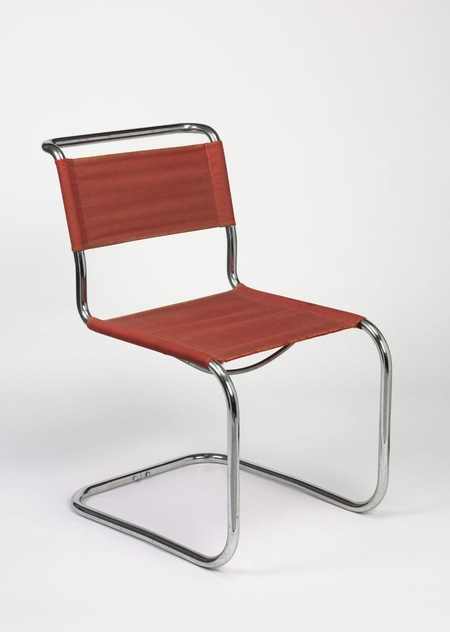
Furniture made from bent steel tubing is widely considered a symbol of the union between art and industry. Marcel Breuer’s chair, Martha Stamm’s and Ludwig Mies van der Rohe’s console chairs, Le Corbusier’s chaise lounge, and Charlotte Perriand’s designs look as if they rolled off an assembly line: thin, gleaming lines, a lack of ornamentation, and semi-transparent fabric seats. For this reason, they are often described as the first truly industrial objects of the 20th century. I am interested in how closely this image aligns with the actual history of their production.
Concept
Furniture made from bent steel tubing is widely considered a symbol of the union between art and industry. Marcel Breuer’s chair, Marta Stamm’s and Ludwig Mies van der Rohe’s console chairs, and Le Corbusier and Charlotte Perriand’s sunbeds look as if they came off an assembly line: thin, shiny lines, a lack of ornamentation, and semi-transparent fabric seats. Consequently, they are often described as the first truly industrial objects of the twentieth century. I am interested in how closely this image aligns with the actual history of their production. Research Hypothesis: Between 1925 and 1935, tubular steel furniture was primarily a visual metaphor for the machine, rather than a product of it. The avant-garde borrowed the language of line, shine, and transparency from bicycles, plumbing, and aviation, but they manufactured items in small batches with a significant degree of manual labor. Mass-produced tubular furniture only emerged when it ceased to be a manifesto and transformed into an anonymous chair for cafeterias, offices, and waiting rooms. Most significantly, its design concept—the «backless chair”—survived the material itself and transitioned into plastic.
The second plane is production. Museum descriptions and Christopher Willke’s monograph on Breuer show that an hired plumber helped weld the first chairs, nickel plating proved too expensive, and Standard-Möbel operated in small batches without steady demand. Mies’s «Barcelona» chair, which became the epitome of «machine» aesthetics, was originally intended as a formal piece for the king’s reception.The third plane is perception. Contemporaries already compared tube furniture to hospital equipment, and Alvar Aalto wrote in 1940 that steel conducts heat too well, while chrome produces too harsh a glare. It is telling that Breuer himself switched to bent plywood in England. If the image of the machine diverged from bodily experience, that divergence should be visible in the objects themselves.The fourth plane is consequences. I trace how tube furniture became mass-produced by firms like Thonet and PEL, how the B32 chair received the name «Ceska» and was reproduced almost anonymously, and how the console transitioned into Vernon Panton’s polyurethane and Konstantin Grcic’s engineering plastic. The irony of the 1980s designers, who restored the tube’s appearance as a finished industrial product, closes this journey.The primary research method is visual comparison. I pair objects together (bicycle and chair, Thonet chair and Breuer console, «Vasily» and «Paimio»), analyzing the construction using photographs from the Victoria and Albert Museum collection and illustrations from the 1981 MoMA exhibition catalog. The chronological scope spans from the 1840s to 2007, with a primary focus on the decade of 1925–1935, when the image was established.



















