Concept
The public role of a museum requires constant reflection: shifts in the cultural environment and audience expectations raise new questions about whom it serves, what values it upholds, and how effectively its activities meet its stated goals. Therefore, the relevance of museum self-critique is not limited to a single crisis—it is tied to the need to reassess the foundations of museum practice and to discuss these foundations with society. Such a reassessment, while potentially opening pathways for development, cannot guarantee obvious changes on its own. Today, studying self-critique requires uncovering both the content of the museum’s discourse and its impact on the institution’s relationship with its surrounding community.
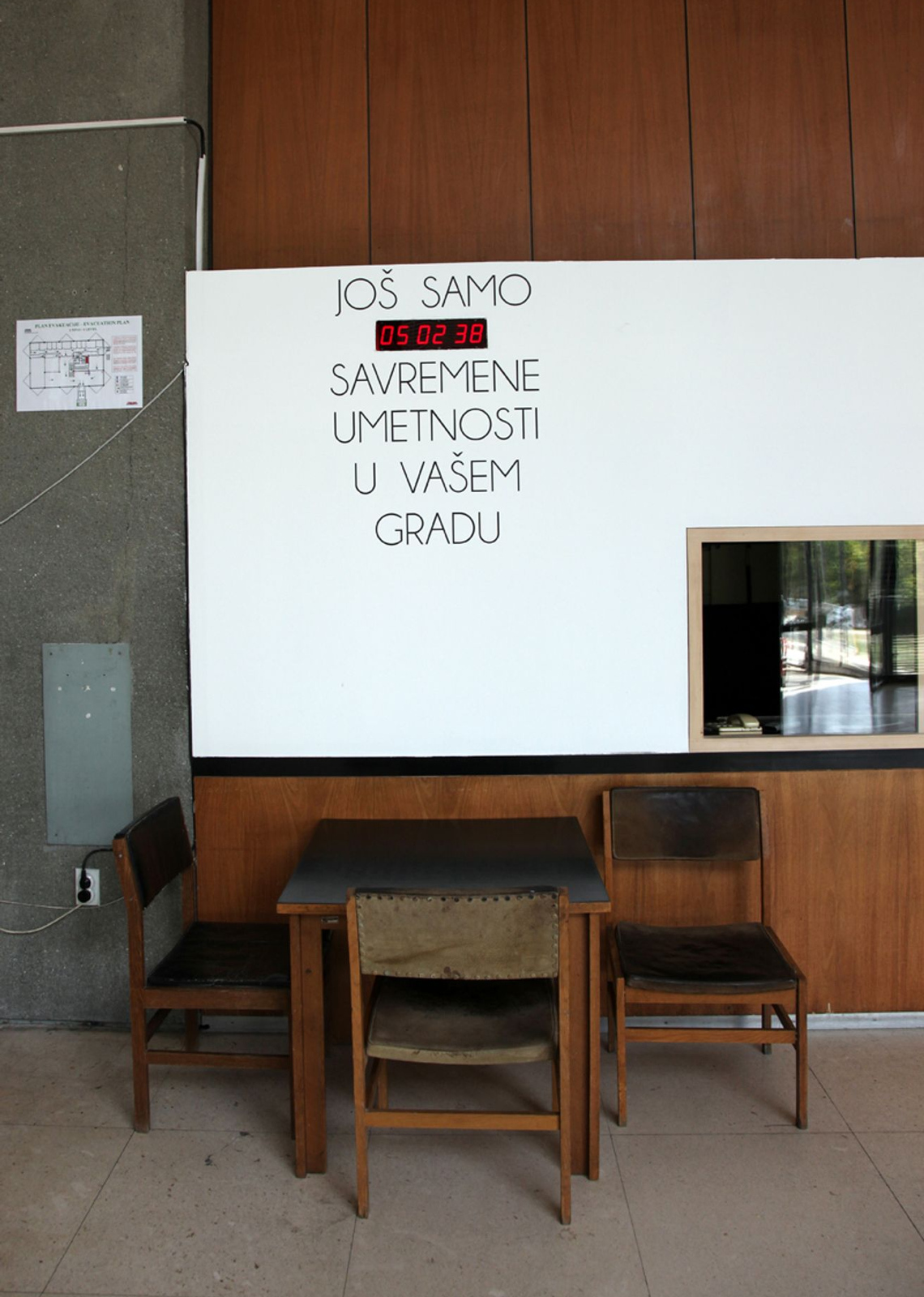
The problem described above is examined using the example of the exhibition, «What Happened to the Museum of Modern Art? ,» which took place in Belgrade from June 23 to September 30, 2012, amidst the prolonged reconstruction of the main building. The project integrated documentation of the reconstruction, artistic interventions, views of the unfinished interior, and unfulfilled promises by the state. Its organizers stated their intention to draw attention and support, as well as to open a discussion about the relationship between the museum and society. [1]
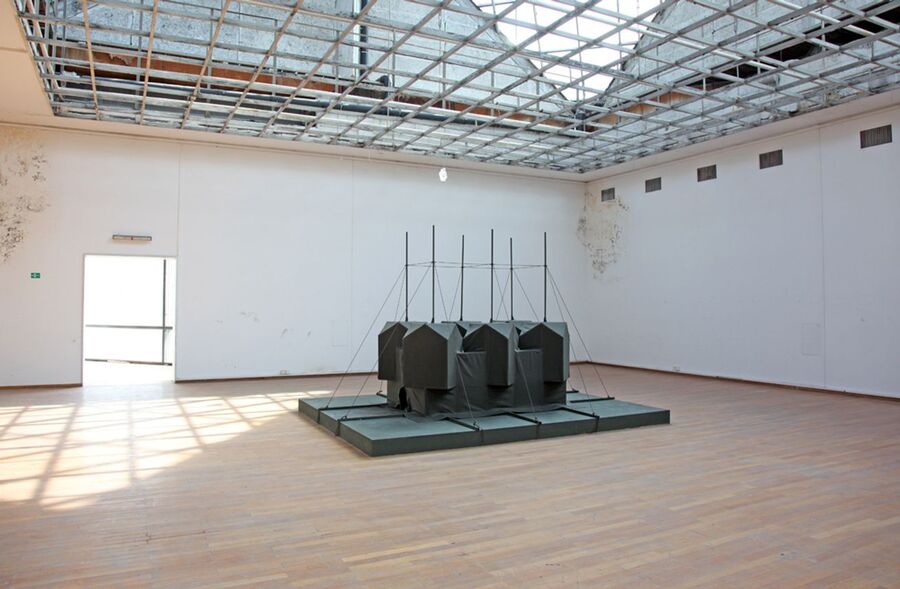
Fig. 1. Radosh Antonievich. «Museum of Contemporary Art Tent, ” 2012. Work as seen at the exhibition „What Happened to the Museum of Contemporary Art?“, Belgrade. Photographer not indicated in the source. Photograph source: Architectuul; information on the work: Museum of Contemporary Art in Belgrade.
The selection of the Belgrade case is driven by the fact that the museum simultaneously serves as the subject of an exhibition and as the organizer of its own narrative. This allows for an investigation into how the institution explains its own position. Seeking support within the explanation can be combined with a critical examination of the museum’s work, but the nature of this combination must be established through the project materials.
This study raises the question: to what extent can the exhibition «What Happened to the Museum of Contemporary Art?» be viewed as a self-critique of the museum, and what consequences for its relationship with the art community can be attributed to this project?
The working hypothesis posits that the exhibition, «What Happened to the Museum of Modern Art?» contains elements of self-critique: it brings to light the contradiction between the museum’s mandate to provide access to art and the inability of visitors to view its permanent collection in the main building due to prolonged reconstruction. It is hypothesized that this public deliberation of the contradiction helped strengthen support for the museum within the art community, leading the community to view the resumption of the main building’s operations as a shared professional and public responsibility.Testing this hypothesis relies on texts concerning institutional critique and new institutionalism. Andrea Fraser’s approach allows for the question of the institution’s own participation in reproducing the critiqued relations, while Nina Møntman’s work connects critical discourse with the structure and practices of artistic organizations. [2; 3] Other articles related to the research topic were also utilized. These concepts serve as the basis for the analysis, without pre-assigning the Belgrade Museum to new institutionalism.The primary source material for this study is the publicly available online documentation from the 2012 exhibition: general views of the galleries, images of artworks, and documentation and captions. The selection criteria are based on the confirmed origin of the photographs, their connection to the project, and the potential to examine significant details. Comparing the general views with the fragments allows for an analysis of the display sequence, the proximity of objects, and the engagement with the visitor. The museum’s history and the reconstruction are included only to the extent necessary to understand these curatorial decisions.
Fig. 2. Chronology of the museum’s adaptation, reconstruction, and expansion. Documentary section of the exhibition «What happened to the Museum of Modern Art?», Belgrade, 2012. The photographer is not cited in the source. Source: Architectuul.
The structure of the work follows the two parts of the research question. The theoretical section defines the foundations upon which self-criticism can be recognized and its consequences can be assessed. Subsequently, the exhibition solutions of the Belgrade exhibition are examined in detail. Following this, the Belgrade case is compared with other museum examples to observe the current state of institutional self-criticism: examples are selected based on differences in methods of addressing one’s own activities and the availability of documentation. Next, responses to the Belgrade project and potential changes in the museum’s relationship with the artistic community are analyzed. The conclusion determines the extent to which each part of the hypothesis is confirmed and what conclusions can be drawn from the available sources.
Institutional Critique and New Institutionalism
Critique from Within the Institution
In the article «From the Critique of Institutions to the Institution of Critique, ” Andrea Fraser examines the institution of art as a system of relationships, values, and actions reproduced by the participants of the art field. Museum organization is part of this system, so the mere presence of a critical statement within a museum does not strip it of its critical content: participants must investigate their own involvement in the relationships they are contesting. Fraser also suggests evaluating institutions based on how closely their actions align with the values they proclaim. [2]
For the case of the Belgrade museum, this implies the necessity of comparing the museum’s stated public mission with the conditions presented in the exhibition for accomplishing that mission. However, discovering a discrepancy does not automatically mean that the museum is critically examining its own position. It remains to be determined whether its decisions are being questioned or if the explanation for the crisis is entirely attributable to external forces. In this study, museum self-criticism is understood as the institution’s public examination of its own premises and practices, allowing for a discussion of their limitations and the possibility of revision. This is a working definition derived for the purpose of analyzing the material.
To apply this definition, it is necessary to distinguish between criticism of the museum by an invited artist and a critical self-examination of its own activities by the museum itself. The example of Hans Haacke helps to illustrate why the venue where an artwork is displayed does not necessarily determine whose position it expresses. [8]
Fig. 3. Hans Haacke. MoMA Poll, 1970. Information Exhibition, Museum of Modern Art, New York, July 2 — September 20, 1970. Photographer not specified. © Hans Haacke / VG Bild-Kunst. Source: Museo Nacional Centro de Arte Reina Sofía.
In MoMA Poll (1970), Haacke invited MoMA visitors to evaluate the political stance of Nelson Rockefeller—Governor of New York and a member of the museum’s board of trustees. The poll concerned his view on President Nixon’s policies in Indochina. [8] Two transparent ballot boxes incorporated visitors' responses into the exhibition itself. By doing so, the artist brought the museum’s political affiliations to public discussion; however, the exhibition alone does not prove that MoMA was reassessing its own position. Therefore, in the Belgrade case, it is necessary to determine how the statements of the invited artists relate to the museum’s curatorial narrative about its own crisis.Simon Sheikh, in «Notes on Institutional Critique, ” examines the shift of critical initiative toward museum curators and organizational leaders. This initiative can be aimed at both changing and strengthening the institution simultaneously. The author also draws attention to the composition of the collective „we“ of the art world: who gains visibility and representation, and who remains excluded. [4, pp. 1–2] This approach allows one to view the museum’s defense and its self-critique as potentially compatible actions. To verify the Belgrade project, one must examine who explains the crisis and whether the exhibition allows for positions that diverge from the organizers’ explanations.
Changes in institutional practice
On the other hand, when discussing shifts in institutional practices, critical work within the discourse on new institutionalism is connected to a reevaluation of how artistic activities are organized. Nina Möntman explores institutions where curators sought to transform functions, hierarchies, and relationships with various audiences. Exhibitions became part of a broader program of research, education, and collaboration. A prime example in her text is the Rooseum Art Center in Malmö, which developed as a space combining the functions of a public center, a laboratory, and an academy. [3]
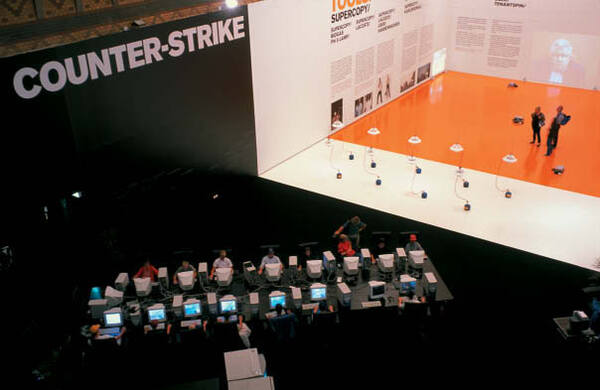
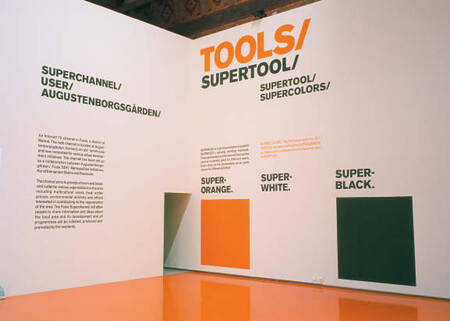
Fig. 4. SUPERFLEX. SUPERFLEX Tools + Counter-Strike. Exhibit view. Rooseum, Malmö, May 25 — July 21, 2002. Exhibit design: SUPERDESIGN. Photo: Vegar Moen. Source: SUPERFLEX / Tools catalog. Fig. 5. SUPERFLEX. SUPERFLEX Tools + Counter-Strike. Exhibit fragment. Rooseum, Malmö, May 25 — July 21, 2002. Exhibit design: SUPERDESIGN. Photo: Vegar Moen. Source: SUPERFLEX / Tools catalog.
The SUPERFLEX project at Rooseum included a Counter-Strike gaming café. [9] The above photographs show the juxtaposition of computer stations and exhibition stands: visitors were offered various ways to engage with the art center. This example reveals the expansion of the exhibition format, but the photographs do not clarify the extent to which participants freely shaped events or how their relationship with the organization evolved. Rooseum is presented here as an example of the history of new institutionalism; it functioned as an art center, not a museum.
Claire Doherty, in the article «The Institution is Dead! Long Live the Institution!», highlights the discrepancy between the promise of participation and the actual visitor experience. Declared openness does not eliminate the possibility of a pre-set script in which the individual is given a limited role. [5, pp. 2, 4, 6–7] Therefore, when analyzing the exhibition, one must consider the specific conditions of interaction and reflection: what information is available to the visitor, can they compare different explanations, and can they express dissent. The photographs and exhibition texts allow us to explore the proposed conditions, but information on how people utilized them requires searching other sources. This distinction is crucial for Belgrade as well: the stated intention to open public discussion must be compared with its documented content.
Critical Discourse and Its Implications
Nina Möntman argues in her research that public recognition of an experimental program does not guarantee its continuation. The organizations she describes attracted new local audiences and gained international recognition, but later faced downsizing and reorganization. For instance, in a 2007 article, she reported the transformation of the Rooseum into a branch of the Stockholm Moderna Museet and the budget cuts at the Vilnius Contemporary Art Center. [3] These examples highlight the distinction between success in public engagement and the sustainability of the organization itself. Applied to Belgrade, this means that public support and changes in museum operating conditions must be assessed separately.
Hito Steyerl, in her article «The Institution of Criticism, ” describes the possibility of symbolically incorporating critique without corresponding changes to institutional conditions. She also examines the contradictions involved in defending cultural institutions amidst nationalist demands and market pressures. [6, pp. 3–4] These points help frame the question of how a critical statement relates to subsequent actions. Furthermore, the absence of discovered organizational changes does not automatically allow one to declare the critique fictitious: the content of an exhibition and its practical consequences require separate evidence.
Evaluating the consequences of an exhibition requires separating the research from the justification of its public benefit. Eleonora Belfiore and Oliver Bennett demonstrate that studies of art’s impact often begin with the assumption of a positive outcome, reducing the inquiry to finding a way to measure it. The authors propose first determining whether the hypothesized impact exists and what its nature is. They also emphasize the complexity of generalizing about people’s reactions to art. [7, pp. 125–126, 137] Therefore, in this research, museum claims of support are compared with independent responses, and attention to the exhibition, agreement with its stance, and participation in museum defense are considered separately.
Conclusion
The analyzed works build a sequence for researching museum exhibition exposition. First, it is necessary to establish the subject of the critique and determine whether it addresses the actions and policies of the institution itself. Then, one must differentiate between the voices of the organizers, invited artists, and the public, and examine the ways they are presented. Analyzing the space and the artworks will clarify the means by which the issue is posed. A separate study of the responses will show what reactions the project elicited and what consequences can be reasonably linked to it. Other museum cases will be examined using the same criteria. The existence of self-critique in another museum does not prove its presence in Belgrade; the comparison refines the characteristics, which are then verified on the primary material.
Exhibition solutions within the museum
Organizers' Position and Exhibition Structure
The project ran from June 23 to September 30, 2012, in the museum’s main building in Ushche Park, which had been closed for reconstruction since 2007. [25] The concept was developed by the museum’s chief curator, Deyan Sretenovich; Una Popovich and Andrey Dolinka were also part of the curatorial group. [26] The organizers called the project a «non-exhibition» because the building did not meet the criteria for a typical museum show. The project merged the reconstruction archive, artistic interventions, and the interior itself. The main stated goal was to draw public attention and support; the museum also provided a platform to discuss the state’s and society’s relationship to its standing. [1]
Fig. 6. View of the halls for the project «What happened to the Museum of Modern Art?». Belgrade, 2012. The photographer and attributions for individual objects in the source gallery are not specified. Source: Architectuul.
The very phrasing sets the limit for self-critical reading: above all, a museum must help the viewer understand why it should be supported. This is aided by the vivid, emotionally structured exhibition: the helmets are arranged in rows on the wall, a separate object is placed in open space, and a passage is left between them. The photograph shows that there are no barriers near the exhibits, there is a significant amount of open space between the objects, and there is no control over the display or additional staging. This once again confirms the emphasis on a «non-exhibition» atmosphere within the display.
Documentation, reconstruction, and issues of liability
Fig. 7. Timeline of the museum’s adaptation, reconstruction, and expansion. Excerpt from the project «What Happened to the Museum of Modern Art?». Belgrade, 2012. Photographer unknown. Source: Architectuul.
The exhibition takes an unexpected turn: construction documents are displayed in galleries usually reserved for artworks, allowing visitors to reconcile the museum’s promise of accessibility with the prolonged absence of a complete exhibition. On the other hand, the disclosure of these documents and the acknowledgment of institutional responsibility require substantiation, as the archive has the power to significantly influence the viewer—whether by revealing contentious museum decisions or by corroborating the institution’s position as a harmed party. The available photograph shows a chronological arrangement, but the fine print does not clarify how responsibility is distributed among management, government agencies, and other stakeholders. Therefore, it cannot be concluded from the image that the museum has admitted to specific management failures. However, what can be established from this is the critical importance of the archive: the operational conditions of the institution become a part of the public display.When analyzing the exhibition through the lens of new institutionalism, it is important to distinguish between the public presentation of an issue and an actual change in the museum’s operation. In Nina Möntman’s description, the curators’ critical work addresses the organization of the institution itself. [3] The publication of the archive can become part of this work if it allows for the discussion of decisions and policies that the museum is capable of revising. In the Belgrade project, the existence of a public narrative regarding the reconstruction is confirmed, but its translation into a revision of management practices is not a conclusion derivable from the presented materials.
Digital Display and Limited Access