Concept
Immanuel Kant divides the sublime into two types. The dynamically sublime is associated with power—a storm, a volcano, a waterfall. The mathematically sublime is associated with magnitude, or quantity. Visual culture often engages with the first type: a storm, a disaster, an explosion. The Japanese photographer Hiroshi Sugimoto is interesting because he consistently chooses the second. In his photographs, nothing happens: an empty movie theater with a white screen, a calm sea with a level horizon.
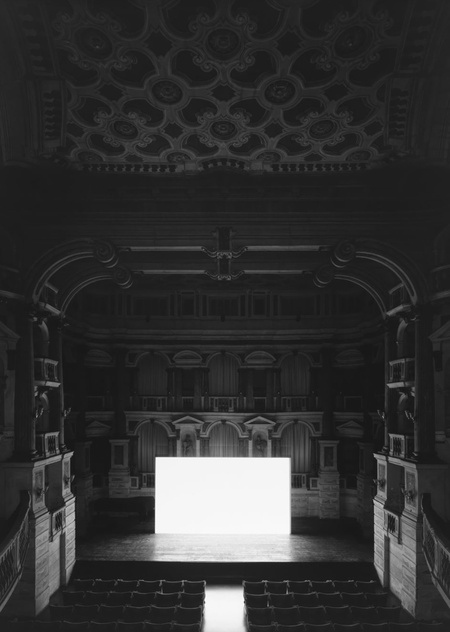
In the «Theaters» series (since 1978), Sugimoto places a large-format camera in a movie theater and leaves the shutter open for the entire screening. The two-hour film, shot at 24 frames per second, consists of 172,800 frames. All of them are placed on a single sheet of film, and the resulting print shows a white rectangle on the screen. In the «Seascapes» series (since 1980), he photographs seas from different parts of the world in one composition: water at the bottom, air at the top, and the horizon dividing the frame in half. I am examining whether these techniques can be described using the language of §§ 25–27 of «Critique of Judgment.»
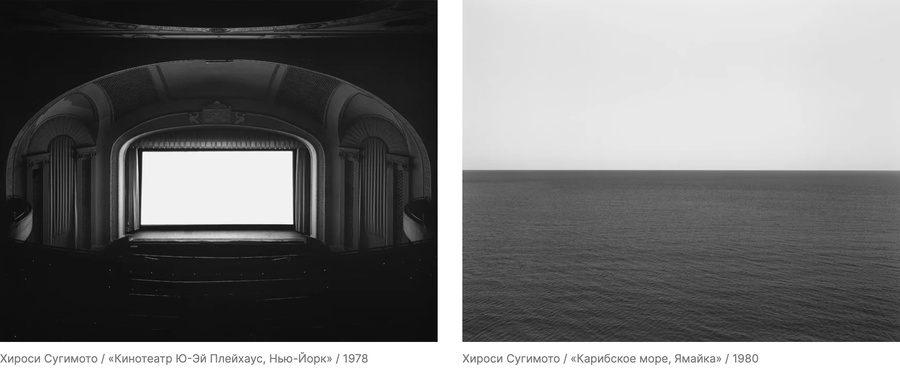
Hypothesis: Sugimoto constructs the sublime through quantity rather than intensity. In «Theaters,» quantity is given as the sum of temporal units, while in «Seascapes,» it is given as extent without units. In both cases, the viewer is aware of the magnitude but cannot synthesize it into a single contemplation. This discontinuity aligns with Kant’s description of the mathematically sublime.
The work proceeds in three stages. First, I extract propositions from Kant and Burke regarding quantity and convert them into five criteria applicable to the image. Then, I select photographs from two series using museum catalogs and the artist’s website, and I analyze each one against these criteria: which unit repeats, whether it can be counted, where the frame boundary lies, and whether there is a human figure in the frame as a measure. In the third stage, I group the photographs by quantity type, resulting in three modes: time, extension, and series.
The sources are divided into three groups. The first group consists of Kant’s and Burke’s texts in Russian translations. The second group includes exhibition catalogs by Sugimoto and his own writings on his series. The third group comprises museum collection pages detailing the technique and dimensions of the prints. The research demonstrates that the category of the 18th century functions as an analytical tool for late 20th-century photography. For the designer, this provides a practical result: a catalog of techniques through which an extremely simple image conveys an extremely vast scope.
The number of Burke and Kant
The sublime emerges in the moment when the count continues, and the image of the whole no longer coheres.
Edmund Burke, in A Philosophical Enquiry into the Origin of Our Ideas of the Sublime and Beautiful (1757), cites vastness and infinity as sources of the sublime. Since the eye cannot perceive true infinity, Burke introduces the concept of artificial infinity. This is created through the sequence and uniformity of parts. A row of identical columns compels the imagination to extend the line beyond the limits of what is visible. Burke explains this effect through physiology: each subsequent part repeats the impact on the eye, causing the tension to build.
Kant, in the «Critique of Judgment» (1790), shifts the question from physiology to the structure of cognition. In § 25, he defines it: the sublime is that which, in comparison with which, everything else seems small. In § 26, he describes the mechanism. Apprehension takes parts one after another and can proceed infinitely. Aesthetic comprehension holds the grasped parts in a single contemplation and has a limit. When apprehension goes further, the initial parts fade, and the whole cannot be synthesized.
Kant presents two examples. Regarding pyramids, one cannot approach too closely or move too far away: from a distance, the stones blend together, and up close, the eye cannot trace a line from the base to the apex. In St. Peter’s Basilica, the entrant experiences a sense of awe—the imagination cannot grasp the whole. Both examples are man-made, and both speak to the viewer’s position. There, Kant distinguishes between two judgments of magnitude. The mathematical is conveyed through numbers and has no limit. The aesthetic is conveyed through sight and has the greatest. The failure of the imagination yields displeasure, but reason demands the whole and discovers in humans a capacity that transcends the senses. From this, pleasure arises through displeasure (§ 27).
Five criteria for quantity
To apply Kant to photography, I translate his tenets into questions for the image.
Kant’s theory describes the viewer’s experience, not the properties of the object. An image can only create the conditions for this experience. I formulate each condition as a criterion and then test photographs against it. A photograph belongs to the mathematically sublime if the quantities within it cannot be encompassed: there are too many units (criteria 1–3), or there are no units at all and the magnitude extends beyond the edge (criterion 4). The fifth criterion shows whether the author leaves the viewer a point of reference for comparison.
Sugimoto’s Three Modes of Quantity
Sugimoto demonstrates the quantity in three ways: by aggregating units of time, eliminating units of space, and repeating the photograph itself.
Time: «Theaters» series
The unit here is a single frame of a film. The projector shows the frames one by one—24 per second—and the viewer catches them in quick succession. By the end of the screening, they remember the plot, but they retain none of the frames from the opening minutes. Kant describes the same phenomenon: the perception moves forward, and the initial segments fade away. Sugimoto’s camera retains nothing. It collates all 172,800 frames of a two-hour film onto a single sheet of film and executes a connection beyond the scope of imagination. The result emerges as a white rectangle. The whole is achieved, and yet it contains not a single image.
The white screen is the main evidence supporting the hypothesis.
Criteria 1–3 are met within the constraints: the element is present, the elements are consistent in format, and they cannot be counted by sight because they occupy a single space. The second row of elements is situated in a hall: identical empty chairs recede toward the screen following the laws of perspective. The hall is lit only by the film’s light; no people are visible—moving figures leave no trace during the exposure time. Criterion 5 yields a negative answer: there is no human figure in the frame to provide scale.
Series: «Seascape»
In the «Theaters, ” there are too many elements. In „Seascapes, ” there are no elements. Sugimoto removes the shore, the ship, the bird, the cloud with a distinct contour—that is, everything the eye could take as a reference point. What remains are the water, the air, and the line between them right in the center. The frame cuts the sea on the left and the right without any hint of an edge. Criterion 4 is fully met; criteria 1 and 5 yield a negative response. The score cannot even begin.
Kant himself cites the ocean as an example: it should be viewed as it appears to the eye.
In the «General Note,» after $\S$ 29, Kant requires viewing the ocean without knowledge of its inhabitants or utility: in repose, it is just a water surface, bounded only by the sky. Sugimoto fulfills this requirement through the medium of photography. The title of the photograph indicates the location, but the image itself does not confirm it: the Ligurian Sea is indistinguishable from the Baltic Sea. With a long exposure, the waves smooth into a uniform texture, and the water loses its last discernible details.