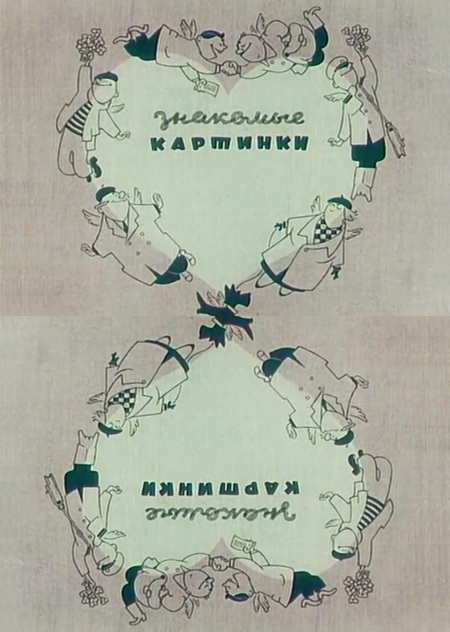
In 1957, a short animated film was released that blended traditional drawn animation with live-action footage starring Arkady Raikin, recounting seven miniature stories. «The first Soviet cartoon of the post-war period, whose footage was shot in a groundbreaking artistic style for its time—one that was entirely stylized (far from realistic depiction)[1].»
Sixty-seven years on, one cannot say that the content and meaning of «Familiar Pictures» are self-evident in 2024 (though this might be something to be pleased about). Yet, in seventy-six years, it will likely be even more difficult to grasp. The need to explain the sharpness of the animated film’s satirical humor—its relevance and provocation at that time (both in its visual style and its content) along with its moralizing motif—is present right now. The definition of satire is as follows: «a work of art that sharply and mercilessly EXPOSES negative phenomena of reality» [2]. The adjective «exposing» inherently contains the result of violating some explicit or implicit rule, an established norm, or a moral code. We learn about this violation precisely when something occurs in a manner inconsistent with the foregoing description.
It is ironic that the satire in the «Familiar Images» series exposes the «varnishing"—the depiction of reality that is far from realistic. This is why reality is harder to represent using realistic techniques.
«GLOSSING OVER REALITY» is an expression from the 1960s in the Soviet Union that meant «beautifying» real life and suppressing negative phenomena. It referred to the work of writers, filmmakers, and other artists and publicists [3]. This type of «beautification» is connected to the «Theory» of Conflictlessness.
While there is no developed theory openly advocating for conflict-freeness in Soviet literature and art, proponents of these views frequently articulated their positions in print, overlooking the contradictions arising from the struggle and overcoming obstacles in the process of building communism. In line with this, supporters of B. «t.» demanded the rejection of conflict in literature. At times, they acknowledged only the «conflict» between the «good» and the «excellent» [4].

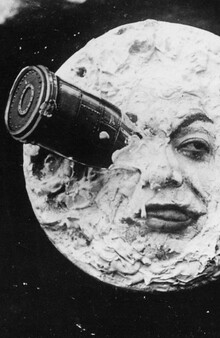
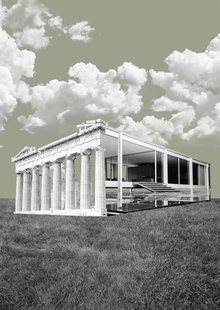
collage inspired by the movie poster
THE «NON-CONFLICT» THEORY—a conditional term in Soviet aesthetics, literary criticism, and literary studies—designates viewpoints that deny the legitimacy of a socially significant conflict in works of Soviet literature and art dedicated to contemporary life [4].
The method of «hiding» conflict contradicts, for example, the [unshakeable] tendency of Socialist Realism in the 1950s art, which assumed that even an artist should not distort reality by adding their personal perception to it. «Familiar pictures, ” however, are visually far removed from the realistic method of depiction („Long live statics!“), while simultaneously satirizing the [desired] images of a reality that is not that. The critique of Conflictlessness is the film’s existence itself—a narrative built according to this theory, yet the viewer does not believe in the reality unfolding on screen. The mission of this film is to allow the audience to see the contradiction „with their own eyes“ through the techniques of animation.
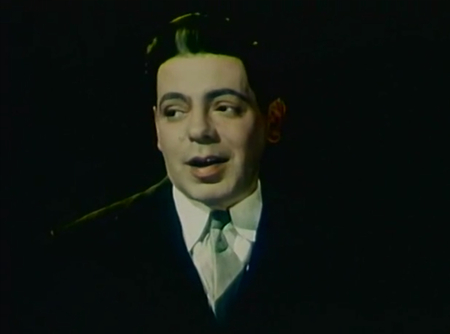
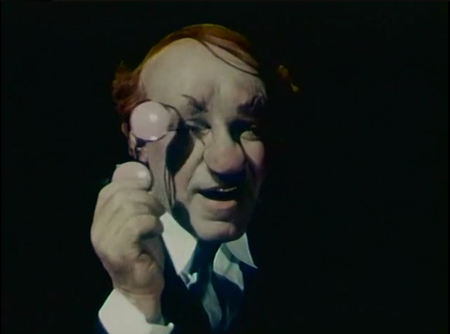
«Your glasses might be pink, your flaws might be pink, but they shouldn’t be there in the first place, ” — advice from the „Familiar Pictures“ workshop led by Arkady Raykin.
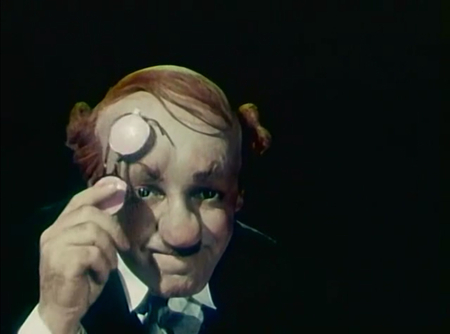
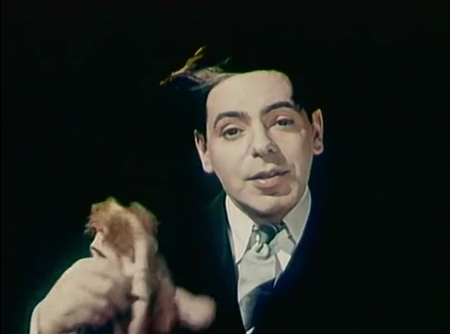
INDEX
Creators History of Creation by Migunov Miniatures

CREATORS
Screenplay by: Lev Arkadyev, Sakko Runge.
Director and Production Designer: Evgeny Mignunov.
Composer: Mikhail Meerovich.
Sound Engineers: Nikolai Prilutsky, E. Nesterov.
Cinematographers: Nikolai Voinov, Apollinarius Dudko.
Assistant Directors: L. Kovalevskaya, N. Maiorova.
Animators: Faina Epifanova, Dmitry Belov, Roman Davydov, Fyodor Khitruk, Boris Dyozhkin, Vyacheslav Kotyonochkin.
Performed and Voiced by: Arkady Raikin.
THE HISTORY OF CREATION BY MIGUNOV
Director and production designer, Evgeny Migunov, discusses the inception of the film-making process (in the article «On Khitruk»): «In 1954, I was making the film „Familiar Pictures.“ The film consisted of animated „pictures from an album“ (a frankly and even grotesque ‘lacquering’), interspersed with an acting overture, a narration, and the conclusion of the ‘living’ Raikin in two guises: as an actor and as the ‘lacquerer in pink glasses.’
Naturally, the approach to ‘animating’ these clearly drawn pictures had to be different. I entrusted Fedya [Fyodor Khitruk] with one of the scenes—the first one, the „Moskovsheevskaya”—because I needed to test the intended stylistic solution in practice.
<…> A few days later, Fedya invited me to the studio. <…> My disappointment was complete.
Before me on the screen, a monstrosity moved with a coarse, overly plastic, naturalistic design, demonstrating its inability to be shown in three-quarter angles, and it was excessively material. Adding to the naturalism was a „fashionable lady“ who reacted literally to every gesture and motive of the seller.
It was a failure. It smelled of amateurism and eclecticism.»
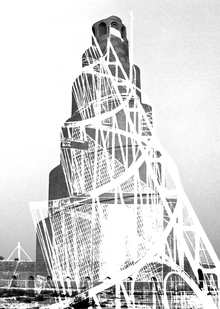
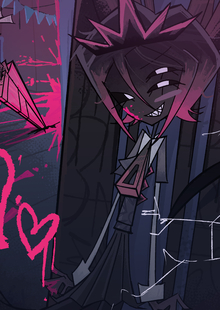
collage based on the movie cover
The next day: Fedya showed up, and we agreed: we would sketch the scene in the layouts now, film it tomorrow, and see what we had by evening! And the following evening, we saw—it had worked! And we saw it in the clearest way! We drew the conclusion: long live static! Expressive static is more important than smooth, melancholic action. A multi-layered ambiguity emerged that was just as powerful as an explicit statement. Both adopted this approach. But it benefited him, not me! I soon demobilized! I brought that painting to completion. And I received a very high rating from the jury and the ministry. I broke through the wall of the in-betweens with sheer force… I intended to create the next painting in a similar style, using the techniques and contrasts I had found, right after this one. But «The Session Attendees» («Mayakovsky by Bureaucrats»), which was brilliantly received by the jury in the stage of the director’s script, never saw the light of day. I was fired under Article 47 «b» of the Labor Code («for lack of premises» or due to a «partial reduction of the plan»)» [5].
Later, Evgeny Mignunov worked as an illustrator and cartoonist. He never had the opportunity to return to animation—he had «demobilized.»
Long live static! Expressive static is more vital than smooth, melancholic action. A polysemy has emerged that is no less powerful than a conclusive statement.
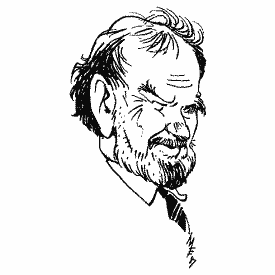
Yevgeny Tikhonovich Migunov — Director and Production Designer of «Familiar Pictures.» Born February 27, 1921, in Moscow. In 1938, he graduated from the Lepeshinsky Moscow Experimental-Demonstration School-Commune and then studied at an art school for one year. In 1939, he enrolled in the newly opened Faculty of Art at VGIK, joining the animators’ studio under Ivan Ivanov-Vano [6], who had begun his work at VKhUTEMAS.
(Self-portrait of E. T. Migunov)
MINATURES
1. First Miniature
Scenario. While shopping for ready-to-wear clothing, a citizen rejects any foreign-made garment offered, asking for «something Moskovian.» The sales associate laughs and replies that everything has already been taken by the morning.
Where is the truth, and where is it not? The seller’s emotional reaction is truthful. The advice to «come in the morning» is also truthful. However, we were analyzing the imported dresses because they had a slightly higher chance of being distinct from «mass-market goods,» or «shirpotreb.» The hidden social conflict—the homogeneity of the manufactured clothing set against the visible appearance of freedom of choice.
2. Second Miniature
Plot. A concerned person searches for someone who lost a thousand rubles. He asks passersby if any of them lost it, but they reply to him quite rudely in the negative. Exhausted by the search, the person leaves the banknotes on a bench, assuming that «he who lost it will retrieve it.» Next, another character appears, complaining about holes in his pocket. Seeing the money, he happily begins counting it and realizes he is holding a thousand. However, in his opinion, he lost 900. He concludes that the money is not his, leaves it on the bench, and returns to his own search, lamenting the depressing reality.