Concept
The visual culture of brand advertising has long been studied and understood: there is a client, a logo, a slogan, a media plan, and a measurable audience. But in recent decades, a strange client has entered advertising—the city. Cities have ceased to be mere settings and have transformed into competitors vying for tourists, investors, residents, and the «creative class.» From this competition, an entire discipline has grown—place marketing. As early as the 1990s, Philip Kotler and his co-authors described the city as a «product» that needs to be packaged and sold to various target audiences simultaneously. Meanwhile, Michael Cavarasis, in a seminal article, revealed the epoch’s main shift: the object of urban marketing is not the city itself, but its image in a person’s mind—and this image must be designed and managed as systematically as a brand.
The event has become the most expensive and most effective tool for this management. Donald Getz described the phenomenon of event tourism: a pre-planned event functions as a concentration of attention that positions a destination in the market and grants it a competitive advantage. Greg Richards and Rob Palmer introduced the concept of the «event city”—a city that builds not a single festival, but an entire portfolio of events as part of its identity, institutions, and programming. Eric Hithers described the „festivalization“ of urban policy: „declining“ industrial cities increasingly use culture and events as a tool of urban marketing, and the success of a festival is measured by the number of tourists, not its artistic content. In this logic, a festival is not a celebration, but an advertising campaign with a very long running time.
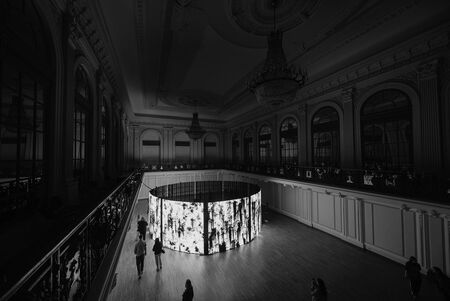
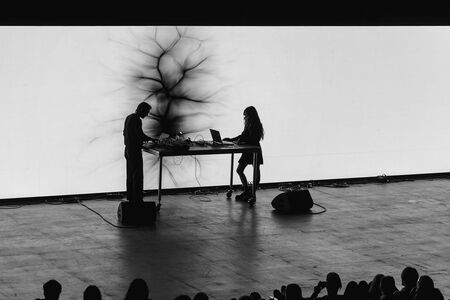
POST SCRIPTUM (2025) — Interactive installation at INTERVALS Festival 2025 / BLCK SUN (2024) — Audiovisual performance at INTERVALS Festival 2025
In this system, multimedia festivals—light shows, projection mapping, and digital and media art festivals—hold a special place. They possess two qualities that traditional advertising spaces lack. The first: the city itself becomes the medium. When a light projection falls onto the facade of an opera house, a cathedral, or an old embankment, the architecture functions as an advertising surface that cannot be purchased separately—you can only come and experience it live. The urban environment transforms from a backdrop into a screen, fundamentally overturning the familiar logic of outdoor advertising: the advertiser does not rent a surface; instead, they «perform» upon a surface that is already the message. The second: a festival cannot be «scrolled through.» Brand advertising is always in a race for attention, whereas a festival captures attention measured by the route length, the distance between installations, and the amount of time a person is willing to spend on an evening stroll through an unfamiliar city. Attention here is not bought—it is constructed within physical space.
However, the genre itself is contradictory. The festival simultaneously functions as an art event with its own curators, artists, and elite agenda, and as a marketing tool that the city administration and tourism departments incorporate into regional development strategies. These two roles inhabit the same project, constantly vying for the budget, the program, and the performance venues. In this work, I investigate precisely how this dual mechanism transforms a multimedia festival into city promotion and what visual and organizational techniques this promotion employs.
Key research question: How do multimedia festivals function as a tool for city promotion—what visual and communicative strategies do they employ, how is the festival’s image transferred to the city’s image, and why, in some cases, is this transfer cemented for decades while in others it remains a one-off event or dissolves?
My hypothesis is that the multimedia festival functions not as a city’s promotional campaign, but as its long-term framework—a «seasonal campaign» that is relaunched annually and accumulates cultural significance. Cities don’t simply «host a festival»; they construct an image through it that is difficult to achieve by other means—an image of a city that «is tech-savvy.» Light and projection operate as a language here: a dark evening, transformed facades, a route through the historic center—the viewer experiences the city simultaneously in the past (its architecture) and the future (media art), and it is this contrast that forms the advertising message.Moreover, unlike brand advertising, where the advertiser controls the message, the city’s festival advertising is always partially co-created with the audience. The viewer doesn’t receive a message—they walk the route, photograph the installation, post their pictures, and become a distributor of the city’s image themselves. Therefore, festival advertising is strongest when the festival’s visual code aligns with the city’s identity—and it weakens when the festival «outgrows» the city and becomes generic, reproducible anywhere in the world.
The objective is to identify the primary ways multimedia festivals construct the promotional image of a city and to determine how this image correlates with the territory’s actual economy and identity.
The study employs a comparative visual analysis of twelve festivals and cities. The materials are examined according to several criteria: initiator (city, state, industry), visual language, target audience (tourists, residents, professional community), measurable impact (number of visitors, economic contribution, media coverage), and the long-term sustainability of the effect.
Four analytical categories are used for systematization: repositioning (where the festival changes the city’s identity), seasonal tourism product (the festival as a driver of the off-season), official platform (the festival as a showcase for the state or city), and professional B2B venue (the city as an industry exhibition booth). While these categories are not intended to be universal, they allow for the comparison of different «regimes» of festival promotion and reveal where visual techniques align and where they diverge.
The research proceeded in several stages: selecting festivals with well-documented histories and measurable impacts, examining the cultural and economic context of each city and initiative, visually analyzing festival materials and media coverage, categorizing the materials, and cross-referencing the findings. It was crucial that the case studies were recorded in public domains—festivals have official reports, economic studies, press coverage, and academic papers. This selection allows for the observation not only of visual techniques but also of how the organizers themselves articulate their objectives. The theoretical foundation is built upon studies of place branding and event tourism: Kotler’s work on place marketing, Cavarazi’s article on the shift from urban marketing to urban branding, Gertz’s work on event tourism, the book «Eventful Cities» by Richards and Palmer, and Hitter’s observations on the festivalization of urban politics. Concurrently, reports on the economic impact of specific festivals—SXSW, Coachella, Lumiere, Edinburgh Festivals, Vivid Sydney—and official documents from the UNESCO Creative Cities Network were utilized. I also relied on publications concerning Russian media art festivals to connect the observations to the Russian context.
Repositioning: The Festival Changes the DNA of the City
The most powerful form of festival advertising is the kind where the festival doesn’t just bring tourists—it changes how the city views itself. This is a rare instance where the advertising effect works both inward, on the residents, and outward, on the external world, simultaneously. First, the city begins to see itself differently, and only then does the rest of the world perceive this new image.
Ars Electronica, Linz
Priz Ars Electronica 2020 / Ars Electronica Animation Festival 2025 on Tour
Linz—Austria’s third-largest city—was fifty years ago an industrial stronghold, dominated by the massive voestalpine plant on the Danube. It had the reputation of a working-class district, a place people went to work, not to sightsee. In 1979, the first Ars Electronica festival took place there—a confluence of art, technology, and society. The festival’s directors framed their goal using almost promotional language: to create a new image for the city. In 1987, the Prix Ars Electronica was established—an award for digital art that established Linz as a destination attracting the professional community every year. In 1996, the Ars Electronica Center opened—a glass «crystal» on the Danube embankment, whose media facade alone became the city’s visual signature: the building glows and reacts to passersby even before any festival begins. The momentum continued to build: in 2009, Linz was named the Cultural Capital of Europe, boasting a budget of around 69 million euros, thousands of cultural events, and millions of visitors annually.
ARS ELECTRONICA CENTER Photo: Ars Electronica, Robert Bauernhansl
The visual language of Ars Electronica is built on contrast: a gray industrial backdrop set against a flash of media art. The festival installations are placed not in galleries, but in tunnels, former factories, and monasteries—the city itself becomes a showcase of what it is «reinterpreting» about its industrial nature. The economic impact has accumulated over decades: the festival attracts approximately 100,000 visitors annually, a notable portion of whom travel from abroad, and major technology companies seek out Ars Electronica for consulting.
Intervals, Nizhny Novgorod
A direct mirror of the Linz case study within the Russian context. The Intervals Media Art Festival has been held in Nizhny Novgorod since 2017, initiated by the dreamlaser studio. It is telling that in the official project presentation, the goals are formulated not in artistic, but in marketing terms: to create an image of Nizhny Novgorod as the «technological and multimedia capital of Russia, ” to raise the city’s and the production company’s visibility, and to improve the quality level of events in the region. This is almost a documented case of a festival that was designed from the outset as a city advertisement—complete with a defined target audience (youth, families, opinion leaders, media) and a logical route through the historical center.
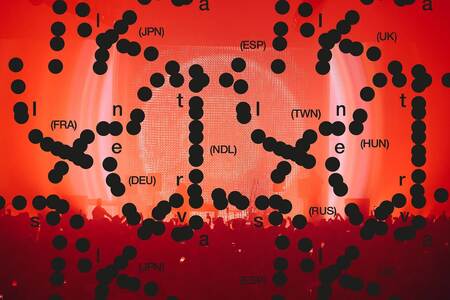
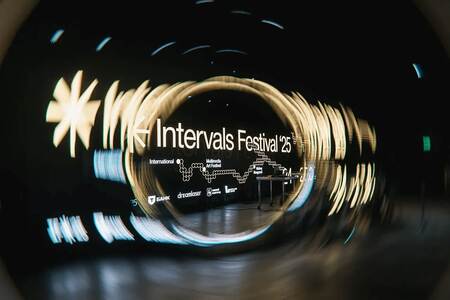
Intervals Festival '25
The audience dynamics demonstrate a cumulative effect: around 20,000 visitors in the early years, approximately 150,000 by 2023, over 450,000 by 2025, and more than 500,000 in the following season. Institutional recognition is also growing: the regional government increasingly presents the area as the most developed in multimedia technologies, relying on festival statistics. Visually, Intervals functions as a «collection of urban illumination»: installations are distributed along the Oka and Volga embankments, Strelka, historical parks, and lesser-known spaces, making the festival route simultaneously an advertising tour of the city. Here, the festival literally performs the function Cavarasis described as «the city as a product»: the viewer, who comes to see an installation, is simultaneously touring Nizhny Novgorod—and returns home with a new visual impression of it.
Seasonal Tour Product: Light as the Engine for the Off-Season
The second strategy is the most pragmatic. Most tourist cities face a «low season» problem, and light festivals solve it with minimal infrastructure investment: stadiums and hotel complexes are not required—only darkness, building facades, and a route.
Vivid Sydney
The grandest example. Vivid Sydney—a festival of light, music, and ideas launched in 2009 and owned by the New South Wales state tourism agency. The key visual element is the «Lighting of the Sails»: projections onto the sails of the Sydney Opera House, which transforms the city’s main icon into a screen. The festival runs during the Australian winter—in May–June—which is the off-season, and this is not accidental, but demand engineering: the city fills its tourism «dead» weeks with an event that cannot be replicated in the summer without losing the magic of the darkness.
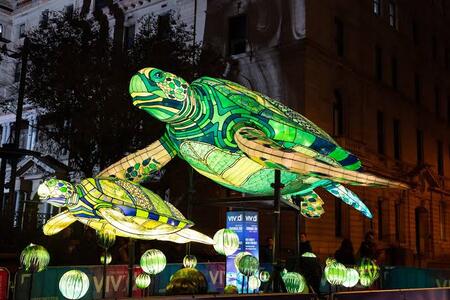
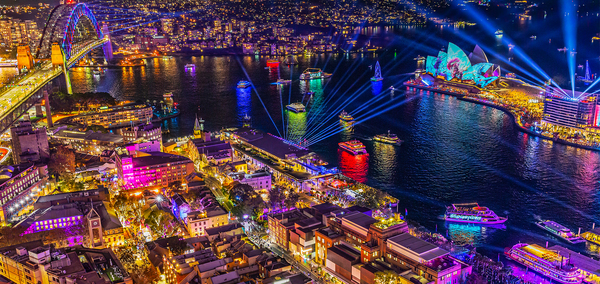
Vivid Sydney 2024
The numbers here speak louder than words: the festival audience grew from hundreds of thousands in its early years to a record 2.4 million people in 2019. Following the pandemic, the festival recovered, gathering over 2.5 million participants in 2024 and bringing hundreds of millions of dollars in tourist spending to the city. But the most compelling metric isn’t economic—it’s reflective: in 2019, Vivid hosted one of the country’s first conferences on territorial marketing. At this conference, the festival itself was discussed as a case study—its work positioning Sydney as a global hub for creative industries was named the best example of place branding in action. The city uses the festival so confidently as a form of advertising that the festival has become the venue where lectures on festival promotion are given.
Lumiere, Darem
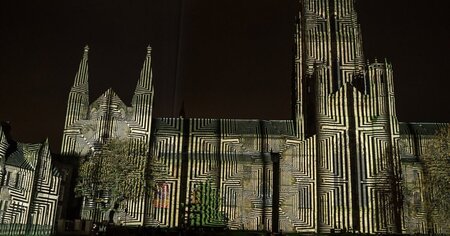
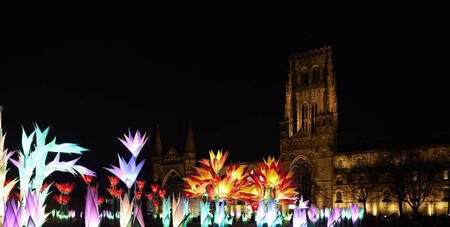
Lumiere Durham 2025
The opposite scale—and perhaps the most visually evident economy. Lumiere is a light biennial held in Darmer, England, launched in 2009 by the production company Artichoke. Here, installations were placed on 12th-century cathedrals, bridges over the River Weir, and the facades of university colleges—the city’s historical architecture itself became part of the narrative. In 2011 and 2013, the Lumiere model was replicated in Derry-Londonderry as the culmination of the city’s year as UK City of Culture: tens of thousands of visitors—more than twice the city’s resident population—came to watch projections on 17th-century city walls. In Darmer alone, the festival attracted over a million visitors over a decade and a half and brought tens of millions of pounds to the local economy; individual events earned back the city budget many times over.