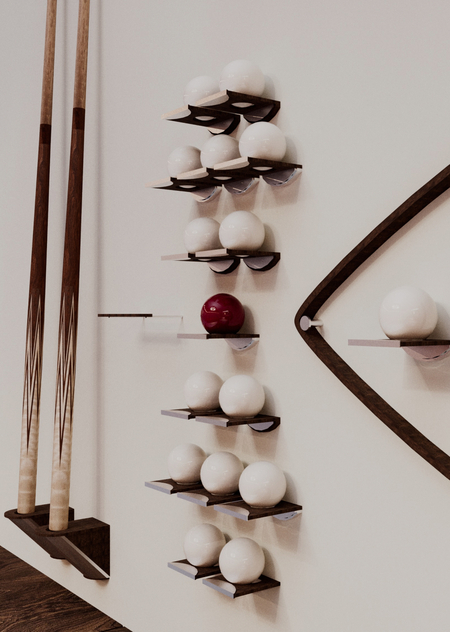
«Module» is a system of compact wall-mounted modules made from wood and aluminum, designed for storing Russian billiards accessories. Individual components are intended for holding one ball, vertically storing cues, and keeping chalk and the triangle organized. The user independently determines the number of modules and their arrangement on the wall. The core structure involves joining wooden parts with a bent aluminum sheet that is 1–2 mm thick; the metal elements slot into prepared grooves, complete the product’s shape, and conceal the wall mounts. The warm texture of the wood complements the glossy surface of the metal. The system organizes the space next to the billiard table, allowing users to create a composition tailored to a specific set of accessories and configured to fit any wall.
Concept and Scenario
At the core of the project is an individual space for each element. Instead of a single unit with a back panel, small, independent modules are used, which can be assembled into a symmetrical or free-form wall composition.
Before playing, the user removes the cue from two supports, takes the chalk, triangle, and balls. After the game, the equipment is returned to its place. The cue is stored both vertically and at an angle: the lower module bears its weight, while the upper one maintains the angle. Each ball is placed on a separate shelf.
The system is suitable for a home billiards room or a small club area. Its composition can be expanded by adding holders for new cues and balls.
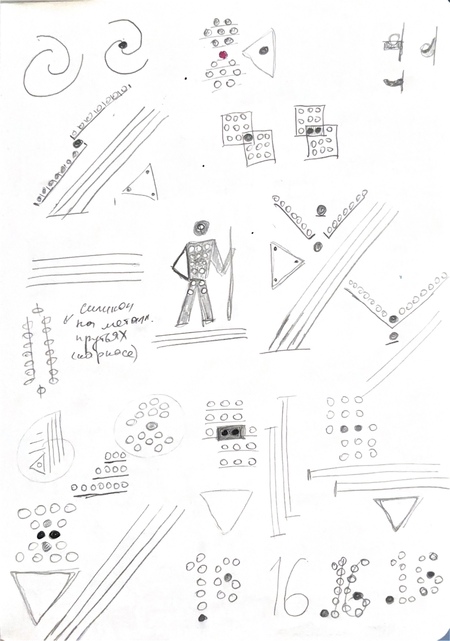
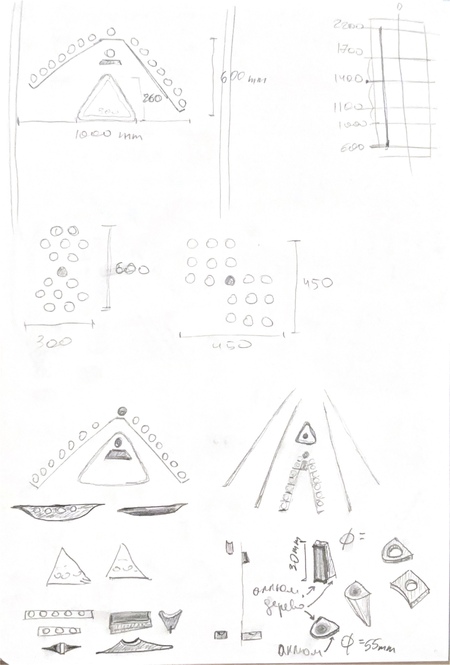
Sketches
Materials
Wooden components should be crafted from solid ash or oak. The visible wood grain becomes the primary decorative element. The surface is sanded and coated with matte furniture oil mixed with wax or a protective lacquer.
For curved inserts, 2 mm thick aluminum sheet suitable for cold bending, such as AMg2M, is used. The metal is given a matte-sanded finish; the edges are rounded, smoothed, and deburred.
The chalk tray stoppers are made from aluminum rod, and the triangle hanger is made from an aluminum blank. Thin, soft pads are provided at the contact points with the chalk to protect the surface.
Construction and Assembly
The system includes five types of elements:▫️ Chalkboard Shelf A wooden platform, 160 mm long and 100 mm deep, featuring aluminum rods that allow for hanging the play glove.▫️ Triangle Hanger (3 pcs) An aluminum pin, 35 mm long, with a retaining flange at the end. Designed for light load bearing.▫️ Single Ball Holder (16 pcs) A wooden module, 80 mm wide and 100 mm deep, with a seating recess that prevents the ball from rolling off. Aluminum inserts complete the design: one covers the mounting holes, and the second protects the wood from damage when colliding with balls while serving a decorative function.▫️ Top Kyu Holder A wooden base, 20 mm high and about 10 mm deep, with an aluminum piece forming an open groove for the upper part of the kyu. The insert is installed after mounting the base and conceals the attachment holes.▫️ Bottom Kyu Support A wooden stand with a receptacle for the bottom end of the kyu and a decorative aluminum insert that covers the mounting holes.
Wall Placement Variations
First, the wooden bases are secured to the wall using screws and fittings chosen to match the wall material. Next, the bent aluminum pieces are inserted into the grooves. Restraints are provided in the joints to prevent the insert from accidentally slipping out.
The distance between the top and bottom supports is selected according to the specific pole. The size of the upper groove and ease of removal are tested on a full-scale prototype.
Production Technology
Production begins with preparing blueprints and creating a prototype set to test the dimensions, joints, and stability of the items.The wooden blanks are cut and then milled: the outer contour, recesses for aluminum, seating pockets, and mounting holes are formed. After rounding the edges, the pieces are sanded and coated with a protective finish.The aluminum inserts are cut from 1 or 2 mm thick sheet metal using a laser or a milling machine. The blanks are cleaned of burrs, bent on a sheet metal bender, and receive final surface finishing. The rods are cut and the ends are finished; the triangle hanger is made using a lathe.The final operations include final assembly, checking the fit of the inserts, testing the fasteners, and packaging. For a small series, identical processing programs and templates are used to ensure part repeatability.
Cost of producing a small run and minimum print quantity
The calculation was performed for a complete set of 24 modules:
• 4 supports for two kites—two upper and two lower; • 16 individual shelves for balls; • 1 shelf for chalk; • 3 aluminum brackets for triangles.
For a preliminary estimate, a series of 10 sets—240 modules—was considered. Materials include ash or oak with a matte protective finish, 2 mm aluminum sheet, and aluminum rod. Repeating parts are processed in a single batch, which reduces equipment setup costs.
▫️ Wood, aluminum, hardware, and consumables Per set, in a series of 10 sets: 2,500–3,500 ₽
▫️ Wooden parts processing: cutting, routing grooves, recesses, and holes Per set, in a series of 10 sets: 5,500–8,000 ₽
▫️ Aluminum parts fabrication: cutting, bending, and processing rods and pins Per set, in a series of 10 sets: 3,500–5,500 ₽
▫️ Sanding, protective finishing, final assembly, and packaging Per set, in a series of 10 sets: 5,500–8,000 ₽
▫️ Total fabrication cost per set Per set, in a series of 10 sets: 17,000–25,000 ₽
One-time production preparation—including the development of technical drawings, processing programs, and setup—is preliminarily estimated at 10,000–20,000 ₽ for the entire series.
Thus, the cost for the first batch is:
10 × (17,000–25,000) + 10,000–20,000 = 180,000–270,000 ₽.
Considering the distribution of production setup costs, one full set of the first series will cost approximately ₽18,000–₽27,000. The minimum technically feasible run is one complete set. For a single sample with production setup, it is advisable to budget ₽30,000–₽45,000. We recommend a starting run of 10 sets—this allows for the distribution of preparation costs and the manufacturing of repeating elements as a cohesive batch.
Visualization
Drawings
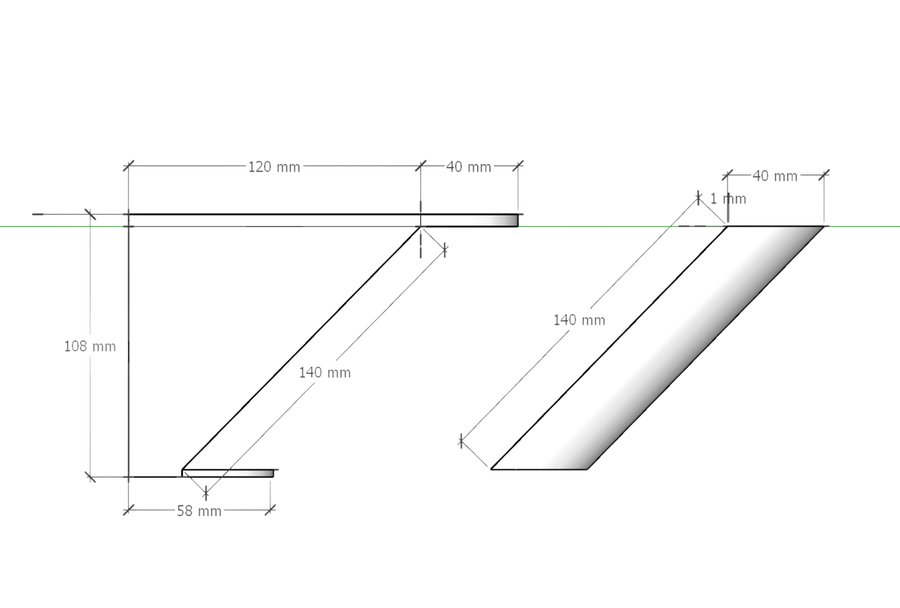
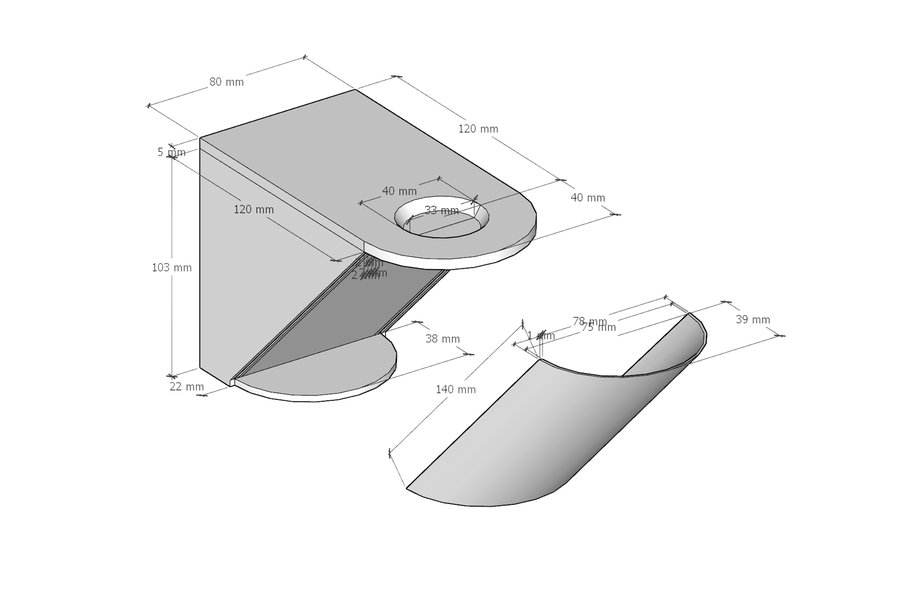
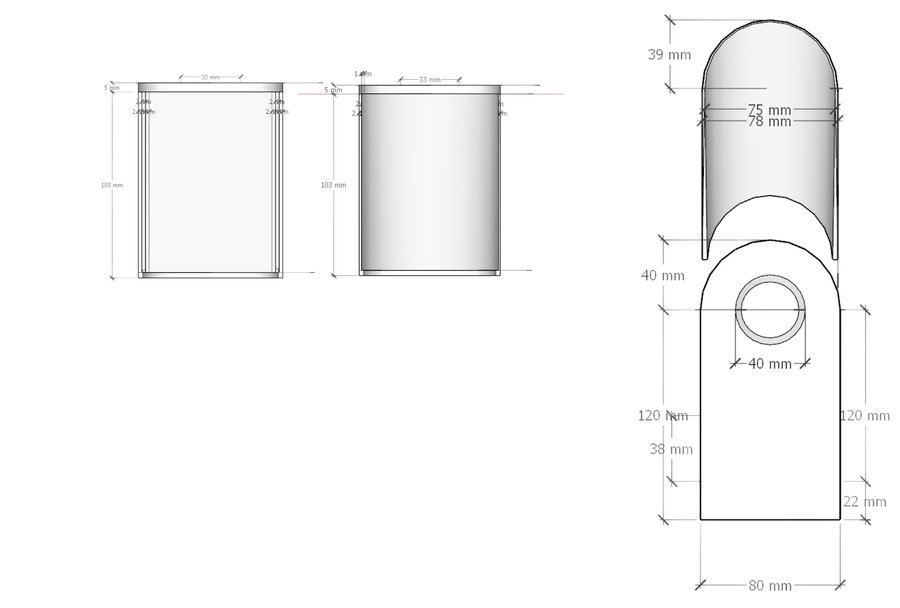
Lower module for key
Top module for the key
Module for the sphere
Chalk Module