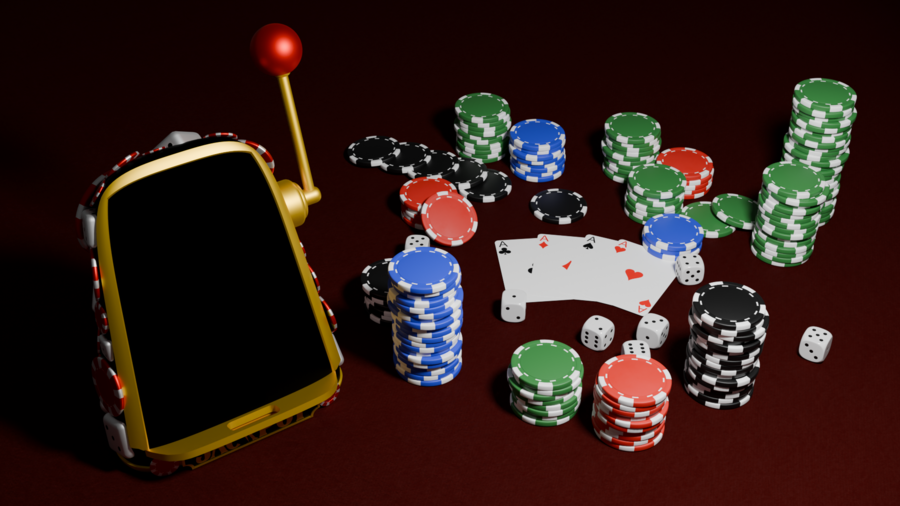
Smartphone stand in the form of a slot machine: a golden casing, red and white chips, dice, and a lever with a red handle. The phone on the stand becomes the machine’s screen, and every swipe of a finger across the strip is another bet.
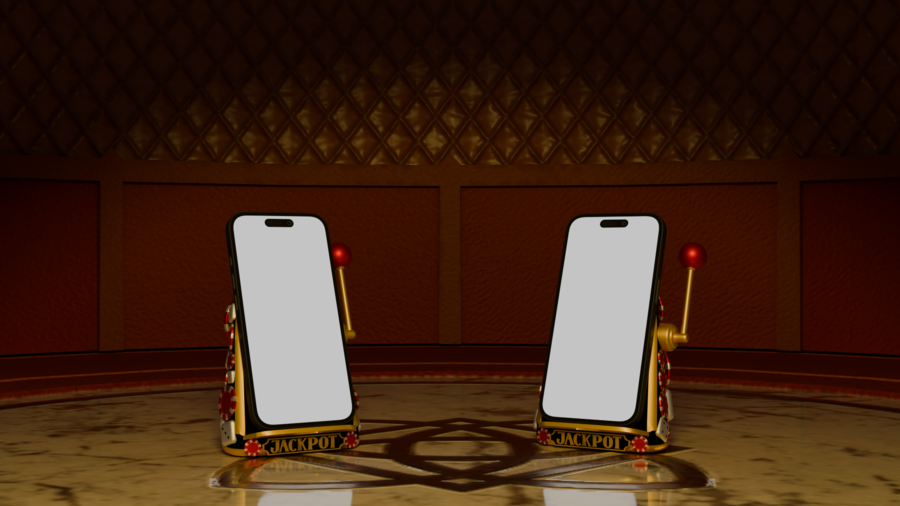
The object continues the game «The house always wins, ” which deconstructs how the gambling industry manipulates users. This stand transfers that theme onto the desktop, linking casinos to doomscrolling: just as a player repeatedly pulls a lever, we repeatedly scroll our feed while anticipating a „win”—a funny video, a like, or a news item.
It is a tabletop accessory for those who understand how digital traps work and know that they are susceptible to them. An ironic reminder that sits right before your eyes while conveniently holding your phone.
Concept
Doomscrolling as a gambling game. The social media feed operates on the same principle as a slot machine: the reward comes unpredictably, making it difficult to stop. The concept makes this parallel literal—the phone screen takes the place of the reels, and the habit of scrolling becomes a new bet.
Target Audience
Women aged 21–28, starting marketing specialists who often work from home. They are knowledgeable about digital ethics and psychology, yet they recognize their own susceptibility to doomscrolling. They purchase the stand as an ironic reminder to themselves. For them, it is crucial that the irony is apparent at first glance, while the object remains convenient for daily use.
Use Case Scenario
The stand sits on the desk. The phone is easily visible during work, calls, and video. When a hand reaches out to grab it and «just check the feed, ” the device reminds you: this is just another commitment.
Dimensions
Height: 111 mm Height including lever: 136 mm Body width: 92 mm Width including lever: approx. 101 mm Depth: 69 mm
Materials
Main material — PLA plastic: it is accessible, prints well on the workshop’s FDM printers, and is easy to sand and paint.• Casing and back cover — PLA. • Lever — PETG: it is stronger against bending and will not crack from constant movement. • Handle and accents — photopolymer resin: printing yields a smooth surface and crisp edges for small components. • Phone slot insert — TPU, flexible plastic: it does not scratch the phone and prevents it from slipping. • Cubes — ready-made 10 mm acrylic cubes. • Feet — self-adhesive silicone bumpers. • Weight — steel washers totaling approximately 150g. • Finish — primer-filler, metallic gold acrylic paint, glossy varnish.
Construction and Assembly
The stand consists of the body, the back cover, and the mounting parts. The body is assembled with screws, so it can be taken apart with a screwdriver.
• Body — a hollow part with 2.5 mm walls. On top, there is a phone slot 14 mm wide and angled at 70 degrees to the surface; it accommodates phones in cases up to 12 mm thick. Before the slot, there is a 10 mm high lip to prevent the phone from slipping. • Back Cover is fastened with four M3×8 screws into brass thermoserts. Beneath it is a compartment for the weight. • Weight shifts the center of gravity downward and backward so that the stand does not tip over under the weight of the phone. • Lever • Handle — a 18 mm diameter ball that slides onto the lever and is secured with glue. • Fittings with a 16 mm diameter and cubes are glued into shallow recesses on the body: their position is determined by the model and is replicated in every unit. • Four silicone feet are glued to the bottom.
Assembly Order: Thermoserts — Weight — Back Cover — TPU overlay in slot — Lever; Handle — Fittings and cubes — Feet.
Production Technology
All plastic components are printed in the School’s workshop.• FDM Printing (housing, lid, lever, overlay): nozzle 0.4 mm, layer 0.16 mm, 3 perimeters, 20% infill (gyroid). The housing is printed bottom-down; the groove requires no supports due to 45° chamfering. • Photopolymer Printing (handle, pegs): layer 0.05 mm, washing in isopropyl alcohol and post-curing. • Housing Finishing: sanding (P240, P400, P800), 2 coats of filler primer, spray-on gold paint, clear coat. The handle and pegs are painted with red and white enamel.Printing one complete set takes approximately 10–12 hours, with a material consumption of about 150 g of PLA. For the series, the painting step can be substituted with printing in gold silk PLA—this eliminates the longest stage, but the print layers will be more visible.
Fabrication Methodology
The stand will not be created as part of a course, so below is the methodology by which it can be reproduced without the author’s involvement.01Modeling. The components are modeled in CAD software taking printing into account: 2.5 mm wall thickness, 0.2 mm gap in connections, and 4.2 mm holes for thermal inserts.02Technology Test. A fragment of the housing with the groove and the lever mechanism is printed at 1:1 scale. On this fragment, the tilt angle, the groove width on a phone in a case, and the lever turning force are tested, after which adjustments are made to the model.03Printing. The housing and lid are printed in PLA, the lever in PETG, and the overlay in TPU on an FDM printer; the handle and knobs are printed on a photopolymer printer with washing and post-curing.04Post-processing. Supports are removed, the housing is sanded (P240, P400, P800), defects are filled with putty, followed by two coats of primer with intermediate sanding.05Painting. The housing is painted «metallic gold» in 2–3 thin layers, drying for 24 hours, and lacquered. The knobs have a white base and red segments applied with masking tape. The handle is coated with red enamel and glossy lacquer.06Assembly. The thermal inserts are soldered at 200°C, followed by the installation of the weight, lid, overlay, lever with handle, knobs, cubes, and feet.07Quality Control. The phone in the case can be picked up and placed down with one hand; the stand does not tip when the screen is touched; the lever maintains its position; and the surface has no chips.08Packaging. The stand is placed in a corrugated cardboard insert and a box measuring 130×110×90 mm.
A small series
Minimum Run — 1 piece: printing does not require plates or setup.Estimated material cost for a run of 10 pieces is 700–900 ₽ per item, excluding labor: plastic and resin — approximately 350 ₽, hardware — approximately 200 ₽, primer, paint, and lacquer — approximately 250 ₽. One finished piece takes about 2 days, including curing time for the coatings.Recommended retail price — 2000 ₽. This is the price of a small gift for oneself—the target audience purchases such an item without long deliberation, and the price covers materials and a portion of the labor. And yes, this is also a margin.
Packaging
Cardboard box measuring 130×110×90 mm, featuring a corrugated cardboard insert that secures the housing and protects the lever. The lid bears a red and white circular casino chip design.