Visual Research Concept
Giallo is generally categorized as a subgenre of Italian cinema that combines elements of thriller, detective, eroticism, and horror films. Plots revolve around crime, but the primary expressive role in these films is played by the mode of presentation. The screen world is deliberately constructed; its visual organization adheres to its own logic, distant from verisimilitude. This work explores this unnatural quality as the foundation of giallo’s visual aesthetic.
The object of analysis is cinematic stylization—that is, the conscious rejection of a plausible depiction of reality. The concept of Mannerism is used to describe it. It developed in Italian art during the 16th century as a departure from the Renaissance ideal of harmony and naturalism. Mannerism is characterized by an emphasized authorial «manner» and complex composition. This research examines whether this concept functions as an analytical tool for Italian cinema of the 1960s–1970s or remains merely a metaphor.
«Considering Jallo solely through his cult status limits the potential for uncovering his meaning.»
The material was selected based on two criteria: belonging to the Italian giallo tradition and the expressiveness of the visual solutions. The study covers six films from 1964–1975 by four directors: Mario Bava’s Six Women for the Killer (1964), Dario Argento’s Bird with Crystal Plumage (1970), Sergio Martino’s The Strange Vice of Miss Ward (1971), Lucio Fulci’s Lizard in a Woman’s Skin (1971), Sergio Martino’s All Colors of Darkness (1972), and Dario Argento’s Blood Red (1975). Bava’s film serves as the starting point due to its unique color environment. The remaining films allow for the identification of common characteristics of the genre across different directorial approaches.
The analysis revolves around three aspects of stylization. The first chapter is dedicated to color and light: how they create the visual environment of a film and to what extent they depart from natural illumination. The second chapter examines the set design, through which the conventional screen space is constructed. The third chapter investigates camera work and editing. It explores how shooting techniques and the assembly of shots contribute to the overall style.
Method of Analysis—comparative visual analysis of specific episodes. The chapter on color and light records the type of light source (whether motivated by the narrative or not), the color scheme (local color, color filters, complementary contrast), and the degree of deviation from plausible lighting. In the chapter on spatial set design, elements are classified by their degree of artificiality. The interior functions as a stage, and mirror and display spaces are analyzed alongside architecture as a decorative background. In the chapter on camera and editing, camera movement is examined by direction and character of movement (panning, tilt, horizontal, vertical, translational, and combined movement), and editing is categorized by the type of gaze organization.Theoretical Framework—the concept of «style» according to Sherman and the typology of artistic motivation by Thompson. This distinction separates techniques justified by verisimilitude from those existing solely for expressive effect. Comparing films by different directors will examine which decisions are characteristic of Giallo in general and which are related to individual style.
The research is based on film studies of Giallo, theoretical texts on Mannerism, and publications concerning the history of Italian cinema from the 1960s to the 1970s. The core material for analysis is the films themselves.
Research Question How does the aesthetic of artificiality shape the visual language of Italian giallo, and how does it resemble Mannerism?Hypothesis It is hypothesized that Mannerist characteristics manifest unevenly within giallo. Color, light, and set design form a stable, overarching layer that is repeated across different directors. Camera work and editing, however, are more often tied to the individual style of specific filmmakers. Therefore, the concept of Mannerism applies to giallo primarily at the level of environmental organization.
Color Stylization.
Artificial Color Environment of Italian Giallo
The connection between giallo and Mannerism cannot be proven by the mere presence of bright colors. More important is to understand whether the lighting reveals the visible world or inherently dictates how that world will appear on screen. In Italian Mannerism, color does not always follow natural illumination. The artist might distribute hues for the expressive quality of the composition, even if this violates the notion of a single light source.
The selected films test when color can be justified by the objects and circumstances of the scene, and when it begins to connect the elements of the frame according to its own internal logic.
Jacopo Pontormo, «Deposition from the Cross,» 1525–1528
This type of approach to an image can be explained through the concept of artistic motivation. This technique draws attention to its own organization even when it possesses a plausible explanation [9].
«Six Women for a Killer» (Blood and Black Lace, dir. Mario Bava, 1964).
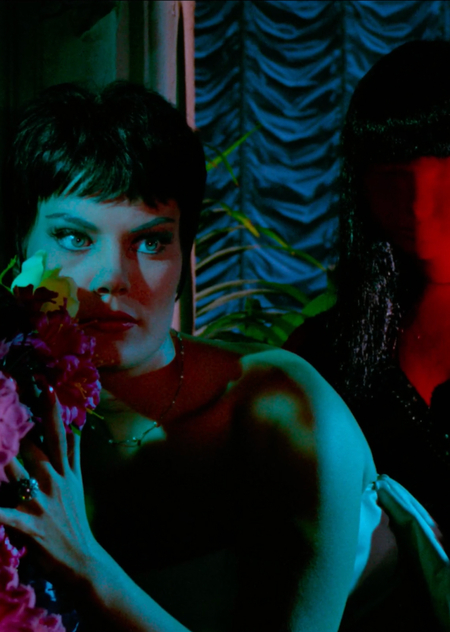
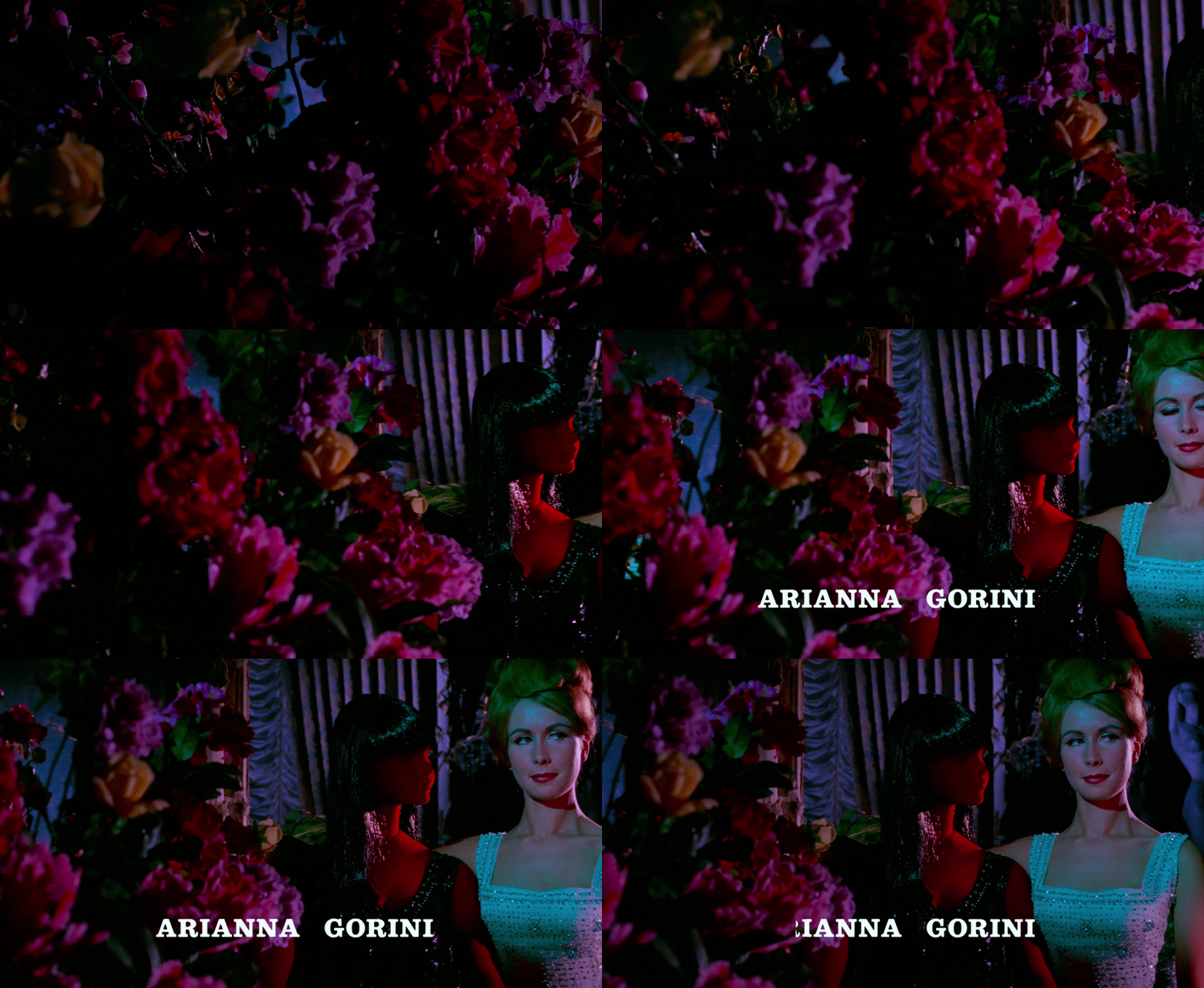
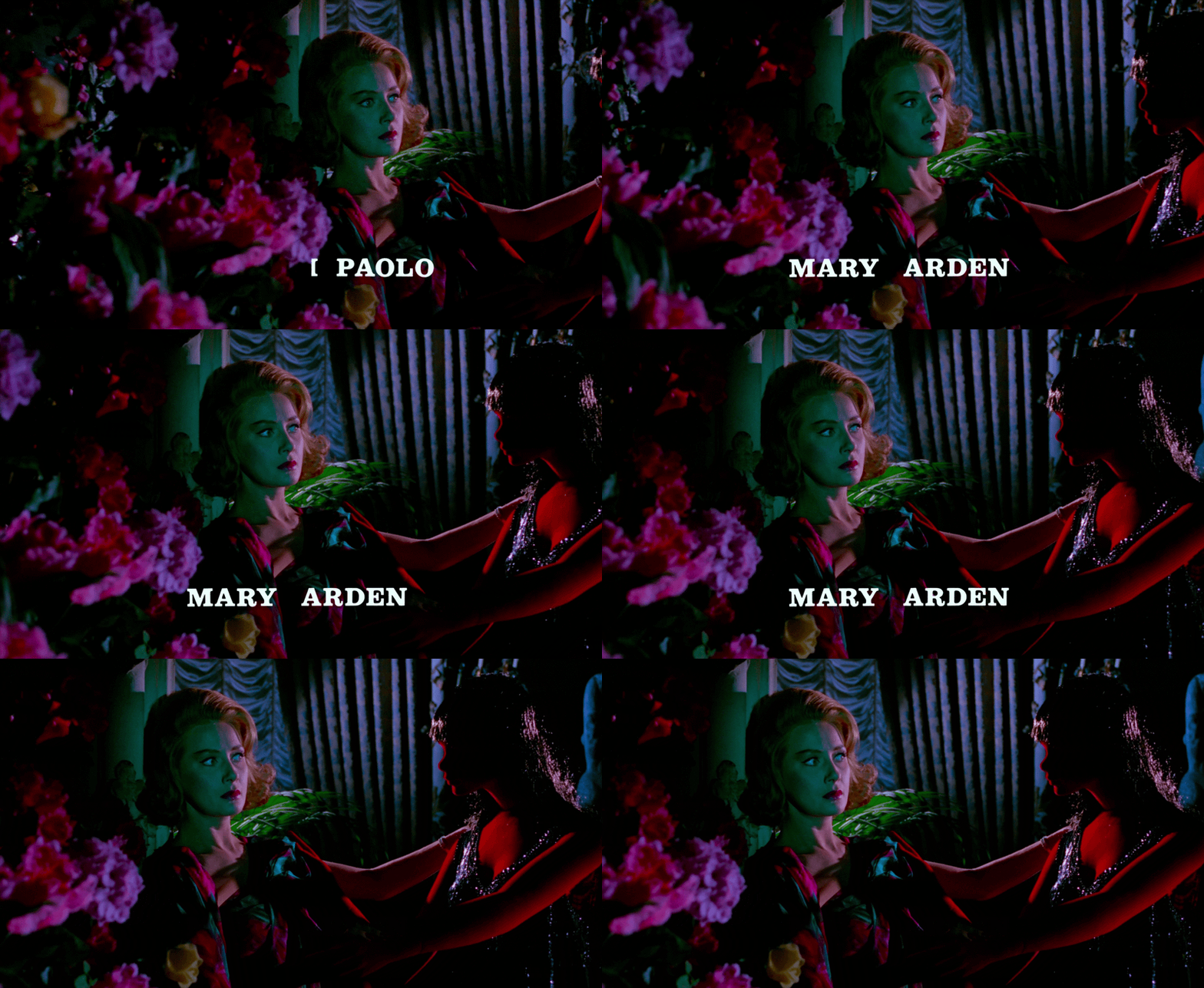
The opening credits of Mario Bava’s «Six Women for a Murderer» establish this dynamic even before the detective plot begins. The actors stand beside mannequins, barely moving. The figures, however, are illuminated by selective pools of color whose origin the viewer cannot decipher from the surroundings. The similarity between the human and the mannequin is not created solely by the proximity of the two objects. The light strips the skin of its natural tonal transitions, causing the face to be perceived as yet another specifically painted surface. The bodies become part of the composition alongside the artificial figures.
«Six Women for a Murderer» (Blood and Black Lace, dir. Mario Bava, 1964).
«Six Women for the Killer» (Blood and Black Lace, dir. Mario Bava, 1964).
The connection to Mannerism manifests in how the character of the human figure is now determined by the structure of the image. The naturalness of the pose and lighting recedes to the background. Bava pushes this principle to the point where the living body merges with the display object. Therefore, mannequins are crucial for uncovering what the light has already done to the actors.
«Six Women for a Murderer» (Blood and Black Lace, dir. Mario Bava, 1964).
In the antique shop, the same principle is transferred from the figure to the space. In the background, a glowing advertisement is visible, capable of explaining part of the colored luminescence, but the entire shop does not yield to its placement.
photo of this advertisement
Specific areas of the interior receive their own color accents, and the transition between them does not correspond to the smooth change in illumination expected from a single source. The significant point is that these areas exist as visually separated zones, all compiled by the camera into one scene. A real room would present itself as a continuous volume where light spreads and reflects, but Bava transforms it into a sequence of planes.The Mannerist principle is revealed in the conflict between the recognizability of the space and the demonstratively composed manner in which it is presented.
Photos of the shop interior design areas
Comparing the titles and the tavern scene reveals that colored lighting operates on different scales according to a single principle. In the titles, it draws the face closer to the object. In the tavern, the light divides the room into distinct fragments. This demonstrates Bava’s consistency. He employs a similar method to transform vastly different subjects, without being limited to repeating a successful color palette. Light ceases to be a condition under which things are visible and instead becomes a force that alters the relationships between them. This exact operation should be examined when approaching Mannerism. The question is not whether a frame resembles a 16th-century painting, but whether the image expresses its constructed nature through a noticeable deviation from the natural organization of form. Bava’s answer is clear, but this does not imply that analogous effects are achieved by other directors in the same way.
In Dario Argento’s «Crimson, ” color operates differently. The red stage fabric in the theatrical episode belongs to the setting itself. Its presence cannot be labeled a lighting error, so drawing mannerism solely from the saturation of red would be inaccurate. More significantly, the color unifies the space of public performance and the motif of violence that the film addresses.
The theatrical surface remains an element within the depicted world, but in the composition, it acquires a meaning that transcends its everyday function. Argento does not abandon object-based motivation; rather, he uses it as a foundation for a persistent chromatic accent. The Mannerist effect is based on intensifying an existing form, not on replacing natural lighting.
This case establishes the boundary of analogy. If the red color merely coincides with the film’s title or is associated with blood, it is not yet proof of a Mannerist method of depiction. To compare, it is important to trace exactly how the relationships within the frame change. The red fabric is no longer a neutral background, as the visual connections between the figures are defined by its saturated surface. The scene is literally devoted to a public presentation, which makes such a decision particularly consistent. The figure exists against a surface that is pre-marked as part of the spectacle.
The strategies of the two films examined diverge from transparent realism, but they do so through different means. This suggests that the commonality of giallo should not be sought in a specific color palette, but rather in the ability of color to change the function of already recognizable elements.
In «All Colors of Darkness,» Sergio Martino focuses the color accent on the pursuer’s unusually prominent eyes. It is important to examine both their shade and the manner in which they are re-presented.