DO NOT OVERWRITE — a desktop box for storing photographs, notes, keepsakes, and other small fragments of personal history. Its visual language is inspired by analog horror, home videos, and the aesthetic of old media.
Externally, it is a familiar storage item. But its design evokes a mysterious archive, where some records might be best left unopened.
01 / The Story of One Entry
I’ve had a long-standing affinity for analog horror. I enjoy not only watching the works themselves but also deconstructing how they function: noticing details, searching for hidden meanings, and reviewing other people’s research and theories. I am particularly fascinated by how creators transform entirely mundane objects into sources of anxiety. Old children’s programs, commercials, instructional videos, public service announcements—everything looks familiar, sometimes even comforting. But if an image lingers for a few seconds longer than it should, or if a strange text overlay or an inappropriate sound appears, the familiar visual begins to be perceived in a completely different light. This contrast interests me most. Horror doesn’t have to look scary from the outset. Sometimes, something is far more effective when it is trying desperately to convince you that everything is fine.
Visual references for the project were The Walten Files, The Mandela Catalogue, Harmony & Horror, Andy’s Apple Farm, and other works that utilize the aesthetic of old media, found footage, and disrupted normalcy.
The idea for this piece came to me while working on another academic project: an intro animation for a YouTube channel dedicated to analyzing analog horror.
I wanted to preserve the atmosphere I had developed in the animation but translate it into a completely different format. Instead of using ready-made characters or recognizable images from other works, I aimed to create a standalone object that could organically exist within this aesthetic.
Thus, DO NOT OVERWRITE was born.
02 / Please do not overwrite
The title DO NOT OVERWRITE references warnings found on information carriers: do not overwrite, do not erase, keep the original.
In the context of this project, the phrase takes on an additional meaning.
We hold onto many things that don’t possess special material value, yet for some reason, we cannot let them go. Old photographs, random notes, tickets, small gifts, items connected to certain people or events.
Unlike a digital file, a memory cannot simply be restored from a backup.
I felt the urge to create a small personal archive for things like this. An object that not only helps organize storage but also becomes part of the history itself.
That is why the box looks as if it has lived a long life. Its surface shows the marks of time—worn edges, old labels, technical notations, and warnings.
Not all of these necessarily have to inspire trust.
03 / Familiar Form. Unfamiliar Content
The project centers around a simple rectangular box with a hinged lid.
Its proportions and design reference home video archives from the late 20th century: the plastic casings of electronics, cassette packaging, informational labels, and service markings.
However, I did not want to literally reproduce a VCR or a VHS tape. It was important to maintain the feeling of a familiar object while giving it its own distinct function.
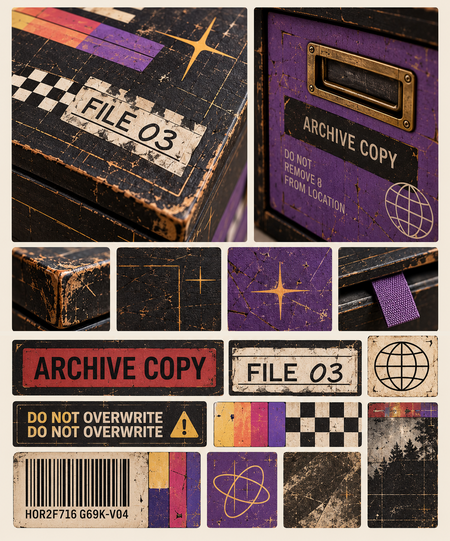
The exterior of the box is finished in dark tones. The lid features the prominent inscription «DO NOT OVERWRITE, ” colored stripes, and the archival record number FILE 03.
Contrasting labels, barcodes, small warning signs, and decorative lines create the impression of a serialized archival piece. Yet, some of the graphics deliberately disrupt the expected order—scuffs, mismatched elements, and unusual phrasing compel the viewer to examine the surface more closely.This isn’t a box covered in monster illustrations. This is a box that looks like it might have its own unpleasant history.
04 / Inside the Archive
The interior space is organized like a small personal vault.
The main compartment is designed for photographs, notes, USB drives, small souvenirs, and other mementos. Removable partitions allow you to categorize the contents or completely clear the interior space for larger items.
Beneath the main compartment, there is an additional, shallow pull-out drawer. This can be used to store small letters, notes, or flat items that you wish to keep separate from the rest of the contents.
The inside of the lid also becomes part of the design. Instead of a standard decorative insert, this area features an excerpt from archival graphics with the reminder:MEMORIES ARE FRAGILE. HANDLE WITH CARE.This inscription simultaneously functions as a warning on an old medium and as a genuinely heartfelt address to the box’s owner.I appreciate that here, the anxious aesthetic transcends being merely decorative. It begins to interact with the object’s actual function.
05 / Color, Noise, and the Traces of Time
The project’s visual system is built on the contrast between the dark body and more saturated color elements.The foundation is an almost black charcoal shade. It creates a neutral background for the graphics and resembles the casings of old video equipment.Purple is used in the interior trim and specific details. Muted yellow appears in markings and decorative lines. Red highlights warnings and archival labels, while cream softens the contrast and gives the typography the look of aged print.Color Palette: Charcoal — #28232F Purple — #79639D Muted Yellow — #E8CC76 Red — #A84550 Cream — #E8DFC9
Special attention is paid to artificial aging. Scuffs, scratches, dirt, and minor mismatches in printed elements are designed as part of the author’s graphic styling, not as actual structural damage. The object must remain comfortable and neatly crafted, even if it visually appears to have been discovered on the shelf of an abandoned video archive.
06 / Structure
Behind its unusual exterior design lies a relatively simple modular structure, engineered to be constructed from sheet materials.Design Specifications: Dimensions: 240 × 180 × 106 mm. Primary material: 6 mm birch plywood. Partitions and drawer components: 3 mm plywood. Lid: hinged, attached via two metal hinges. Interior organization: main compartment featuring removable dividers. Additional element: a bottom sliding section with a fabric loop for opening. Finishing: painting, custom print graphics, and a protective matte coating.
The dimensions were chosen considering desk use and the storage of small personal items. The box can be placed on a desk, bookshelf, or chest of drawers.The design allows access to all compartments without special tools. Removable dividers allow the internal organization to be customized for specific items.
07 / Box Fabrication
The chosen assembly method for production is using pre-cut plywood parts.The main components of the body, lid, and interior shelf are intended to be cut from 6 mm thick material. Thinner plywood is used for internal partitions and the drawer compartment details.The cutting process is carried out via laser cutting using prepared vector files.After cutting, the parts undergo sanding and fitting. The body is assembled using glued joints, and the interior shelf, drawer guides, and lid mounts are installed.
The next phase is finishing. Surfaces are primed and painted, after which the graphic designed for the project is applied to them: labels, markings, decorative stripes, and aging textures.A protective matte coating completes the work.Vector cutting files and a separate editable set of decorative graphics are provided for reproduction.At this stage, the design structure and preliminary part geometry have been developed. Before manufacturing, it is necessary to verify the actual thickness of the materials, cutting allowances, joints, hinge installation, and the function of the sliding mechanism in a test assembly.
08 / Small Run
The project is developed with the possibility of re-fabrication in mind. The main structure consists of sheet metal components that can be created using digital cutting. The decorative graphics are separate from the structure and can be reproduced through printing. This allows for the preservation of the dimensions, component layout, and overall aesthetic when producing subsequent units.
For storage and transport, a simple cardboard packaging with a protective insert, tailored to the dimensions of the item, is envisioned. Its detailed structure will be addressed in a later stage of development. In the future, the box could receive various graphic iterations built around the concept of archival records, while the structural foundation will remain consistent.