Communication theory: LIFt. CG & Ai
Structure:
• About Lift • Communication theory as a framework for design practice • Presentation of the brand for a general audience • Presentation of the brand for a professional audience • Strategic construction of the communication model • Encoding, decoding, and feedback in the brand system
Lift is a creative studio working with CG, AI, and visual storytelling for small brands. The studio is built around the idea of simplicity: creating visual content should be as intuitive as calling an elevator.

logo
Communication theory as a framework for design practice
Within contemporary design practice, communication is understood not simply as message transmission, but as a meaning-making process shaped by symbols, context, and interpretation. As emphasized throughout the course, communication can be defined as a relational process of creating and interpreting messages.
This project is primarily grounded in Craig’s Semiotic Tradition, which views communication as the study of signs and symbols and how meaning is produced through them.
From this perspective, design is a structured system of visual signs that rely on shared cultural conventions. In parallel, the project draws on Visual Rhetoric, where design functions as a persuasive tool shaping perception, attention, and interpretation.
For Lift CG & AI, design is treated as a strategic act of encoding meaning, where complex CGI and AI technologies are translated into clear and accessible visual symbols, reducing cognitive effort for the audience.

Presentation of the Brand for a general audience
From the perspective of Uses and gratifications theory, audiences are not passive recipients of messages. Instead, they actively choose media that satisfies specific needs: clarity, emotional comfort, efficiency, and aesthetic pleasure.
Lift addresses these needs by offering a form of communication that minimizes effort and uncertainty. The brand does not demand attention through aggressive persuasion; instead, it positions itself as a solution that naturally fits into everyday experience.
The core message of Lift is deliberately simple: Creating a high-quality video is as easy as calling an elevator.
This message reduces cognitive load and aligns with the audience’s desire for quick understanding and predictable outcomes. The elevator is a familiar object that already carries strong associations of reliability, ease and trust. As a result, the audience does not need additional explanation to grasp the meaning.
The communication strategy of Lift is also based on Fisher’s narrative paradigm, which suggests that people interpret information primarily through stories rather than abstract arguments. In this context, the elevator functions as a narrative metaphor.
The brand communicates:
Who it is: a CGI & AI studio What it offers: fast, high-quality visual production Why it matters: reducing complexity and uncertainty for the client
The audience intuitively evaluates the message through narrative coherence (does the story make sense?) and narrative fidelity (does it align with their values and lived experience?).


Portrait of the target audience
Who is Lift for? Why?
• Local brands that need strong, eye-catching visuals to stand out • Brands aware that weak design slows growth, but lacking resources for an in-house designer • Small-scale content creators and bloggers looking to find and connect with their audience • Clients with limited time for developing original creative content
Audience Personas
Anastasia, 25
• Developing a personal brand • Looking for ways to diversify and enhance her visual content _________________________________________________________Evgenia, 35
• Has launched her own brand • Lacks the budget for regular professional creative shootsPresentation of the Brand for a professional audience
The visual identity of Lift CG & AI is designed as a communication system, where form and color function are symbolic codes rather than decoration.
According to the Semiotic Tradition (Craig), the logo operates as a sign that communicates meaning. Its continuous, flowing line references elevator movement and vertical progression, reflecting the studio’s core idea:
creating CGI and AI visuals should feel as simple as calling a lift. The smooth rhythm and minimal form reduce semantic noise and allow the logo to work across multiple communication channels.
From a Visual Rhetoric perspective, the logo emphasizes continuity, accessibility, and technical clarity, positioning the studio as both professional and approachable.
Color Palette
The color palette is part of the encoding of meaning.
Soft pink introduces emotional openness and lowers the perceived complexity of AI-driven technologies. Light and medium blues communicate trust, structure, and reliability. While deep blue anchors the identity in professionalism and expertise. _______________________________________________________ Within the Phenomenological Tradition, these colors are chosen for how they are emotionally experienced, not only symbolically interpreted.The placement of the posters inside the elevator is a deliberate element of the communication strategy. The elevator functions are used not only as a physical medium but as a communicative context that directly reflects the brand’s core metaphor.
As a closed, time-limited, and highly focused space, it minimizes visual noise and concentrates audience attention, enhancing the decoding of the message. Importantly, the posters address the audience at a moment when digital connection is often weak or unavailable. From the perspective of Uses and Gratifications Theory, this temporary disconnection creates a need for stimulation and engagement.
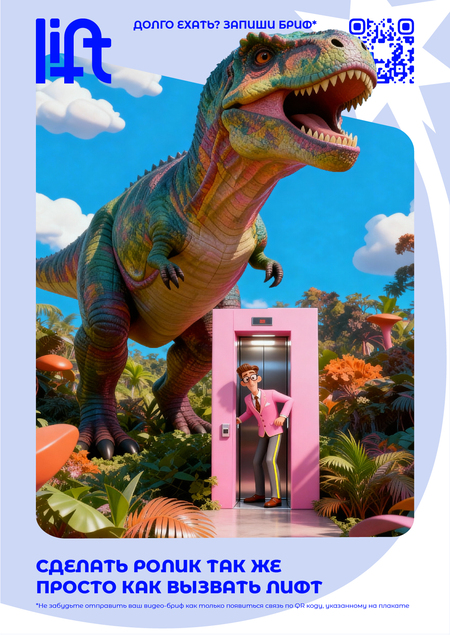
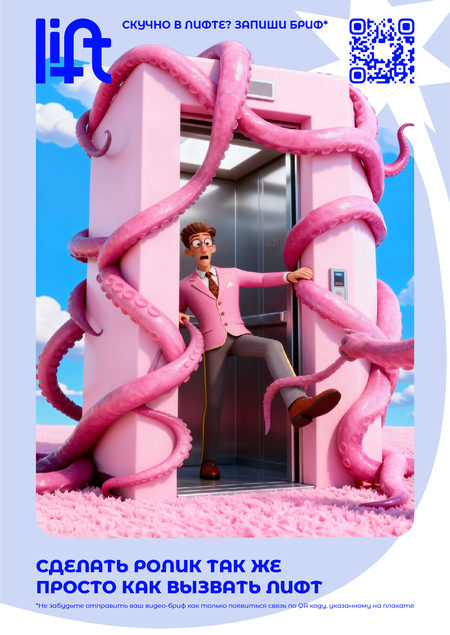
The posters respond to this need with a clear and timely call to action, transforming an otherwise idle waiting period into a meaningful communicative experience.
In this way, the elevator becomes an ideal communication channel, where the medium and the message coincide, and the viewer is positioned as an active participant in the communication process, strengthening emotional engagement and brand recall.
Strategic construction of the communication model
The communication strategy of Lift CG & AI is developed through the deliberate application of several theories discussed in the course.
First, the Elaboration Likelihood Model (ELM) structures content distribution:
The central route of persuasion targets highly involved users through detailed explanations, workflows, and case studies.
The peripheral route of persuasion targets broader audiences using visual metaphors, striking imagery, and minimal verbal explanation.
Second, Relationship Management Theory
Which informs how the brand establishes and maintains long-term relationships. Communication is not treated as a single transaction but as an ongoing process focused on trust, commitment, and emotional connection.
This includes:
- Continuous feedback loops
- Responsiveness to audience interpretation
- Adaptation of visual identity based on user response
Encoding, decoding, and feedback in the brand system
Lift CG & AI operates as a bidirectional communication model, where meaning is constantly negotiated between sender and receiver. Visual outputs — posters, short videos, and digital content — function as points of entry into the brand narrative.
Each member participates in:
• Encoding of meaning (concept, aesthetics, narrative) • Decoding processes shaped by audience expectations and cultural frameworks • Feedback mechanisms through social media interaction and client response
Rather than functioning as a linear presentation of visuals, the brand exists as a dynamic communicative system, continuously shaped by context, interpretation, and relational dynamics between the studio and its audience.
List of literature and image sources
Course «Communication Theory: Bridging Academia and Practice» [Electronic resource]. (accessed 12.12.2025.)
Kozhevnikova Y. «Lift. CG & Ai Studio» [Electronic resource]. — Available at: https://portfolio.hse.ru/Project/270103 (accessed 05.12.2025).