Categories
1. Concept 2. The Heka: How Adornment Could Protect 3. The Malkat: Adornments from a Home Near the Palace 4. Assaph: A Casket in the Tomb of an Unknown Man 5. The Tomb of Three Wives of Thutmose III: Adornments from the Marketplace 6. Conclusion
Concept
Visual Research Profile
Chronological Framework The XVIII Dynasty of the New Kingdom, from the reign of Thutmose III to the reign of Amenhotep III (approximately 1480–1350 BCE). Two ornaments—a necklace from the Asasif necropolis and a wide necklace with «Nefer» amulets—might have been created slightly earlier (the museum dates them to approximately 1550–1425 and 1504–1450 BCE), but they also originate from Thebes. Furthermore, I am examining when and how these objects were discovered and how they entered the museum: this occurred between 1910 and 1988.
Geographical Context Thebes, the capital of the 4th Nome of Upper Egypt, on the west bank of the Nile: the palace city of Malkata, the necropolis of Asasif, and the Wadi Gabbanat el-Qurud canyon. Today, all the items under consideration are housed in the Metropolitan Museum of Art in New York.
Research Subject Jewelry and amulets from the Faiyum of the XVIII Dynasty.
Subject of Study The role of jewelry in the lives of the residents of Thebes: its significance for beauty, an individual’s social standing, and magical protection, as well as how the history of the find influences our understanding of these objects.
Research Objective To compare jewelry from the princely city of Malkata and from Fivan burials, tracing their journey from original owners to museum display cases in order to understand how beauty and magic were interwoven within them.
Question What role did adornment play in the lives of Thebans, how exactly did magical protection function within them, and to what extent can we deduce this from the artifacts currently housed in the museum?
Hypothesis I hypothesize that the protective symbols on jewelry held a similar meaning regardless of where they were found—in a dwelling or in a burial. Furthermore, magic operated not only through depictions of deities but also through the word, the material, the color, and even sound. The materials and complexity of the jewelry were dependent on the individual’s social standing. Additionally, I suggest that our understanding of jewelry is shaped by how it entered the museum: artifacts from archaeological excavations reveal more about the owners' lives than items purchased on the antique market.
Rationale for Topic Selection
In the museum, an ancient Egyptian ornament rests motionless in a display case, and what we see first is its beauty: the gold, the vibrant colors, the intricate details. But for its owner, it was part of life—it was worn on the body, gifted, preserved, and placed in the tomb.
I became curious: did Egyptians wear ornaments only for beauty, or did these adornments hold another meaning?
Egyptologist Rosalind David writes that everyone in Egypt wore jewelry; it indicated a person’s social standing, but its primary purpose was the magical protection of the wearer in life and after death [8, Ch. 4]. I want to figure out how this protection «worked»: through images, words, materials, color, or sound.
I focused on a single city and a specific period because much varied across different parts of Egypt and through different eras. I chose Thebes during the reigns of Thutmose III through Amenhotep III—this is where we have preserved ornaments from both the residential royal city of Malkata and from burials, allowing for comparison.
All the selected ornaments are currently housed in the Metropolitan Museum of Art, but they arrived there through different paths—either through archaeological excavations or through the antique market. It is important for me to understand how this journey influences what we know about these objects today.
Principle of Visual Material Selection
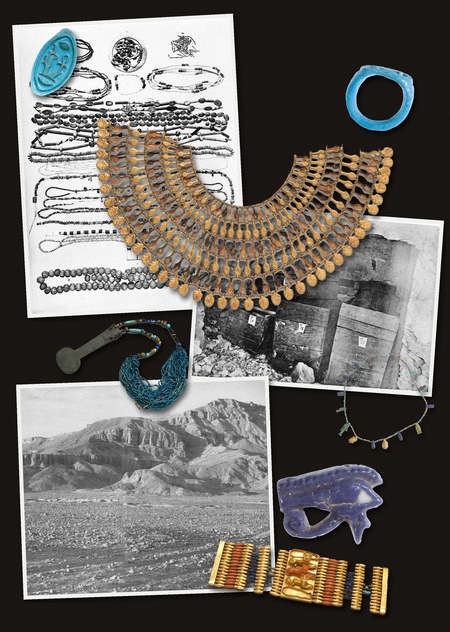
I selected the jewelry based on three criteria.First: all pieces originate from the period of the Eighteenth Dynasty in Thebes, and the museum indicates the location of their discovery. I excluded items whose finding locations are unknown from my research.Second: the jewelry was found in various locations and belonged to people of different social standings. Some were discovered in the palace city of Malkata, where people lived. Others were found in burials—in the necropolis of Asasif and in the tomb of the three foreign wives of Thutmose III in the Wadi Gabbanat el-Kurud gorge (Fig. 1). This allows for a comparison between ornaments for life and those for the tomb, as well as between the possessions of ordinary Theban residents and those of the royal family.Third: the jewelry entered the museum through three different channels. Some were found by the museum itself: they were excavated in Malkata between 1910 and 1912. Others were found by Lord Carnarvon and Howard Carter in Asasif in 1911, and the museum purchased them from Carnarvon’s widow in 1926. The tomb of Thutmose III’s wives was discovered by robbers in 1916, and the items from it dispersed into the antique market. The museum acquired them piecemeal from 1919 to 1988. For some of these pieces, we only have the tentative understanding that they originate from this tomb.
Fig. 1. U. Chan. The West Bank of Thebes: the palace city of Malqata, the Asasif necropolis, and the Wadi Qabbanat al-Qurud gorge. Map from the Theban Mapping Project, 2020 (excerpt).
Research Framework Principles
The work is structured not chronologically, but thematically—starting with the most familiar ornaments and moving toward the lesser-known ones. This demonstrates how a museum’s narrative path influences what we learn about an object. First, I explain how the inhabitants of Thebes perceived magic and why an ornament might have protected its owner. Then, I examine three groups of ornaments: those from Malkata that the museum discovered independently; those from Assasif found by Carnarvon and Carter; and those from the tomb of Thutmose III’s wives, which the museum acquired from an antiques dealer. Each group begins with a description of its discovery location and a visual representation of that site. I analyze every ornament from multiple perspectives: where it was found and how it reached the museum; what materials and colors it is made from; how it was worn; what symbols and inscriptions it bears; and how, according to the beliefs of that era, it protected its owner. To facilitate this, I show close-up fragments of the ornaments so the viewer can see what I am discussing. Finally, I compare the three groups and test my hypothesis.
Working with Sources Principle
My main source material is the jewelry itself. I examine photographs and records from the Metropolitan Museum of Art: they provide details on the material, date, finding location, and how the object entered the museum. I rely on the museum for dates because they vary slightly across different books.
I learn about where and how the jewelry was discovered from excavation reports—specifically, the book by Carnarvon and Carter on the excavations in Thebes [4], the article on the Malkata excavations [17], and K. Liliquist’s book on the tomb of the three wives of Thutmose III [10]. For information regarding magic and the function of wearing jewelry, I consult R. David’s book, «Religion and Magic in Ancient Egypt» [8].
The anthropological concept of Igor Kopytoff’s «biography of a thing» [1] helps me work with these sources: an object, much like a human, has its own history. It is created, worn, gifted, interred, later found, sold, and finally displayed in a museum. Therefore, I examine not just the jewelry itself, but everything that happened to it.
Most of the sources are in English because the archaeological digs in these areas were conducted by American and British archaeologists. I translate them myself using AI: I render the names and terminology into the accepted Russian forms, and I cross-reference the main quotations with the original book text.
Key Question and Hypothesis
The central question of my research is: what role did ornamentation play in the lives of the people of Thebes, how exactly did magical protection function within these items, and to what extent can we deduce this from the artifacts currently housed in the museum?I hypothesize that protective symbols on jewelry held the same significance in both domestic life and burial, and that magic operated not only through depictions of deities but also through language, material, color, and sound. Furthermore, I suggest that the materials and complexity of the jewelry were dependent on the owner’s social standing, and that we know more about excavated objects than about those sourced from antique markets.To test this, I compare the same symbols found on jewelry from Malkata and from tombs; for each piece, I analyze the mechanism of protection; I compare materials—for example, faience from Malkata versus gold from the tomb of Thutmose III’s wives; and I contrast what we know about objects from different discovery histories. Through this process, I realize that the discovery context does not always dictate how an object was used—a tomb ornament could have been worn by the person during their lifetime.
Heka: How an Adornment Could Protect