Navigator
- Research Concept.
- Academic Vision of the Landscape. Adherence to the Canon.
- Heinrich Semiradsky—the embodiment of academic landscape painting.
- The Peredvizhniki’s Vision of the Landscape—nature taking center stage.
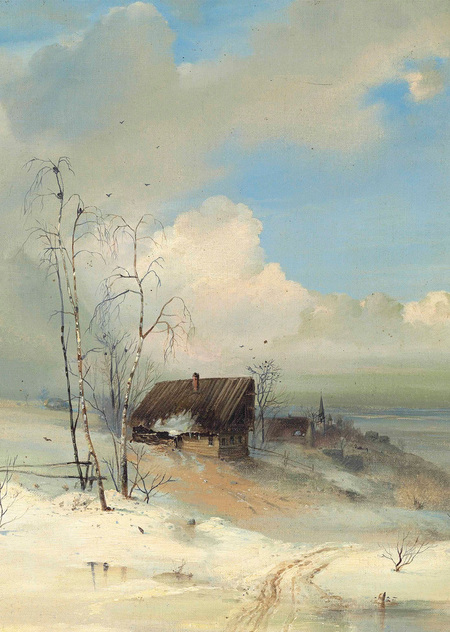
- Alexei Savrasov. Landscape—lyricism.
- Ivan Shishkin—thoughtful observation.
- Conclusion.
Research Concept
Art has undergone numerous stages of development throughout human history. During this time, it has experienced rises and falls, clashed with the public, laws, and morality, and even generated conflicts within the artistic community itself.
Art is divided into countless styles, movements, and directions, and often disagreements arise within them—different views on what an artist should create and what foundations to rely upon in their knowledge.
One such famous conflict was the Rebellion of the Fourteen—an event that led to the creation of the traveling exhibition movement. Fourteen of the best students at the Academy of Arts disagreed with the requirements of the creative competition and refused to participate, thereby forfeiting many privileges, one of which was a multi-year trip to Europe.
The Academy enforced extremely rigorous standards regarding subject matter and genre, classifying them into high and low. It strictly adhered to the laws of composition, drawing, and color, following the wisdom of antiquity and elevating it to an absolute, presenting it as a universal model for emulation. A clear understanding of anatomy and mastery of drawing were mandatory requirements for every student. Academicism interpreted its stringent demands for both the technical execution of paintings and the subject matter and composition. A clear hierarchy of genres was established. In this environment, new ideas and directions—which were already beginning to emerge across Europe—simply had no room to exist. This is how the confrontation with academicism began.
The reason I chose this topic was my desire to trace the visual and narrative differences between academicians and the Peredvizhniki through the lens of landscape—my favorite genre of painting. I have long been interested in this period because it allows one to observe the conflicts between various artistic movements in Russian art.
To fully explore this topic, I selected well-known works by Academic and Peredvizhnik artists, those that most vividly demonstrate the differences in landscape approaches across various movements.
All artworks are arranged chronologically by the artist, and their grouping is determined by subject matter, technique used, or similarities in elements I want you to focus on during your visual analysis.
The textual sources I selected describe both the creative work and stylistic characteristics of individual artists and directly discuss Realism and the creative endeavors of the Wanderers.
The aim of this research is to demonstrate the differences in creative, narrative, and stylistic characteristics across the aforementioned disciplines.
The Academic View of Landscape. Adherence to Canon
Academicism is an incredibly rigorous art movement characterized by a strict adherence to classical traditions and canons. It primarily relies on idealized imagery from antiquity and mythological narratives from ancient Greek and Roman mythology. It demands that the artist create a «thoughtful» work, both in terms of the approach to the work (a large number of sketches, meticulous composition planning) and in terms of deep thematic content. The painting must convey a highly spiritual message, which is established in every aspect—from the subject matter and moral content to the presence of allegories and historical references.
This approach led to a division between high and low genres: historical, portrait, and biblical scene paintings were considered the highest genres—those best suited for imbuing spiritual meaning—whereas still life, landscape, and everyday subject matter were less suitable for this purpose.
Due to the low status of landscape painting, it is difficult to find this genre among academic artists. Primarily, it served as a backdrop for the narrative unfolding on the canvas—a supplementary function.
Gerhard Semiradsky — the embodiment of academic landscape.
Heinrich Semiradsky is a brilliant representative of the academic tradition. Themes of antiquity and early Christianity resonated deeply with him, as did complex, multi-layered compositions and a profound love for Rome. All of this is reflected in his canvases. His paintings possess all the most vivid academic characteristics: antique subjects, deliberate composition, and a spiritual message woven into both the narrative structure and the subtle background details, which are steeped in allegory and deep meaning.
Woman or Vase. G. I. Semiradsky. Canvas, oil (1878)
However, among other representatives of his field, Heinrich Semiradsky stands out due to his approach to landscape. He treats it with as much seriousness as his primary composition, basing it on actual views of Rome for the highest degree of authenticity. He incorporates the element of en plein air painting, which already deviates from the classical studio practice. Consequently, the landscape in his works can often draw undue attention, leading Semiradsky to face criticism at times.
Persecutors of Christians at the Entrance to the Catacombs. G. I. Semiradsky. Canvas, oil (1874)
The Sinner. G. I. Semiradsky. Canvas, oil (1875)
Rest. G. I. Semiradsky. Canvas, oil (1890)
Conversation by the Source. G. I. Semiradsky. Canvas, oil (1902)
The architecture in his works is equally authentic. Semiradsky relied on historical sources and existing blueprints in his renderings. However, such a precise and meticulous approach still doesn’t make Semiradsky’s work a landscape, as despite the thorough detailing, the main focus remains elsewhere.
The Lights of Christianity. Nero’s Torches. G. I. Semiradsky. Canvas, oil (1877).
Dance Among Swords. G. I. Semiradsky. Canvas, oil (1881)
Patrician Siesta. G. I. Semiradsky. Canvas, oil (1881)
Paris’s Court. G. I. Semiradsky. Canvas, oil (1892)
The landscape vision of the Peredvizhniki—nature takes center stage.