Communication theory: Strochka
Introduction
«Good design requires good communication, especially from machine to person, indicating what actions are possible, what is happening, and what is about to happen.» — Don Norman, The Design of Everyday Things
Design and contemporary art are not just about aesthetics or objects — a poster, a product, or an art installation is fundamentally about communicating ideas, emotions, and values to an audience. Communication theory provides a framework for understanding this process. While it does not add a «new» dimension to design, it offers essential principles and insights that help creators develop and convey the intent behind their work more effectively to their intended audience. In other words, by understanding how communication works, designers can better ensure that what they mean to express is actually understood as intended.
Communication theory as a field is rich and interdisciplinary, spanning face-to-face dialogue to mass media and cultural discourse. As communication scholar Robert T. Craig observes, «Communication theory is enormously rich in the range of ideas that fall within its nominal scope, and new theoretical work on communication has recently been flourishing». This richness means there are many different lenses through which communication can be understood. Drawing on these theories allows designers to ground their creative decisions in proven concepts about how messaging works. In a classic sender–receiver model, designers «encode» ideas into visuals and audiences «decode» them; if the encoding is unclear, the message may be lost. Knowing such fundamentals encourages clarity and intentionality in design.
Communication theory highlights factors that can greatly influence a design’s impact. Marshall McLuhan famously argued that «the medium is the message», suggesting that the choice of medium or format (e.g. digital vs. print) can shape how the content is perceived. Persuasion theories — such as Petty and Cacioppo’s Elaboration Likelihood Model — explain that audience members can be influenced through rational arguments or emotional appeals, a concept highly relevant to advertising and social campaigns. By applying such theories, designers learn to create visuals that not only look appealing but also connect with how people think and feel.
Treating design as communication means recognizing that every element in a design carries meaning. Communication theory provides the vocabulary and concepts to analyze and refine that messaging. It equips designers with a deeper understanding of their role as communicators (rather than mere decorators), and encourages them to consider not only what a design looks like, but how it speaks to others. By leveraging theoretical insights into messaging, perception, and context, designers can elevate their work beyond stylistic flair, achieving greater clarity, impact, and meaningful audience engagement.
Presentation for a General Audience
A Place to Sew, Learn, and Belong
Strochka is an open sewing workshop — a calm, friendly space where anyone can learn to sew, rent equipment, or start creating from scratch. No loud machines or factory rush. Just daylight, fabric, and people who care.
You don’t need experience. Just curiosity.
Have you never touched a sewing machine? That’s perfect. At Strochka, we’ll show you how. Take a class. Ask a mentor. Watch. Try. Unpick. Try again. That’s how things are made here — slowly, thoughtfully, together.
Make with your hands. Think with your hands.
We believe that making is a form of thinking. In a world of screens and speed, sewing reconnects us with slowness, tactility, and care. One stitch at a time, you’ll start to notice how much your hands already know.
Workshops. Lectures. Conversations.
Strochka is more than a workspace. It’s a space for exchange — of ideas, knowledge, and support. Join a workshop, attend a talk, or just come for a quiet afternoon and see who’s there.
Rules you can follow. Or break.
We teach sewing rules — and when it’s worth bending them. You’ll learn structure and pattern, but also intuition and improvisation. Sometimes the best work happens when the seam goes off track.
You bring the idea. We bring the space.
Everyone arrives at Strochka with something: a need, a sketch, a wish, a question. We create the space for those things to take shape — not just in fabric, but in friendship, confidence, and shared making.
Presentation of the Brand for a Professional Audience
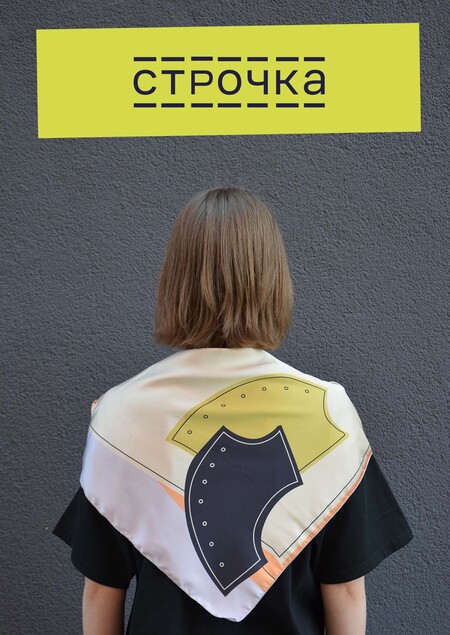
Full version and short version of the logo
An open sewing studio built as a community system
Strochka is an open sewing workshop that combines three roles in one space: — Education (from first stitch to advanced construction) — Access (equipment rental + supervised workstations) — Community (talks, peer support, knowledge exchange)
The studio is intentionally positioned as an alternative to «factory logic»: calm pace, clear rules, and human-scale making.
Who strochka is for (stakeholders + publics)
We address several professional groups with distinct needs: — Design educators / schools — a practice-based extension of curriculum (classes, labs, workshops) — Independent designers / small labels — prototyping, sampling, micro-production support — Cultural institutions — public programs (lectures, open workshops, exhibitions around craft) — Sustainability / repair initiatives — community repair formats and skill-based literacy — Brands / partners — collaborations, sponsored equipment, scholarships, co-produced events
The same space works for each group because it is organized around «shared meaning + shared practice» and sustained through ongoing interaction.
Program architecture
Strochka operates through a modular offer: 1. Open studio hours — bookable workstations + equipment library 2. Mentored sessions — supervision, troubleshooting, quality control basics 3. Course tracks — beginner / intermediate / advanced (construction, patternmaking, finishing) 4. Talks + lectures — craft as culture, design literacy, material thinking 5. Community formats — peer critiques, open showcases, «rules you can follow — or break» sessions
Each format produces repeat engagement and supports long-term skill building.
How we ensure quality (operations + learning design)
We treat the studio like a communication system: outcomes depend on how clearly we structure interactions. — Clear onboarding: safety, equipment basics, studio etiquette — Feedback loop: mentors observe → correct → participant retries (learning through iteration) — Transparent rules: what is allowed, what requires supervision, what requires certification — Documentation: short «how-to» cards and checklists near machines (reduce noise + errors)
This approach follows the idea that communication is goal-oriented, includes encoding/decoding, and improves through feedback.
Partnership models
We propose collaboration formats that are easy to scope and measure: — Institutional lab (semester-based): scheduled groups + outcomes (projects, prototypes, exhibition) — Residency / micro-grants: access + mentoring for selected designers or community participants — Equipment sponsorship: branded workstation + scholarship seats — Public program co-production: a lecture series or a themed «making week» — Impact partnerships: repair literacy, upcycling programs, inclusive access initiatives
We prioritize long-term relationships built through openness, shared tasks, and ongoing dialogue — not one-off promotion.
Strochka’s differentiators (what makes it «not just a studio»)
— Community-first pace: «slowly, thoughtfully, together» is operational, not decorative — Knowledge is social: learning happens through exchange, not only instruction — Rules + creative deviation: structure is taught as a tool for originality — A clear semiotic code: calm visuals, process imagery, and material detail communicate values without «selling» them
Communication assets
Brand colors
Strochka provides a ready-to-deploy set of materials for partners and media: — Program one-pagers (PDF) for each format — Photo set of space / process / community (brandbook-aligned) — Speaker bios + lecture abstracts — Case documentation templates (before/after, process notes, participant quotes)
This supports consistent interpretation of the brand across channels and reduces misreading of intent.
Brand fonts
Call for collaboration
We are currently looking for: — Educational partners for recurring programs — Cultural partners for public events — Sponsors for scholarships and equipment access — Professional mentors and guest speakers
Strochka’s goal is to become a stable, ethical node in the local creative ecosystem: a place where making is treated as both practice and public culture.
How Communication Theories guided the creation of Strochka’s Presentations
We used the course theories as a design tool: not only to «decorate» the brand, but to predict how different audiences will decode the same brand idea, and to reduce the risk of misunderstanding.
1. Communication as encoding/decoding in context → two versions of the same message.
The course defines communication as a process of generating meaning through sending/receiving verbal and nonverbal symbols, always influenced by context. that idea became the base logic of the project: — In part 2, we encoded «Strochka» as a human, welcoming place («calm, friendly… anyone can learn»). — In part 3, we encoded «Strochka» as a stable professional infrastructure (education + access + community, plus program formats and partnership models).
The point is not that the brand «changes, ” but that meaning is negotiated differently depending on the audience’s goals, vocabulary, and expectations—exactly the encoding/decoding problem described in the lectures.
3. Craig’s traditions as «lenses» → selecting what to emphasize.
The course frames communication theory as multiple traditions (cybernetic, socio-psychological, socio-cultural, rhetorical, semiotic, etc.), each highlighting different aspects of communication.
We treated these traditions as a checklist for brand strategy: — Socio-cultural lens (shared practice + shared meaning): both texts position sewing as a social practice that produces belonging and knowledge through interaction («exchange — of ideas, knowledge, and support»). — Cybernetic lens (system + feedback): part 3 describes the studio as a system where outcomes depend on structured interactions, onboarding, documentation, and feedback loops. — Semiotic lens (signs + codes): part 3 explicitly names «a clear semiotic code» (calm visuals, process imagery, material detail) to control interpretation across channels. — Rhetorical lens (public speech structure): both parts use headline → short body → image direction as a persuasive «speech form, ” but adapted to audience needs (inspiring vs. operational).
3. Elaboration likelihood model → emotional entry (part 2) vs analytical proof (part 3)
The course explains that persuasion often follows two routes: — Central route (high involvement, effortful processing) — Peripheral route (low involvement, quick cues like tone, attractiveness, authority, scarcity).
We used this distinction to engineer the two texts:
Part 2 (general audience) mostly supports the peripheral route. — Simple, sensory cues: daylight, fabric, calm pace — Identity-based framing: «belong», «together», «care» — Low cognitive load: short sentences, familiar situations (first time sewing, curiosity)
Part 3 (professional audience) is built for the central route: — Structured argumentation: who it serves (stakeholders), modular offer, quality assurance, assets. — Operational detail that rewards attention: onboarding, documentation, formats, measurable collaboration models. — «Proof-by-structure»: the text itself behaves like a system description, matching the promise of the studio.
So the difference between parts 2 and 3 is not «tone only»: it is a deliberate shift in the «expected cognitive processing route» described by the model.
4. Theory of planned behavior → turning interest into action by reducing barriers.
The course stresses that attitude change is not enough; behavior depends on intention, shaped by attitudes, subjective norms, and perceived behavioral control (control beliefs). We applied this in both texts, but with different «barriers»:
Part 2 (individual visitor): — Control beliefs: «you don’t need experience… ask a mentor… try again» reduces fear and increases perceived ability. — Subjective norm: community cues («people who care, ” „together“) create social permission to join as a beginner.
part 3 (institution/partner): — Control beliefs: one-pagers, photo sets, templates, and clear program formats reduce uncertainty and make collaboration „doable.“ — Normative beliefs: positioning „Strochka“ as an „ethical node in the local creative ecosystem“ makes partnership feel aligned with professional values and public mission.
In other words, TPB guided not only „what we say“, but „what we remove“ (confusion, risk, lack of clarity) so intention can realistically become action.
5. Politeness theory and «face» → the tone of invitation instead of pressure
The course explains politeness as managing face (positive face: need to be appreciated; negative face: need for autonomy) and minimizing face-threatening acts through strategy choice.
We used politeness theory to keep «Strochka» non-aggressive and trust-building: — Part 2 protects the beginner’s positive face («that’s perfect») and reduces shame around inexperience. — Part 3 respects partners’ negative face by using proposal language («we propose… formats that are easy to scope») rather than demands, and by emphasizing transparency and rules (predictable boundaries reduce discomfort).
This is why both texts avoid «hard selling»: the brand’s relationship model is cooperative, not coercive.
6. Media ecology («the medium is the message») → why visuals are process-based and calm
The lectures argue that the medium shapes perception and that meaning is strongly affected by the communication environment. We applied this by aligning visual direction with the intended message:Instead of product-glamour imagery, we repeatedly specify process images (hands, tools, pinned fabric, workshop moments) because the medium (process photography + calm space) is already the message: «human-scale making.»
7. Framing → one brand, two frames that don’t contradict.
The course shows that framing changes what people understand as «the situation, ” by selecting emphasis, causes, and interpretive cues. We intentionally used two compatible frames: — Frame in part 2: „a place to learn and belong“ (personal entry point) — Frame in part 3: „infrastructure for learning, production, and cultural programming“ (institutional entry point)
They don’t conflict because both point to the same core: a community-organized practice space — just scaled to different publics.
Norman Donald A. The design of everyday things. — MIT Press, 2013.
Craig R. T. Communication theory as a field //Communication theory. — 1999. — Т. 9. — №. 2. — С. 119-161.
McLuhan M. Understanding media: The extensions of man. — MIT press, 1994.
Petty, R. E., & Cacioppo, J. T. (1986). Communication and persuasion: Central and peripheral routes to attitude change. Springer-Verlag. (Основной источник для Elaboration Likelihood Model — ELM.)
Ajzen I. The theory of planned behavior: Frequently asked questions //Human behavior and emerging technologies. — 2020. — Т. 2. — №. 4. — С. 314-324.
Hall S. Encoding—Decoding (1980) //Crime and media. — Routledge, 2019. — С. 44-55.
Carey J. W., Adam G. S. Communication as culture, revised edition: Essays on media and society. — routledge, 2008.
Wenger E. Communities of practice: A brief introduction. — 2011.
Eco U. A theory of semiotics. — Indiana University Press, 1979. — Т. 217
All pictures are from Dasha Levashova’s projects: https://portfolio.hse.ru/Project/215278 (Дата обращения 12.12.2025)