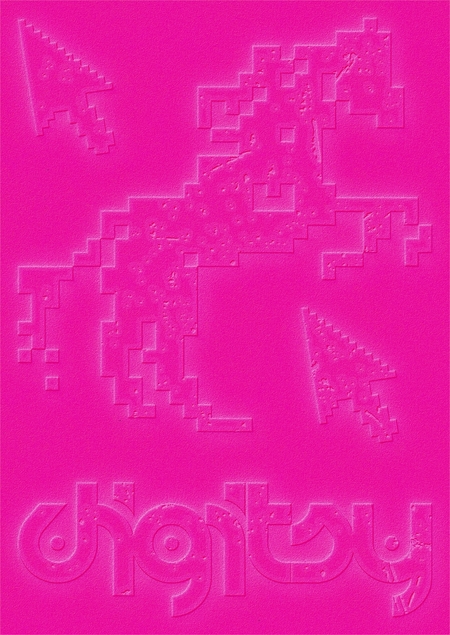
Communication Strategy: DIGITSY

PART I: How Communication Theory Operates in Design and Contemporary Art?
In the field of design and contemporary art, communication theory provides a framework for understanding how meaning is created rather than simply transmitted. As defined in Communication Theory: Bridging Academia and Practice, communication is defined as a systemic, dynamic process that unfolds over time and is shaped by context, participants and goals.
This perspective is especially relevant to contemporary visual practices, where artworks and design objects rarely communicate fixed or singular meanings. Instead, they function as open systems that invite interpretation, participation, and experiential engagement. Meaning is not embedded solely in the object itself but emerges through interaction between visual form, spatial organization, cultural context and audience perception.
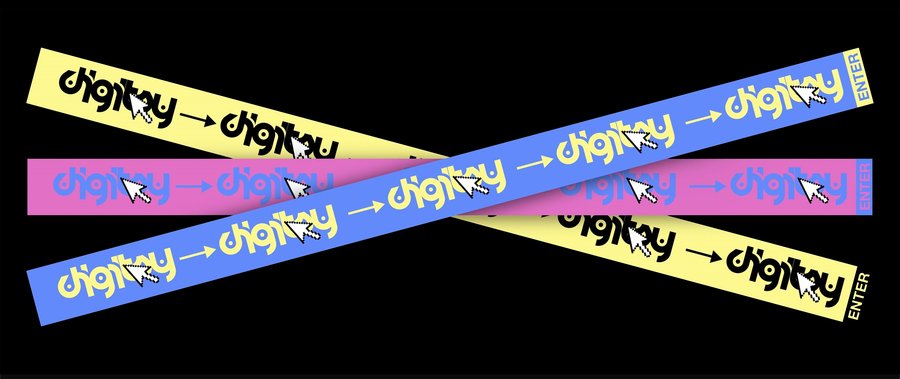
Communication theory also highlights the importance of non-verbal and visual forms of communication. In design and spatial practices, meaning is shaped through form, scale, rhythm and environment rather than through language alone. In this sense, design can be understood as a communicative practice that structures perception and experience.
Within this framework, communication theory functions not only as an analytical tool but also as a practical foundation for creative practice. By understanding how meaning is produced through interaction, signs and context, designers and artists can intentionally shape communicative experiences rather than focusing solely on aesthetic outcomes.
PART II: Presentation of DIGITSY for a General Audience
Brand Concept And Positioning
DIGITSY is an emerging exhibition brand currently in its development and launch phase. The project is conceived as a digital art exhibition exploring how digital aesthetics and technologies have evolved over recent decades. From a communication theory perspective, DIGITSY is positioned not as a finished cultural statement, but as a communicative platform designed to initiate meaning-making between digital art, space and audience.
Communication Goal At The Launch Stage
At the initial stage of development, DIGITSY’s primary communication goal is to clearly articulate its core idea: digital art as an evolving cultural and perceptual process. According to the course materials, effective communication requires a clearly defined purpose and sensitivity to context.DIGITSY therefore prioritizes the establishment of a coherent conceptual framework before expanding its communication reach.
Target Audience Definition
DIGITSY defines its initial target audience as digitally literate young adults aged 21–30 who study or work in fields related to visual communication, digital design, media art and architecture.In communication theory terms, this audience shares interpretive frameworks shaped by everyday interaction with digital interfaces, systems and visual environments
Communication Approach: Interpretation Over Transmission
DIGITSY adopts an interpretive approach to communication, as described in the course. Rather than transmitting fixed meanings, the brand is designed to create conditions in which audiences can construct their own interpretations. At the launch stage, this approach allows the brand to remain open, exploratory and adaptable while engaging its audience.
Visual and Spatial Communication Strategy
From the outset, DIGITSY plans its communication primarily through visual and spatial systems rather than extensive verbal explanation.The course emphasizes that meaning in visual communication is shaped through signs, perception and context.Accordingly, DIGITSY relies on digital visual codes—such as pixels, interface metaphors and navigation cues—to establish familiarity and reduce communicative ambiguity.
Communication as a Process Over Time
As an emerging brand, DIGITSY treats communication as an ongoing process rather than a single event. Communication theory defines communication as dynamic and continuous, shaped over time by interaction and context.DIGITSY’s exhibition concept reflects this understanding by presenting digital art as a sequence of stages through which meaning unfolds gradually.
Brand Development Logic
In line with the course’s focus on bridging theory and practice, DIGITSY positions communication theory as a strategic foundation for brand development.At the launch stage, theory informs how the brand defines its audience, structures experience and selects communicative tools, allowing DIGITSY to evolve consistently while remaining conceptually grounded
PART III: Presentation of DIGITSY For a Professional Audience
From a professional perspective, DIGITSY is conceived as a communication-driven exhibition concept rather than a purely curatorial project.At the development stage, the brand treats exhibition design as a structured communicative process in which space, visuals, and audience interaction function as primary meaning-making mechanisms.This aligns with the course’s definition of communication as a system composed of participants, symbols, and context.
DIGITSY approaches space as a communicative medium rather than a neutral container for artworks. According to the course materials, non-verbal communication plays a crucial role in shaping interpretation, particularly in visual and spatial contexts.Spatial organization, sequencing and transitions are therefore treated as communicative elements that guide perception.
The project’s visual language is grounded in the semiotic tradition of communication.Semiotics is defined in the course as the study of how meaning is produced through signs within shared cultural systems.DIGITSY intentionally employs digital visual codes—such as pixels, interface-like graphics, and navigation symbols—as signifiers that resonate with the audience’s interpretive frameworks.
In line with contemporary communication theory, DIGITSY positions the audience as an active participant rather than a passive receiver.Meaning is understood as co-created through interaction and interpretation.This principle informs design decisions related to navigation, choice, and openness of spatial routes, allowing multiple trajectories and interpretive outcomes.
DIGITSY’s exhibition structure reflects a process-oriented understanding of communication.Communication is described in the course as dynamic and unfolding over time, rather than as a single moment of message delivery.Accordingly, the exhibition is organized as a sequence of stages representing different phases of digital art development, allowing meaning to accumulate through movement and experience.
For communication designers and cultural professionals, DIGITSY serves as an example of applying communication theory at an early stage of brand development. The project demonstrates how theoretical concepts can inform strategic decisions before public launch, reflecting the course’s emphasis on using communication theory as a practical framework.
PART VI: Rationale Behind The Communication Strategy of DIGITSY
The communication strategy of DIGITSY is grounded in the course definition of communication as a process of meaning-making rather than simple information transmission.This approach is particularly relevant to digital art, where interpretation, experience and context play a central role.
While classical transmission models such as Shannon and Weaver’s model are introduced in the course as foundational for understanding communication structure, the course also emphasizes their limitations in complex cultural environments.DIGITSY uses transmission logic only as a baseline for clarity—ensuring a consistent core message and coherent channels—while moving beyond it to focus on interpretation, ambiguity and experiential engagement.
DIGITSY draws primarily on Craig’s phenomenological and semiotic traditions.The phenomenological tradition informs the emphasis on lived experience, perception, and participation. The semiotic tradition guides the use of shared digital visual codes that make the exhibition intelligible within contemporary digital culture. Rhetorical elements support attention and engagement but do not dominate the strategy.
The project also integrates concepts discussed in the course related to media and digital communication. Media ecology perspectives highlight that the medium shapes perception; therefore, the exhibition’s visual and spatial language is designed as an interface rather than a neutral backdrop.Social presence theory informs the brand’s digital communication strategy, emphasizing immediacy, familiarity and responsiveness to create a sense of human presence and trust.
From a public relations perspective, DIGITSY adopts a dialogic orientation.Communication is designed to build relationships rather than function as one-way broadcasting.Audience feedback, interaction and participation are treated as integral components of the brand’s communicative system.
Finally, DIGITSY approaches its launch as the first stage of a scalable communication system rather than a singular event. The brand is constructed as a modular structure with repeatable symbols, flexible formats and a strong visual core, allowing it to expand into online, offline and hybrid contexts while maintaining conceptual coherence.
Project Authors: Egor Golenko, Sofia Milgotina, Anastasia Maiorova, Alena Reshetnikova
Course Materials: Communication Theory: Bridging Academia and Practice. Lecture materials and slides, Weeks 1–9. — 2025. (аccessed 13.12.2025)
Key Theoretical Frameworks Referenced (аccessed 13.12.2025)
Craig, R. T. (1999). Communication Theory as a Field. (аccessed 13.12.2025)
Social Presence Theory (Short, Williams, & Christie). 2025. (аccessed 13.12.2025)
Media Ecology perspectives (as presented in the course). 2025. (аccessed 13.12.2025)
Dialogic theory of public relations. (аccessed 13.12.2025)
Golenko E. DIGITSY // Portfolio of the HSE University School of Design. 2023. URL: https://portfolio.hse.ru/Project/198133# (аccessed 13.12.2025)
Golenko E. DIGITSY // Portfolio of the HSE University School of Design. 2023. URL: https://portfolio.hse.ru/Project/198133#198133_455162 (accessed 13.12.2025)
Golenko E. DIGITSY // Portfolio of the HSE University School of Design. 2023. URL: https://portfolio.hse.ru/Project/198133#198133_455243 (accessed 13.12.2025)
Golenko E. DIGITSY // Portfolio of the HSE University School of Design. 2023. URL: https://portfolio.hse.ru/Project/198133#198133_455216(accessed 13.12.2025)
Golenko E. DIGITSY // Portfolio of the HSE University School of Design. 2023. URL: https://portfolio.hse.ru/Project/198133#198133_455357(accessed 13.12.2025)
Golenko E. DIGITSY // Portfolio of the HSE University School of Design. 2023. URL: https://portfolio.hse.ru/Project/198133#198133_456045(accessed 13.12.2025)
Golenko E. DIGITSY // Portfolio of the HSE University School of Design. 2023. URL: https://portfolio.hse.ru/Project/198133#198133_455216 (accessed 13.12.2025)
Golenko E. DIGITSY // Portfolio of the HSE University School of Design. 2023. URL: https://portfolio.hse.ru/Project/198133#198133_456045(accessed 13.12.2025)
Golenko E. DIGITSY // Portfolio of the HSE University School of Design. 2023. URL: https://portfolio.hse.ru/Project/198133#198133_456045(accessed 13.12.2025)