1,5 KUZNETS

Communication theory in the field of design
Communication in the course is understood as the process of creating meaning through interaction and the exchange of symbols in a specific context. An examination of communication theory in the field of design suggests that any visual object is not a neutral form, but rather a message encoded through signs, symbols, materials, images, and methods of presenting and transmitting information. Design functions as a mediator between the author and the audience, while meaning is formed and constructed through interpretation.
Design communication is viewed as an ongoing process that unfolds over time and involves interaction between sender and receiver. The visual language of design consists of verbal and nonverbal signs and always functions within a specific cultural and social context, which directly influences the interpretation of meaning. This project primarily utilizes an interpretive approach, as the goal is not to form a single meaning, but to create a field of meanings and possible interpretations.
Based on the theory of Robert Craig, who identified seven traditions of communication theory, this work draws on sociocultural and semiotic approaches. Communication is viewed as the process of forming and reproducing social practices and meanings in a specific cultural and social context, as well as the exchange of meanings through signs and symbols, with an emphasis on their interpretation and decoding. Visual solutions built on a sociocultural approach take into account the experiences, expectations, and symbolic codes of a specific audience, which fosters trust and a sense of intimacy. Applying a semiotic approach, in turn, allows the creation of visual systems that clearly convey ideas and simplify user navigation within a brand.
The application of communication theory in design contributes to the creation of intuitive, easily perceived, and emotionally compelling solutions.
Communication theories demonstrate how narrative influences the formation of understanding and the level of emotional engagement of the audience.
The use of storytelling in branding, digital products, and presentations makes interactions more humane and memorable. A well-constructed visual narrative helps users not only master a product’s functionality but also realize its value. Taken together, these theoretical approaches demonstrate that successful design goes beyond aesthetics and relies on a deep understanding of how people perceive and interpret information.
Communicative approaches enable visual and textual elements to be structured as a coherent and unified system capable of conveying clear meanings, evoking emotions, explaining functions, and enhancing user experience. By integrating these theoretical foundations, designers are empowered to create solutions that not only address practical needs but also create more meaningful and valuable user experiences.
Presentation for a general audience
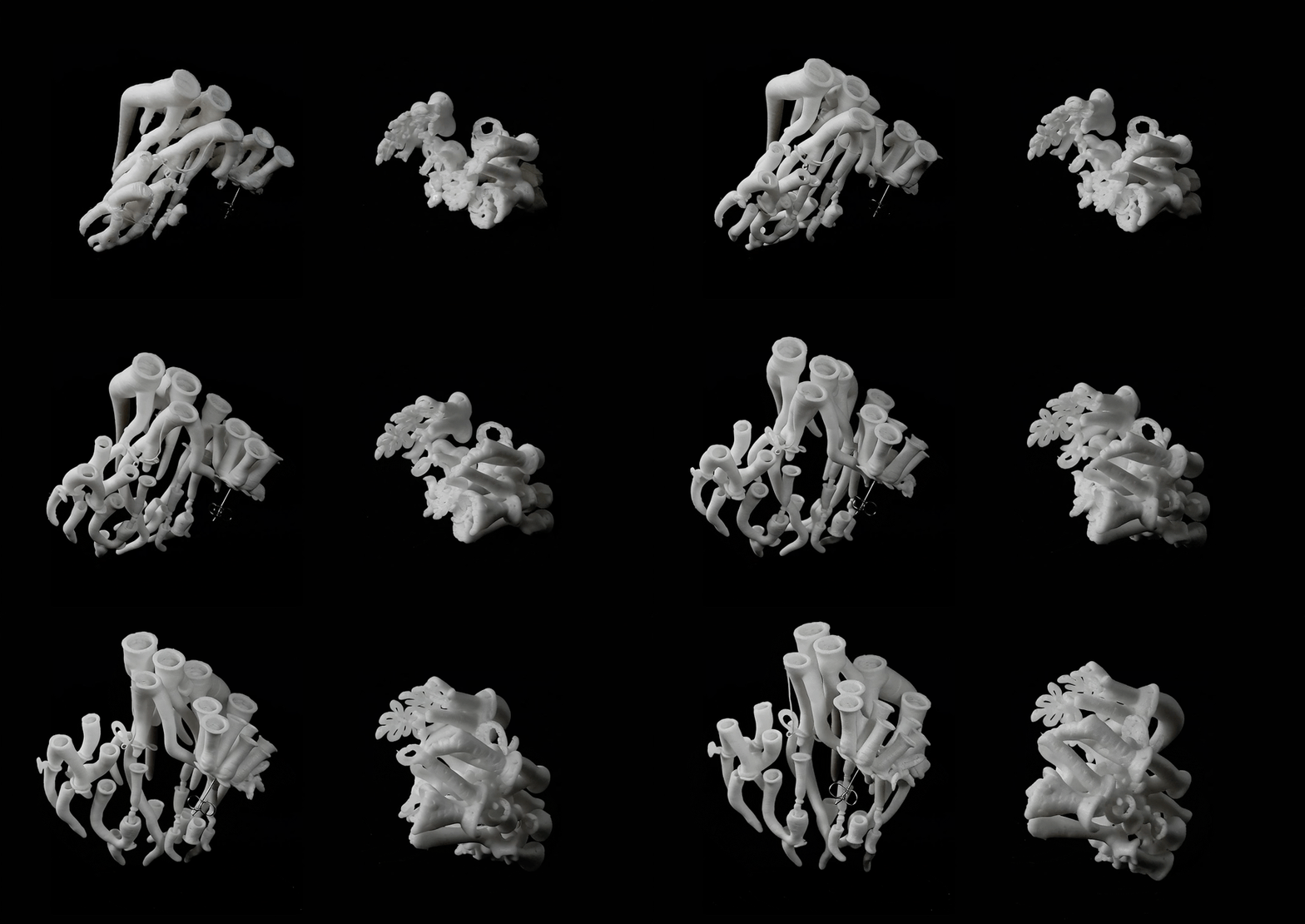
1.5 KUZNETS is a designer jewelry brand that works with the aesthetics of 3D printing and pop culture. The project is based on the idea of rethinking the value of form, where what is typically considered a technical waste or manufacturing error becomes a central visual and meaningful element.
In terms of communication, the brand acts as a sender of a message in which form functions as a sign, material as a carrier of meaning, and jewelry becomes a medium between the individual and the cultural context. Through its visual language, the brand conveys a desire for experimentation, instability, and a rejection of conventional aesthetic norms.
The project appeals to an audience that perceives jewelry not only as accessories, but as means of self-expression and identification.


The brand is especially attractive to visionaries who are willing to work with unconventional visual codes, unafraid to stand out and shape their own statement through appearance.
Communication is built not through direct statements, but through visual codes such as unique silhouettes, a sense of unfinished work, and the digital origin of form. These elements allow jewelry to be used as a means of visual statement and a gentle protest against standardized aesthetics.
The brand’s core values revolve around embracing instability and imperfection, interest in the technological origins of objects, understanding of individuality as a result of interpretation and rethinking traditional notions of beauty and value. The brand does not impose a fixed meaning, but creates a space for decoding and interpretation, where the viewer becomes an active participant in the communication process.
Presentation for a professional audience
For the professional design community, the project can be considered interesting as an example of the conscious application of communication theory in visual practice, as well as a groundbreaking statement about material, production method, and contemporary understanding of aesthetics. On a semiotic level, the jewelry’s forms function as signs of digital production.
The aesthetics of «waste», unnecessary and seemingly unremarkable details, are interpreted as a meaningful visual code expressing an unconventional approach, a protest against traditional forms, as well as immersion in the current cultural and historical context and attention to environmental issues.
The lack of polish, deliberate incompleteness, and non-ideal appearance are perceived as a conscious rejection of the classical jewelry canon and an acceptance of imperfection as an aesthetic value.
The project’s innovation is also evident at the level of design as a process. The use of 3D printing and the rethinking of by-products of manufacture allow the material to be viewed not as a constraint, but as a source of form. Color schemes and unique silhouettes emphasize the experimental nature of the objects and reinforce the sense of their digital origin. The production method becomes not a hidden stage, but rather part of the visual statement, increasing the project’s conceptual integrity.
On a sociocultural level, the brand reflects a shift toward the acceptance of hybrid and post-digital forms. 1.5 KUZNETS’s jewelry becomes a marker of belonging to a culture of experimentation and a critical attitude toward mass production, while the digital origin of the form is perceived as a value, not a defect.
The project demonstrates how visual language functions as a system of signs, and the designer acts not simply as a creator of form, but as a constructor of meanings and contexts, whereas innovative production methods and the exploration of incompleteness become key elements of communication.
Rationale Behind the Strategy: Theoretical Foundations and Practical Application
The project’s communications strategy was shaped by the key tenets of the course, which understand communication not as a one-way message transfer, but as a process and a dialogue.
The 1.5 KUZNETS brand is constructed as an evolving interaction between the designer, the object and the audience, in which meaning is not predetermined but rather formed through perception and interpretation.
This approach allows for the jewelry to be viewed not simply as a product, but as a means of communication and visual expression.
The project’s visual strategy consciously allows for multiple interpretations. Differences between how the message is encoded by the designer and how it is decoded by the viewer are not recognized as a mistake but rather become an important part of the concept. This perspective directly relates to the interpretive approach, in which meaning depends on the cultural, visual, and personal experiences of the audience.
1.5 KUZNETS jewelry does not strive to be unambiguous, obvious or «understandable for everyone»; on the contrary, it demands attention, engagement and an inner process of comprehension of the meaning.
The project draws on the semiotic and sociocultural traditions of communication theory. A semiotic approach allows one to consider the shape, material, color, and degree of completion of objects as signs that convey ideas of instability, a protest against perfection and a rejection of traditional aesthetic norms. A sociocultural approach, in turn, considers the context of digital production, mass visual culture, environmental concerns, and contemporary society, in which ideal, smooth, and flawless forms can be easily reproduced by algorithms, technology and artificial intelligence without human intervention.
In this context, working with production waste and intentional incompleteness becomes not only an aesthetic tool but also a communicative gesture. The project proposes contemplation of imperfection as an alternative to the obsessive pursuit of perfection. This statement is connected to a critique of overproduction, environmental issues, and consumer culture, as well as a desire to restore the value of uniqueness, manual intervention, and individual choice.


The brand’s communication is built as an emotional path. The viewer and potential customer goes from surprise and discomfort caused by the unconventional form to acceptance and recognition of the object’s value. This new sense which leads to leaving one’s comfort zone becomes an important part of the user experience. Jewelry functions as a tool of self-expression, allowing one to stand out from the crowd, make a statement and define one’s position through appearance.
The brand 1.5 KUZNETS creates a shared emotional and semantic space for an audience with similar values. These people want to be different, consciously choose unconventional forms, protest against uniformity and demonstrate their awareness of contemporary cultural and environmental issues. The brand’s communication strategies are not aimed at attraction of a mass audience, but at creating a sense of closeness and belonging to a community of people who share a similar perspective on aesthetics, technology and the value of imperfection.
Craig R. T. Communication Theory as a Field // Communication Theory. 1999. Vol. 9, No. 2. P. 119–161.
Carey J. W. Communication as Culture: Essays on Media and Society. London: Routledge, 1989.
Hall S. Encoding/Decoding // Hall S., Hobson D., Lowe A., Willis P. (eds.) Culture, Media, Language. London: Routledge, 1980. P. 128–138.
Littlejohn S. W., Foss K. A., Oetzel J. G. Theories of Human Communication. Long Grove, IL: Waveland Press, 2016.
Barnard M. Graphic Design as Communication. London: Routledge, 2005.
Kress G., Van Leeuwen T. Reading Images: The Grammar of Visual Design. 2nd ed. London: Routledge, 2006.
Frascara J. Communication Design: Principles, Methods, and Practice. New York: Allworth Press, 2004.
Buchanan R. Declaration by Design: Rhetoric, Argument, and Demonstration in Design Practice // Design Issues. 1989. Vol. 2, No. 1. P. 4–22.
Margolin V. Design Studies: Theory and Research in Graphic Design. New York: Allworth Press, 2010.
Barthes R. Mythologies. New York: Hill and Wang, 1972.
Project on HSE Design platform // HSE Design. URL: https://hsedesign.ru/project/dcadd6600d1b4e82bf12905e452d11d0 (accessed: 05.12.2025).
Student project on HSE Portfolio // HSE Portfolio. URL: https://portfolio.hse.ru/Project/225887 (accessed: 05.12.2025).
Artificial intelligence was used to generate models for demonstrating the jewelry, as well as for creating animated pictures. The model is based on Midjourney (link: https://www.midjourney.com/explore?tab=video_top).